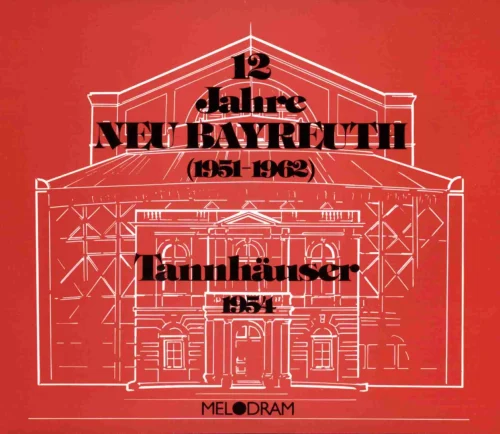
Joseph Keilberth / Orchester der Bayreuther Festspiele (Melodram)
Joseph Keilberth’s 1954 live reading of Tannhäuser from the Bayreuther Festspiele (hybrid version) is precise, incisive and always attentive to the theatrical aspects of the score, making it one of the finest conducted versions of the work in recorded history. As Tannhäuser, Ramón Vinay, a fantastic Heldentenor, does superbly. His beautiful, almost baritonal sound may show some slight strain in the higher reaches of the role, but his dramatic portrayal of the character and the journey he undergoes is excellently conveyed. The necessary contrast between Elisabeth and Venus is expressed almost to perfection: Gré Brouwenstijn’s Elisabeth is sweet, tender and delicate, while Hertha Wilfert’s Venus excels in seductive suggestion. The star of the show, perhaps, is Dietrich Fischer-Dieskau as Wolfram, a role that seems almost tailor-made for him, requiring both the beauty of tone of a Lieder singer and the ability to express himself in dramatic situations like an opera singer. Josef Greindl does very well as Landgrave Hermann, while the secondary roles are sung by artists of the highest quality, including Josef Traxel (Walther), Theo Adam (Reinmar) and Gerhard Stolze (Heinrich der Schreiber).
André Cluytens / Orchester der Bayreuther Festspiele (Orfeo)
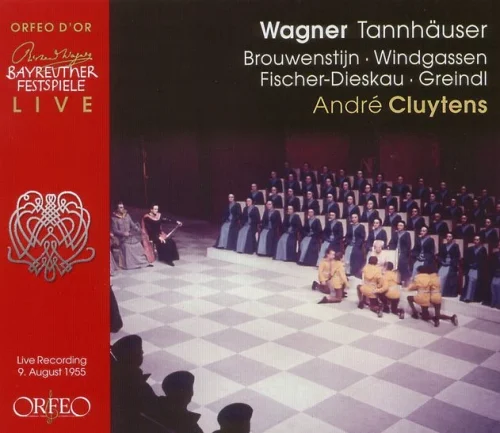
André Cluytens’s 1955 Bayreuth performance of Tannhäuser (Orfeo), in perfectly acceptable mono sound from the festival’s golden age, is one of the finest recordings of this opera. Cluytens uses the Dresden version, with the Venusberg music from Paris added. As Tannhäuser, Wolfgang Windgassen sounds considerably fresher than in his later interpretations. There is beauty, elegance, and power in the voice, making this one of the great portrayals of the role. Gré Brouwenstijn gives us a warm-hearted and human Elisabeth, Dietrich Fischer-Dieskau an incisive and poetic Wolfram, and Josef Greindl’s Hermann has majestic weight. Cluytens’s inspired reading is warmer and more sensual than many others, but also passionate and powerful.
Franz Konwitschny / Staatskapelle Berlin (Warner)
Franz Konwitschny was one of the great Wagner conductors of his generation, something that is clearly evident in his Tannhäuser from 1960 with the Staatskapelle Berlin on EMI/Warner, which also uses the original Dresden version. Konwitschny’s interpretation, in very fine sound, has a sure feeling for the work’s majestic structure. Vocally, the recording is one of the best. Hans Hopf is a powerful and steady Tannhäuser, though perhaps somewhat lacking in poetry. Elisabeth Grümmer sings Elisabeth. Her interpretation is one of the finest of all, with nuance, warmth, and beauty in the voice. Marianne Schech’s Venus is powerful, Dietrich Fischer-Dieskau again gives a nuanced and incisive Wolfram, and Fritz Wunderlich’s Walther is probably the finest on record, with a sensitive radiance in the portrayal.
Wolfgang Sawallisch / Orchester der Bayreuther Festspiele (Decca)
Wolfgang Sawallisch’s live recording for Philips/Decca from Bayreuth in 1962, in atmospheric stereo, is one of the freshest interpretations of the work. Sawallisch, who combines the Dresden and Paris versions, shows his greatness as a Wagner conductor here, with flexible tempos, a feeling for the lyrical side of the music, and a strong forward drive. Vocally, Wolfgang Windgassen is not on the same level here as he is under Cluytens, but the performance still has both great beauty and drama. Anja Silja gives a vocally lean and dramatic interpretation of Elisabeth, penetrating and personal. Grace Bumbry is a sensual, erotically charged, and dramatic Venus. The remaining roles are at the very highest level, with Josef Greindl again as Hermann.
Georg Solti / Wiener Philharmoniker (Decca)
Recorded in 1971 at the height of Decca’s Wagner series with Georg Solti (Paris version), this remains one of the most dramatic interpretations of Tannhäuser on record. Solti brings immense passion and power to the score, while still finding moments of sensitivity when needed. At just 34 years old, René Kollo delivers one of the finest Tannhäusers ever recorded, combining heroic strength with youthful lyricism in an intensely passionate performance that covers the role’s full vocal range with confidence. Christa Ludwig may not be the most seductive Venus, but she sings the role with great authority and control. Helga Dernesch offers a beautifully sung Elisabeth, with ringing high notes and a delicate middle and lower register, although the voice can sound pressed at times. Victor Braun, a singer not often heard on Wagner recordings, gives a convincing performance as Wolfram, even if he does not stand out among the rest of the cast.
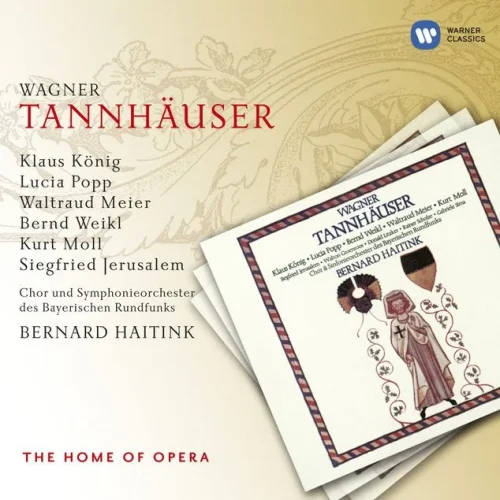
Bernard Haitink / Symphonieorchester des Bayerischen Rundfunks (Warner)
The main allure of this 1985 studio recording (Dresden version) is Bernard Haitink’s conducting of the work: introspective, full of detail and with an impressive sense of perception. He is always nuanced in the intimate character moments, yet never fails to grasp the scale of the grand scenes. Aided by the excellent orchestra and chorus of the Bayerischer Rundfunk, two of the highlights of this recording are the Prelude and the Pilgrims’ Chorus. The singers are not always up to par with the musical direction, though. Klaus König, while a singer with a robust voice capable of handling Wagnerian writing, has issues with phrasing and interpretation, while also lacking nuance in his dramatic portrayal. Waltraud Meier’s Venus, although often exhilarating on stage, is not as effective in an audio-only recording, as some of the less alluring qualities of her voice cannot be amended by the superb actress she is onstage. On the other hand, Lucia Popp’s Elisabeth, a role she never sang onstage, is magnificent. An impressively intelligent singer, she manages to bring something more to the character than merely being tender and frail, conveying instead a profound emotional involvement with the opera. Bernd Weikl is an outstanding Wolfram, while Kurt Moll manages to be one of the greatest Hermanns in recorded history. The sound quality of this set is excellent.
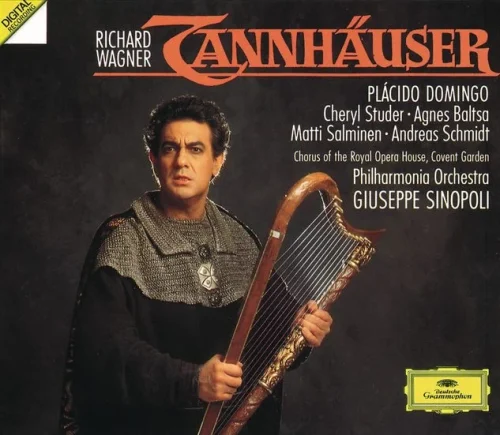
Giuseppe Sinopoli / Philharmonia Orchestra (Deutsche Grammophon)
Giuseppe Sinopoli’s 1989 recording with the Philharmonia Orchestra on Deutsche Grammophon (Paris version), in very dynamic sound, is one of the most skilfully conducted. Sinopoli, using somewhat slower tempos, gives an incisive interpretation: romantic, poetic, and highly dramatic, not least in the choral passages. Plácido Domingo as Tannhäuser was a controversial choice. The Spanish tenor’s German is far from idiomatic, and his lyrical interpretation lacks bite in the high notes, but Domingo’s softly rounded portrayal is still convincing overall. Elsewhere, the recording offers many fine vocal performances. Cheryl Studer’s Elisabeth is one of the most beautifully sung on record, Agnes Baltsa’s Venus has sensuality and drama in her expression, and Matti Salminen’s Hermann is shaped with both majestic power and warmth.
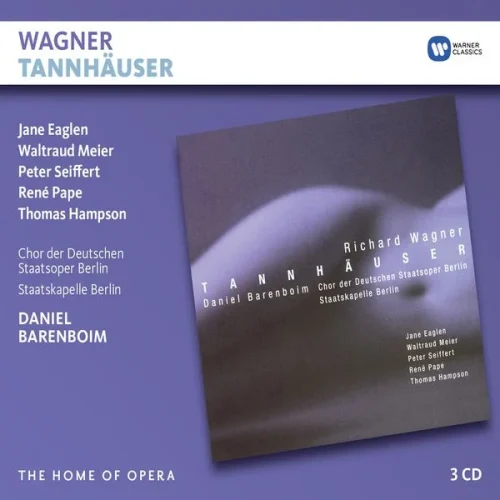
Daniel Barenboim / Staatskapelle Berlin (Warner)
Made in 2001 (hybrid version), this is probably the finest modern recording of the opera. Daniel Barenboim, one of the leading Wagner conductors of his generation, leads the Staatskapelle Berlin with complete command of the score, bringing out its nuances with transparent and delicate conducting. Peter Seiffert may not have the most dramatic voice for the title role, but his singing is focused, lyrical, and highly effective. Waltraud Meier is a charming, intoxicating, and deeply erotic Venus, while Jane Eaglen, though occasionally a little restrained as Elisabeth, has a voice that suits the role ideally. Thomas Hampson sings Wolfram beautifully, although it is quite clear that the role stretches his vocal resources.
Bonus
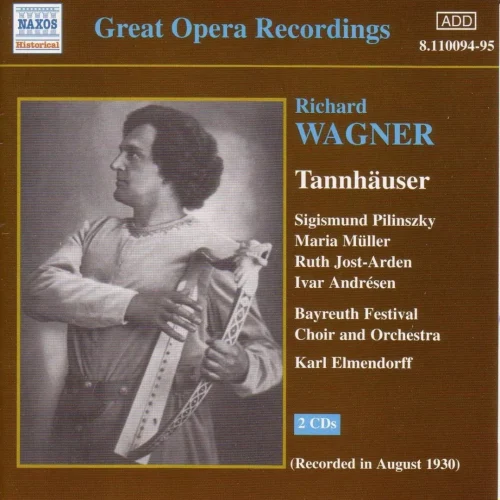
The 1930 Bayreuth recording (Paris version with cuts) conducted by Karl Elmendorff is an essential document for Wagner enthusiasts. The sound quality is poor by modern standards, with the limitations one would expect from an early recording. Beyond its historical importance, it preserves the Bayreuth performance tradition of the interwar years and offers a rare glimpse into Wagner singing and interpretation from that era.