Wagner’s Der Ring des Nibelungen is one of the greatest and most demanding works in the history of opera. First performed as a complete cycle at the opening of the Bayreuth Festival in 1876, it has since become a major artistic test for any opera house that takes it on. It is also one of the clearest examples of Wagner’s idea of the “Gesamtkunstwerk”, where music, drama, poetry, staging, and myth are brought together into one unified work of art.
Over the years, recording the Ring has also become an important project in itself. There are many great cycles available today: some in mono, some in stereo, some recorded live, and others made in the studio. Choosing between them is never simple, since a complete Ring lasts around fifteen hours and has to be judged across many different roles, orchestral details, dramatic choices, and recording conditions. Many modern recordings offer a very refined sound, but when it comes to pure drama, it is still hard to beat the Bayreuth cycles from the middle of the last century. In this article, we will look at ten of the most essential complete Ring cycles, without placing them in any particular order. We will only consider complete cycles here; separate articles on each of the four individual operas will follow later.
Rudolf Moralt / Wiener Symphoniker (Gebhardt Records)
Recorded during a radio performance in Vienna in 1949, this was one of the earliest complete recordings of Wagner’s Ring. Rudolf Moralt conducts the Wiener Symphoniker with a strong sense of momentum, keeping the drama moving from beginning to end. His pacing is one of the recording’s greatest strengths, making the nearly fifteen-hour journey feel much shorter than it really is. The sound is naturally limited by the recording technology of the time. The orchestra can sometimes sound distant and compressed, but the voices come across with surprising clarity, allowing the excellent cast to make a strong impression. Ferdinand Frantz is an authoritative Wotan, combining power with dignity throughout the cycle. Günther Treptow sings both Siegmund and Siegfried, bringing a warm, dark, expressive voice along with the dramatic strength and flexibility required for both demanding roles. Hilde Konetzni gives a passionate and emotionally charged Sieglinde, while Helen Braun offers a sensitive and lyrical Brünnhilde in Die Walküre. Gertrude Grob-Prandl takes over the role of Brünnhilde in Siegfried and Götterdämmerung. Her performance is firmly rooted in the old German Wagner tradition, with a large, dramatic voice and a commanding presence. Karl Kamann is a thoroughly sinister Hagen, delivering one of the highlights of Götterdämmerung.
Joseph Keilberth / Orchester der Bayreuther Festspiele (Andromeda)
Joseph Keilberth was one of the great Wagner conductors of his time. His death has become part of Wagner history: he collapsed while conducting Tristan und Isolde in Munich, during the same passage in Act II where Felix Mottl had also suffered a fatal collapse decades earlier. His 1952 Bayreuth Ring was already a remarkable achievement, but the 1953 cycle has an even sharper edge. The sound, despite capturing the electricity of live theatre, has the expected limits of a live recording from the early 1950s, but it is still very listenable. The orchestra comes through well enough, and Keilberth’s conducting has tremendous life. He keeps the drama moving with urgency, strength, and emotional force, without ever making the music feel rushed. There is a real sense of theatre throughout the whole cycle. Hans Hotter gives a dark, raw, and deeply individual Wotan. His performance is not polished in a conventional way, but it is full of character and authority. He is matched very well by Ira Malaniuk’s fierce and aggressive Fricka in Act II of Die Walküre, and by Maria von Ilosvay’s earthy, mysterious Erda in Siegfried. Josef Greindl is a brutal and brilliant Hunding, making the role sound genuinely threatening. Regina Resnik is a passionate Sieglinde, warm and intense, and she is ideally paired with Ramón Vinay’s powerful and expressive Siegmund. Vinay brings real weight to the role, but also plenty of feeling. Wolfgang Windgassen is in excellent form as Siegfried in the last two parts. This is one of his finest accounts of one of his signature roles, sung with youthful energy, lyrical strength, and dramatic confidence. The greatest reason to hear this cycle, though, is Martha Mödl’s Brünnhilde. This may be her finest Brünnhilde on record. She combines tenderness and intensity in a way few singers have managed, giving the character both heroic force and human vulnerability. The voice has warmth, pain, nobility, and fire, and her high notes are remarkably secure and clean here.
Clemens Krauss / Orchester der Bayreuther Festspiele (Orfeo)
Clemens Krauss’s 1953 Bayreuth Ring is one of the monumental Ring cycles of its era, and it has the electricity of a live Bayreuth performance at the highest level. Krauss drives the music forward with extraordinary energy. His reading is sharp, urgent, and often almost explosive, keeping the listener fully involved from beginning to end. The cast is one of the main reasons this cycle has such a strong reputation. Hans Hotter gives a tremendous Wotan, full of expression, intelligence, and tragic weight. Ramón Vinay brings a dark-coloured, warm voice to Siegmund, giving the role both strength and feeling, while Regina Resnik is a touching and vulnerable Sieglinde. Wolfgang Windgassen is a youthful and bright Siegfried, with a penetrating tenor and a natural dramatic instinct. At the centre of the cycle stands Astrid Varnay’s Brünnhilde. Her soprano has a powerful, metallic edge, but it is not just a display of force. She also brings sensitivity, warmth, and emotional depth to the role.
Wilhelm Furtwängler / Orchestra Sinfonica di Roma della RAI (Warner)
Wilhelm Furtwängler left behind two complete live recordings of the Ring on record: one from La Scala in Milan in 1950, and one from Rome in 1952, performed in concert. Choosing between them is not easy. The Milan recording has more spontaneity and drama, while the Rome interpretation is more reflective and analytical. In the end, the choice still falls on the Rome recording with the Italian Radio Orchestra, released much later by EMI, now Warner. The sound is much better here, and the vocal interpretation is perhaps a little more even in quality, even if Kirsten Flagstad’s Brünnhilde and Set Svanholm’s Siegfried are something very special in the La Scala Ring. In Rome, Brünnhilde is sung by the legendary and deeply penetrating soprano Martha Mödl, who interprets the role with psychological insight, even if there are some vocal flaws on the technical side. Ludwig Suthaus’s Siegfried has a baritonal colour, and is a mature and carefully thought-out interpretation, even if the voice lacks a little edge. Wotan is sung by Ferdinand Frantz, who gives a technically secure and well-sung performance. Overall, the vocal performances are at a very high level. Furtwängler’s interpretation, with plenty of rehearsal time and with only one act performed each day before the audience in Rome, is brooding and “mythic” in character, with overwhelming drama at the climaxes. In terms of sound, the performance leaves something to be desired, but Warner’s latest remastering has greatly increased the clarity and dynamic range.
Joseph Keilberth / Orchester der Bayreuther Festspiele (Testament)
Testament’s stereo release of Josef Keilberth’s Ring from Bayreuth in 1955 was something of a sensation when it finally appeared in 2006. For reasons including contractual issues, the recording had remained in Decca’s archives for several decades before it was eventually released. Here we can hear the whole legendary 1950s Bayreuth cast in stereo and in very good sound quality, which makes this box set a truly unique document. Astrid Varnay’s Brünnhilde shines more than ever, as do Hans Hotter’s monumental Wotan and Wolfgang Windgassen’s beautifully sung and dramatic Siegfried. Josef Keilberth’s interpretation is as fresh and charged as on his other recordings, and more modern in sound than, for example, Knappertsbusch’s.
Hans Knappertsbusch / Orchester der Bayreuther Festspiele (Orfeo)
Three complete recordings of the Ring with Hans Knappertsbusch have survived. All three have very great merits and are essential for the true Wagner enthusiast. The one chosen here is the 1956 recording, released by Orfeo. It has the best sound of the three and, overall, a very convincing cast, although Jon Vickers’s and Leonie Rysanek’s performances in the 1958 Die Walküre should also be taken into account. In the 1956 Ring, Wolfgang Windgassen is still in very good form as Siegfried, Astrid Varnay’s laser-sharp Brünnhilde is as unforgettable as she is with Krauss and Keilberth, and Hans Hotter’s dark, philosophical Wotan still has power in the voice. The standard in the other roles is also of the very highest class in almost every part, especially Gustav Neidlinger’s powerful Alberich and Josef Greindl’s monumental Hagen. Knappertsbusch’s interpretation also has a unique epic breadth. He is slower and heavier in his reading than Krauss and Keilberth, but he gives the singers time to articulate and to carve out the depth of their roles. His interpretation also has a powerful and convincing sense of the whole that few other Wagner conductors can match.
Georg Solti / Wiener Philharmoniker (Decca)
Few recording projects have meant as much to the history of classical music as Georg Solti’s legendary Decca Ring cycle from the 1960s. It was the first complete studio recording of the Ring, and it set a new standard for what a large-scale opera recording could be. Decca’s original sound was already spectacular for its time, and the cycle has only gained in impact through later remasterings. The orchestral detail, the stage effects, and the sheer scale of the sound still make a powerful impression. Solti’s conducting is the main reason to hear this Ring. His handling of the score is extremely impressive, combining energy, precision, and dramatic force. He brings out the theatrical power of the music and maximises the great climaxes, but he does not lose clarity or sensitivity. The Vienna Philharmonic plays with brilliance, weight, and colour throughout. Vocally, the cycle may not have the same overall level as the legendary Bayreuth recordings from the 1950s, but there are still many remarkable performances. Das Rheingold brings together major Wagner singers of an older generation: Set Svanholm as Loge, Kirsten Flagstad as Fricka, and George London as a commanding Wotan. In the last three parts, Birgit Nilsson is the central vocal presence. Her steel-edged Brünnhilde cuts through the orchestra with astonishing power and security, yet she also brings nobility and feeling to the role. Wolfgang Windgassen’s Siegfried, in the final two operas, sounds more mature and masculine than in his early Bayreuth years. He may have lost some youthful freshness, but he gains authority and experience. Hans Hotter was clearly past his vocal prime by the time of these sessions, but he still gives a wise and thoughtful Wotan and Wanderer in Die Walküre and Siegfried. The voice may no longer be at its freshest, but the interpretation remains deeply musical and full of understanding.
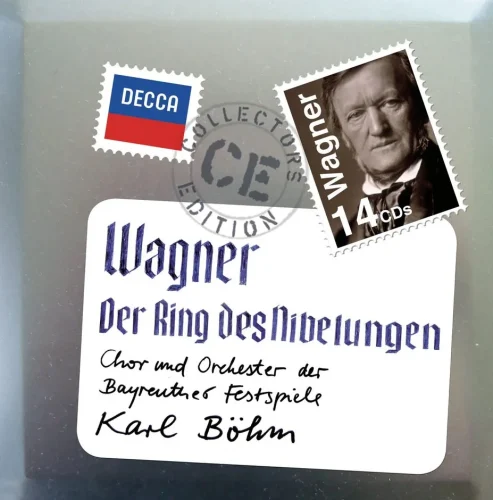
Karl Böhm / Orchester der Bayreuther Festspiele (Decca)
Karl Böhm’s Ring was recorded live at the Bayreuth Festival in 1966 and 1967 by Philips, now Decca, and it also has a very impressive sound. Although the orchestral interpretation does not have the same brilliance as Solti’s or Karajan’s, Böhm’s performance has wonderful drive and spontaneity, helped by his faster tempi. There is a sense of tension in the performance that keeps the music alive and moves the drama forward. Vocally, it is at a very high level. Birgit Nilsson’s Brünnhilde stands out in particular as one of the finest performances of this role, with both sensitivity and power in her interpretation, and she is far more intense here than with Solti. Wolfgang Windgassen’s Siegfried sounds much more worn than in the Bayreuth recordings from the 1950s, but there is still both beauty and heroism in his singing. The rest of the cast is also of very high quality, especially Leonie Rysanek’s passionate Sieglinde, Theo Adam’s brooding Wotan, and Gustav Neidlinger’s demonic Alberich.
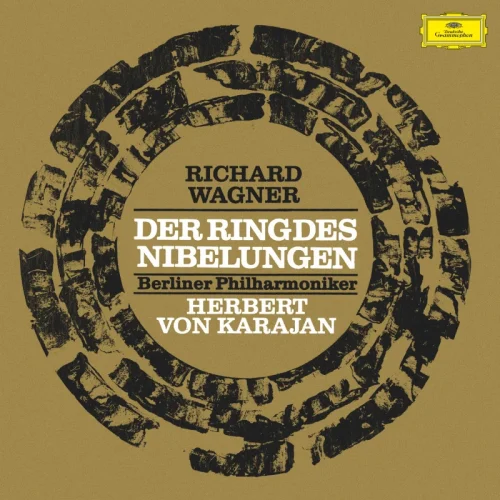
Herbert von Karajan / Berliner Philharmoniker (Deutsche Grammophon)
Herbert von Karajan’s Ring with the Berlin Philharmonic was recorded in the studio between 1966 and 1970 for Deutsche Grammophon. Over the course of the cycle, Karajan chose to use different singers in some roles. For example, Wotan is sung by Dietrich Fischer-Dieskau in Das Rheingold, while Thomas Stewart takes the role in Die Walküre and Siegfried. Brünnhilde is also split between Régine Crespin in Die Walküre and Helga Dernesch in Siegfried and Götterdämmerung, while Siegfried is sung by Jess Thomas in Siegfried and Helge Brilioth in Götterdämmerung. This has a partly negative effect on the continuity of the interpretation, but many of the vocal performances are still at a very high level. Gundula Janowitz’s Sieglinde and Jon Vickers’s Siegmund should also be mentioned, as they bring a special radiance and fire to Karajan’s Die Walküre. The main strength of the recording lies in Karajan’s poetic, shimmering, and majestic interpretation. The Berlin Philharmonic also plays with an elegance that hardly any other ensemble has matched on record in the Ring.
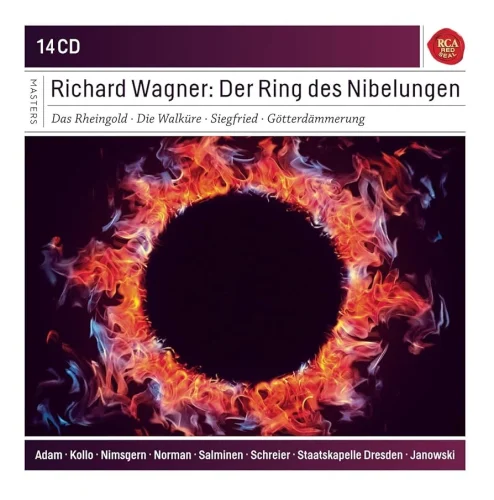
Marek Janowski / Staatskapelle Dresden (RCA)
One of the finest later Ring cycles is Marek Janowski’s recording with the Staatskapelle Dresden from the 1980s. It does not try to overwhelm the listener with constant force. Instead, Janowski gives the music space to breathe. His interpretation is delicate, passionate, and very carefully shaped, with a strong balance between drama and reflection. The cycle also seems to grow as it goes on. Theo Adam’s Wotan is one of the most distinctive parts of the set. His voice and style are very personal: expressive, dominant, and full of character. He shows the development of Wotan across the cycle very clearly, from ruler and manipulator to a more wounded and reflective figure. Compared with the rawer and harsher Wotans of Hans Hotter, Adam feels more human and down to earth. Siegfried Jerusalem is a determined and expressive Siegmund. He does not rely on sheer vocal power, but he gives the role urgency, warmth, and feeling. Jessye Norman is a deeply human Sieglinde, sung with warmth, passion, and a noble sense of line. Their scenes together have real tenderness. Jeannine Altmeyer’s Brünnhilde is beautifully sung, delicate, and full of feeling. She may not have the huge vocal volume of the great Bayreuth heroines such as Mödl, Varnay, or Nilsson, her Brünnhilde is more lyrical than volcanic, but that is also part of the appeal. René Kollo brings maturity rather than youthful wildness to Siegfried. His singing has clarity, shine, and style, and he gives the character a more thoughtful quality than some other tenors. It is a beautifully sung interpretation, even if it is not the most boyish or reckless Siegfried on record.
Bonus
The 1951 Met Ring cycle under Fritz Stiedry is a historic document with a truly legendary cast, including Astrid Varnay, Kirsten Flagstad, Hans Hotter, Günther Treptow, Helen Traubel, Ferdinand Frantz and Set Svanholm. The audio quality is poor, and that may make it hard to enjoy for casual listeners. Still, the importance of the performance is clear from the first moments. For serious Wagner collectors and lovers of opera history, this is a recording well worth hearing.