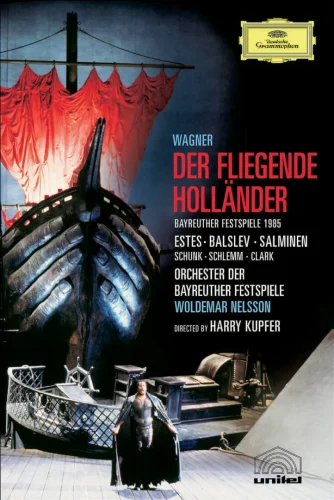
Der fliegende Holländer is widely regarded as Wagner’s first true mature opera, even though it was his fourth, after Die Feen, Das Liebesverbot and Rienzi. Wagner himself, and later Cosima, effectively treated it as such, which is why it long stood as the first work of the so-called Bayreuth canon, until the inclusion of Rienzi in 2026. Holländer also marks Wagner’s first truly successful use of the leitmotif technique, as well as other innovations, such as the blurring of the line between recitative and aria, that make it hard to believe it is a contemporary of Italian belcanto or French grand opéra.
As with every Wagner opera, the Bayreuther Festspiele is an indispensable source of magnificent Holländer recordings and, together with the many studio versions, has left the work exceptionally well served on disc. Many great bass-baritones have sought to leave their mark in one of the most supernatural leading roles in opera, the Holländer, while just as many dramatic sopranos have sought to distinguish themselves in the very difficult role of Senta. Without further ado, in this article I will cover ten essential recordings of Wagner’s Der fliegende Holländer, in no particular order.
Christoph von Dohnányi / Wiener Philharmoniker (Decca)
We begin this article with Christoph von Dohnányi’s 1991 recording. It is a highly analytical and intellectual reading that perhaps lacks some of the otherworldly or romantic qualities found in other versions to be discussed later, but is nonetheless a recording of considerable interest. The magnificent sound of the Wiener Philharmoniker is an added bonus. Robert Hale delivers a technically secure and decently compelling interpretation of the Holländer, though he lacks that supernatural quality that so many singers also fail to convey. Hildegard Behrens, on the other hand, offers a Senta of great psychological and emotional involvement, though her fiery temperament at times causes her to lose focus. Josef Protschka’s Erik is excellently sung, with an appropriate lyricism that so many others who attempt the role lack, while Kurt Rydl’s Daland is mostly solid without doing anything especially notable.
Wolfgang Sawallisch / Orchester der Bayreuther Festspiele (Decca)
Of the many Holländer recordings left by the German conductor Wolfgang Sawallisch, this 1961 Bayreuth performance is perhaps the finest. Sawallisch leads the orchestra in a highly impetuous way and with considerable intensity, at times sacrificing some of the score’s nuance and subtlety, but delivering an exhilarating reading nonetheless. Franz Crass, in what is perhaps his finest recording, is a brilliant Holländer. The natural dark tints of his voice make him ideal for the ghastly and otherworldly title role. As Senta, Anja Silja matches the recording perfectly, her vigorous interpretation borders on the neurotic, to the point that it can at times sound somewhat rough. Josef Greindl’s Daland is mostly well sung and characterized, though there are some sinister moments woven into the portrayal that can occasionally misrepresent the character. Fritz Uhl delivers a solid Erik, impassioned and well matched to Silja’s Senta.
Otto Klemperer / Philharmonia Orchestra (EMI/Warner)
Otto Klemperer’s only recording of a Wagner opera would be this 1968 Holländer. With the Philharmonia Orchestra, the German conductor delivers, as always, a highly intellectual reading of the work, immersing himself in the complex psychology of the two tormented protagonists and giving the listener a thoroughly absorbing experience throughout. Theo Adam, as the Holländer, overcomes some of his vocal shortcomings, such as his occasional wobble, through sheer force of acting and interpretation, possibly helped by the conductor’s approach, and ultimately delivers a respectable portrayal of the character. Anja Silja’s Senta is somewhat more restrained here than with Sawallisch, though she still overplays the role a little. Martti Talvela is the highlight of the cast, a superb Daland, while Ernst Kozub is a compelling Erik, but the cast is not always on the same level as the conductor.
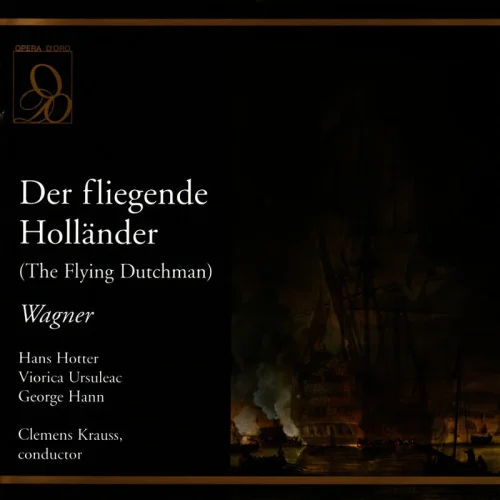
Clemens Krauss / Orchester der Bayerische Staatsoper (Opera D’Oro)
This 1944 radio recording from the Bayerische Staatsoper has rightfully been hailed as legendary ever since its release for two main reasons. The first is Clemens Krauss’s musical direction, full of lyricism and richness without adding any unnecessary weight to the score. Dramatically, every scene is conveyed fantastically, from the wave-like music of the overture to Senta’s salvation at the end of the opera, and everything in between. The second is a 35-year-old Hans Hotter in his prime, delivering the finest interpretation of the Holländer in recorded history: tragic and otherworldly, endowed with a dark and potent voice, yet never sacrificing the phrasing and nobility of the role. The rest of the cast is mostly up to par, especially Georg Hann as Daland. However, Viorica Ursuleac, a fine soprano most of the time, has intonation issues that inevitably mar the performance. For its era, the sound quality is quite good.
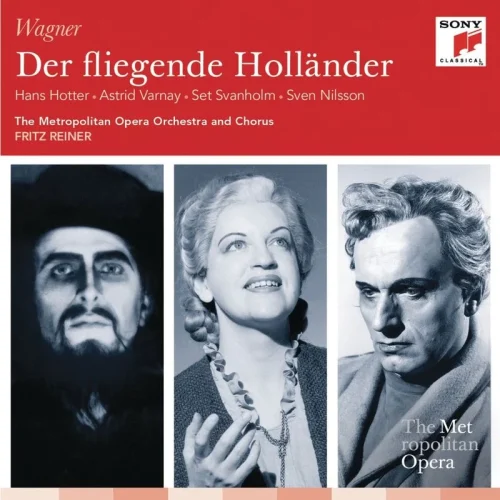
Fritz Reiner / Metropolitan Opera Orchestra (Sony)
Fritz Reiner conducts this 1950 performance from the old Metropolitan Opera with remarkable sharpness and understanding of the work. It was in this production that Hans Hotter made his Met debut, reprising with great authority his portrayal of the Holländer from six years earlier, perhaps with a voice somewhat less youthful, but with even greater theatrical and emotional involvement. A young Astrid Varnay makes her first recorded appearance as Senta here, fresh of voice and deeply committed dramatically, although it is clear that she still lacks some of the nuance she would acquire in later recordings and that would make her one of the great Sentas on disc. Opposite her, Set Svanholm delivers a superb Erik, a true Heldentenor who moves through the role compellingly and with ease. Sven Nilsson does well as Daland, though he does not approach the level of the other three principals. The poor sound quality is, of course, an evident drawback of this recording.
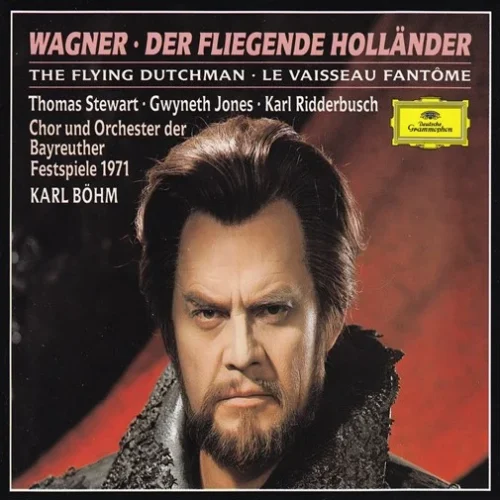
Karl Böhm / Orchester der Bayreuther Festspiele (Deutsche Grammophon)
This 1971 live recording from the Bayreuther Festspiele is thoroughly shaped by Karl Böhm’s musical direction. He is present and in control throughout, delivering a beautifully light, poised and elegant reading that avoids both the temptation to become excessively raucous and the opposite danger of turning overly intellectual to the point of boredom. The soloists can best be described as an ensemble cast, in the sense that they are not individually dazzling, but under Böhm’s guidance and through their chemistry with one another they become more than the sum of their parts. Thomas Stewart’s Holländer, though a little strained at the top, is compelling and vocally agile, while Gwyneth Jones’s voice sounds wobbly at times, especially in the upper register, but her characterization of Senta is superb. Karl Ridderbusch is a magnificent Daland, his velvety voice perfectly suits the role and, with Böhm’s help, never pushes into exaggeration, while Hermin Esser as Erik barely makes it through the role.
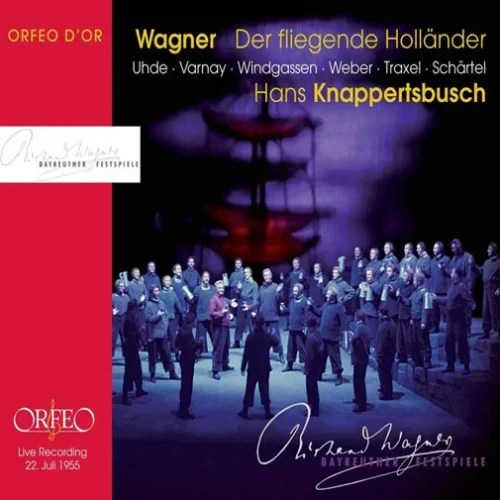
Hans Knappertsbusch / Orchester der Bayreuther Festspiele (Orfeo)
From the Bayreuther Festspiele, this 1955 recording is superbly conducted by Hans Knappertsbusch, characterized, as is always the case with the German conductor, by slow and ample tempi. The descriptive nature of the score —the winds, the sea, the sailors and everything else— is perfectly conveyed by Knappertsbusch on the podium, never at the expense of its otherworldly atmosphere. Astrid Varnay is perhaps the finest Senta in the discography, not only vocally but interpretively as well. The disturbed, dramatically involved, almost twitchy Senta comes to life in this performance in a way that no other version quite matches. As the Holländer, Hermann Uhde, despite certain vocal shortcomings, most notably a strained upper register, matches Varnay’s Senta dramatically, making every scene between them exhilarating. Ludwig Weber does well as Daland, but among the rest of the cast, the main attraction is Wolfgang Windgassen, the finest Erik in recorded history.
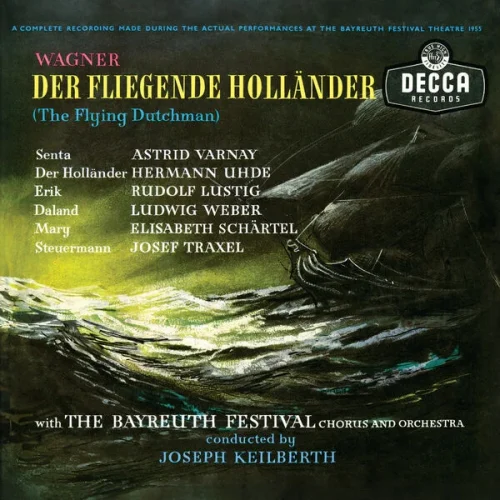
Joseph Keilberth / Orchester der Bayreuther Festspiele (Decca)
From the same year as the previously discussed Knappertsbusch recording, and with almost the same cast, this performance finds Joseph Keilberth —who around that time also led one of the greatest live Ring cycles on record— conducting the work in a very different manner from Knappertsbusch. More direct and more controlled, certainly, if at the expense of some of Knappertsbusch’s atmosphere and tragic weight, but ultimately a much more polished and dramatically effective account of the work. Uhde, Varnay and Weber reprise the roles they had performed so well under Knappertsbusch, but there is one major downgrade: Rudolf Lustig is Erik here and does not hold a candle to Windgassen. The great advantage of the Keilberth set, however, is its superior sound quality. Ultimately, these two recordings offer the rare chance to hear the same work, with nearly identical casts, through two very different conducting minds, each with an equally valid but distinct vision, so that each listener may decide where his preference lies.
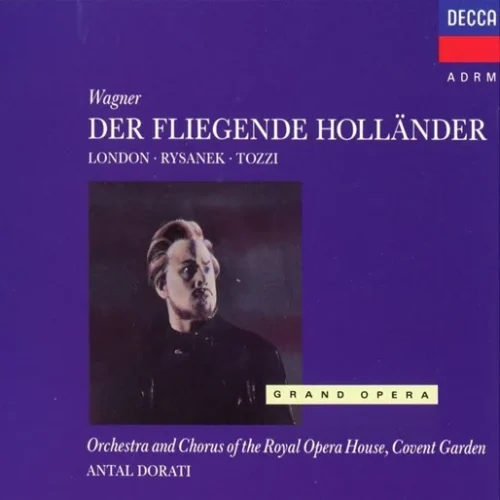
Antal Doráti / Orchestra of the Royal Opera House, Covent Garden (Decca)
This 1960 studio recording is superbly conducted by Antal Doráti, in a manner not unlike Clemens Krauss, with remarkable musicality and lyricism. George London is a thrilling Holländer, the role fitting his dark, imposing voice perfectly, even if his singing can at times lack nuance. Leonie Rysanek, always deeply involved in her characterizations, embodies a superb Senta. Although intonation was always something of an issue for her, the way she brings Senta to life is almost unmatched. Innocent youth, desperate longing and everything in between are sung with exceptional mastery. Giorgio Tozzi and Karl Liebl, without doing anything extraordinary, acquit themselves well as Daland and Erik. The sound quality in this set is fantastic, and the use of stereo is especially clever, as in the ‘confrontation’ between the two crews in the third act. This is Decca sound at its peak.
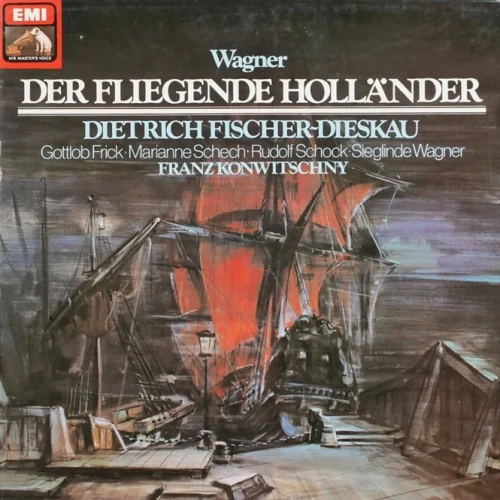
Franz Konwitschny / Staatskapelle Berlin (EMI/Warner, also on Brilliant Classics)
A controversial recording from 1959, to be sure, though not necessarily because of the musical direction. The always underrated Franz Konwitschny conducts the work thrillingly and excitingly, at times even to the extent of occasionally brushing past some of the score’s more intricate details. The real controversy lies in the choice of Dietrich Fischer-Dieskau as the Holländer, which may be an immediate turn-off for some listeners. As a lifelong admirer of his work, I will be the first to admit that his elegant voice does not naturally possess the bass-baritone weight the role demands. Yet, as with every role he sang, the characterization is masterfully realized: the spectral and supernatural, the psychological and the tormented aspects of the part are highlighted in a way that most singers simply cannot match and for that reason alone, it is worth hearing. As for the rest of the cast, Marianne Schech delivers a youthful Senta, if a somewhat rushed one, Gottlob Frick is a magnificent Daland and Rudolf Schock a superb Erik. As a bonus, Fritz Wunderlich delivers the finest Steuermann on record.
Bonus
Woldemar Nelsson / Orchester der Bayreuther Festspiele (Deutsche Grammophon, on DVD)
Harry Kupfer’s Bayreuth production of Der fliegende Holländer is preserved in this 1985 video recording, in which the central focus is Senta’s obsession with the Holländer, emphasized by the fact that she is almost constantly seen holding a portrait of him. It is an excellent way to experience Wagner’s first masterpiece, with a very capable cast consisting of Simon Estes, Lisbeth Balslev, Matti Salminen and Robert Schunk, all competently conducted by Woldemar Nelsson.