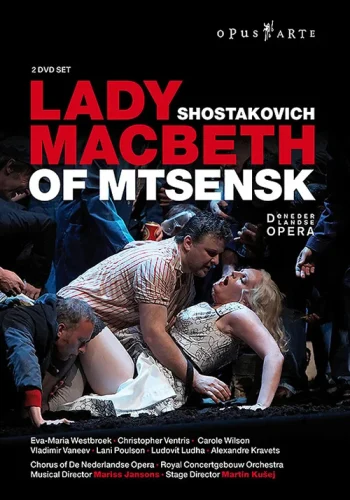
It’s never a good sign when the leader of the country leaves your performance in a huff. In January 1936, Joseph Stalin attended a performance of Dmitri Shostakovich’s Lady Macbeth of the Mtsensk District at the Bolshoi Theatre, walked out before the final act, and two days later Pravda published the unsigned editorial “Muddle Instead of Music.” The opera, which had triumphed with well over a hundred Soviet performances in just two years and enjoyed international acclaim, was condemned as formalist cacophony. Its raw sexual content was labeled pornographic, and its satirical elements were attacked as anti-Soviet. Beyond the music itself, the assault served as a blunt political warning to all Soviet artists: “This game may end very badly.” Shostakovich lived in genuine fear for years afterward, famously keeping a packed suitcase by his door in case the secret police arrived at night.
Katerina Izmailova is trapped in a stifling provincial merchant household with an impotent husband and a sadistic, lecherous father-in-law. She takes a lover and descends into murder. Shostakovich’s score fuses verismo passion with expressionist brutality, grotesque satire with moments of real tragic weight. The final act, set in a Siberian prison convoy, reaches devastating pathos. Shostakovich later produced a sanitized revision titled Katerina Izmailova (Op. 114), which removes much of the graphic sexuality and softens the orchestral extremes. While the revision clarifies some textures, it dramatically neuters the work’s most incendiary power. The original 1932 version (premiered in 1934) remains dramatically superior and is the preferred choice for most listeners today. Perhaps not quite overflowing with riches when it comes to recordings, but the available options provide everything needed to explore one of the 20th century’s most powerful and provocative operas.
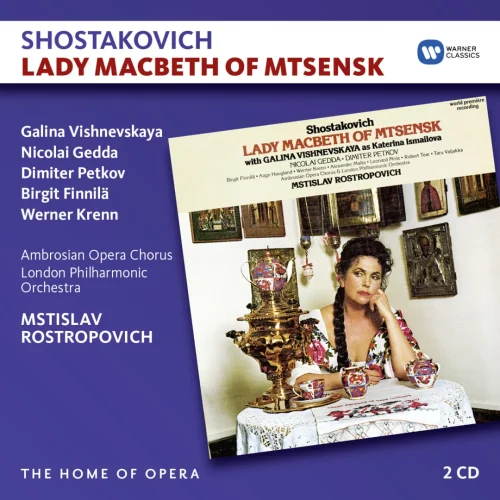
Mstislav Rostropovich / London Philharmonic Orchestra (Warner)
This remains the recording against which all others are measured. Mstislav Rostropovich, Shostakovich’s close student and friend, conducts with ferocious authority and deep personal insight. Galina Vishnevskaya, his wife and the composer’s preferred interpreter for the role, delivers a Katerina of extraordinary range and intensity: vulnerable in her loneliness, ecstatic in passion, savage in her crimes, and utterly devastated in the final despair. Though Vishnevskaya was somewhat past her vocal prime by the late 1970s, her performance carries the lived weight of a woman who understood the opera almost autobiographically — as a political as well as personal statement. Nicolai Gedda brings virile charisma to the selfish lover Sergei, while Dimiter Petkov is a monstrous Boris. The strong supporting cast includes Robert Tear as the Shabby Peasant and Aage Haugland as the Police Sergeant. Recorded at Abbey Road Studio One in London, this was the first widely available, uncut studio recording of the original 1932 version — made in the West because such raw honesty with the unexpurgated text would have been impossible in the USSR at the time. The 1979 sound has hall warmth and presence. Nearly every subsequent recording defines itself in relation to this landmark set. If you only own one, start here.
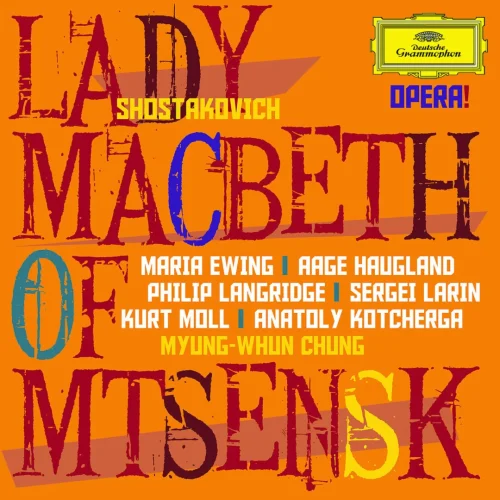
Myung-whun Chung / Orchestre de l’Opéra national de Paris (Deutsche Grammophon)
The strongest alternative to the Rostropovich. Myung-Whun Chung brings intelligence and controlled passion, treating the score as both grand symphony and taut drama. Dating from 1993, the Bastille orchestra delivers overwhelming force, and Chung shapes the interludes with greater structural clarity than most, while the brass bites harder in the satirical passages. Maria Ewing’s Katerina divides opinion sharply: her vocal mannerisms can feel overacted, with whining and swooping that border on cabaret or jazz inflections — inappropriate to some ears. Yet her feverish intensity suits this obsessive, destructive heroine, conveying raw drive even if it lacks Vishnevskaya’s deeper tragic reckoning. Aage Haugland returns as a sonorous, tyrannical Boris; Philip Langridge is convincingly spineless as Zinovy; Sergei Larin is involved as Sergei; and Kurt Moll’s brief appearance as the Old Convict is a masterclass in scene-stealing economy. For listeners who want more orchestral transparency and a slightly cooler dramatic temperature than the 1979 set, this 1993 recording is an excellent choice.
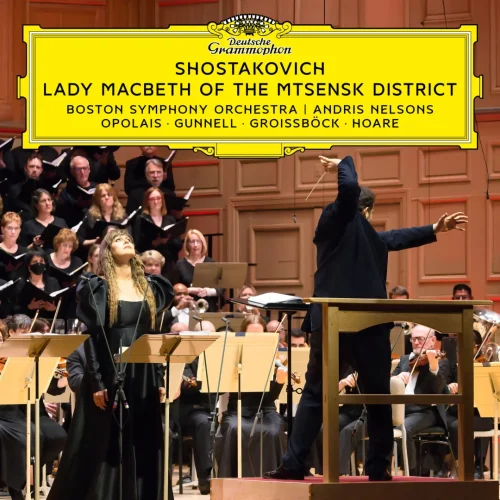
Andris Nelsons / Boston Symphony Orchestra (Deutsche Grammophon)
The most recent major release, issued in March 2025 as the culmination of Andris Nelsons’ decade-long Shostakovich cycle with the BSO. Kristine Opolais brings a fresh, vocally secure and dramatically convincing Katerina — younger and more naïve in her desires than Vishnevskaya’s seasoned portrayal, which makes the final act’s annihilation hit with a different, quieter devastation. Brenden Gunnell is a solid Sergei, and Günther Groissböck provides firm bass authority as Boris. The Tanglewood Festival Chorus adds weight to the ensembles. The modern engineering captures every strand of Shostakovich’s dense orchestration with impressive clarity. However, Nelsons sometimes luxuriates in sonic beauty and Mahlerian expansion where the score demands sharper bite and dramatic urgency — the performance runs roughly 20 minutes longer than the classic versions. This is the go-to contemporary option for those who find the older recordings sonically dated, but it does not yet displace the interpretive power of Rostropovich or Chung.
Gennady Rozhdestvensky / Orchestra of the Stanislavsky and Nemirovich-Danchenko Musical Theatre (Melodiya)
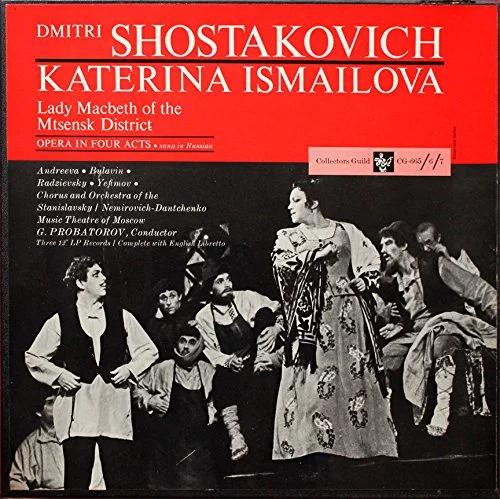
The most important recording of the revised Katerina Izmailova (Op. 114). Made with the forces of the Stanislavsky and Nemirovich-Danchenko Musical Theatre shortly after the revision’s Moscow performances in 1964, this captures Shostakovich’s own adjustments in context. Eleonora Andreeva sings Katerina with genuine dramatic commitment, yet the sanitized version noticeably smooths edges: the bedroom scene loses its graphic charge, and the interludes lose much of their satirical bite. It reveals exactly what the composer felt compelled to sacrifice to bring the opera back to the stage during the post-Stalin thaw. The sound is thin and compressed by today’s standards. This version is essential for historical completeness and for hearing both editions side by side, but most listeners will prefer the uncut original for its full dramatic and musical impact.
Bonus