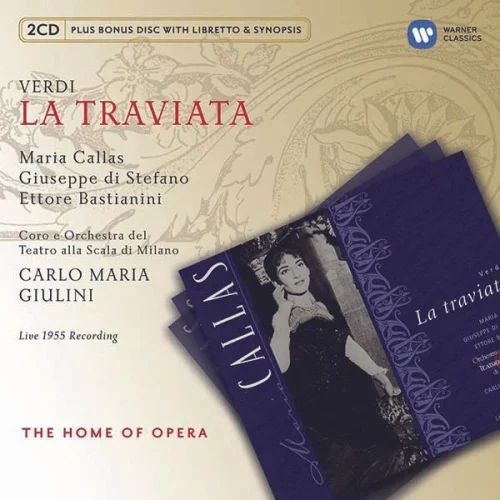
Carlo Maria Giulini / Orchestra del Teatro alla Scala (Warner)
Maria Callas left several outstanding recordings of Violetta: the early Mexico City performance (Myto), the Lisbon version (Warner) with a great cast including Alfredo Kraus and Mario Sereni, and the Covent Garden recording (ICA Classics), which offers the best sound quality. All deserve their place, but since I should highlight other great sopranos who mastered the role and choose only one featuring Callas, I would go for the 1955 live recording from Teatro alla Scala under Carlo Maria Giulini (Warner). Callas delivers the full emotional range of the role — beauty, intensity, and desperation. Giuseppe Di Stefano sings one of the finest Alfredos on record, with his expressive and elegant tenor, while Ettore Bastianini completes the remarkable cast with a firm, commanding Germont.
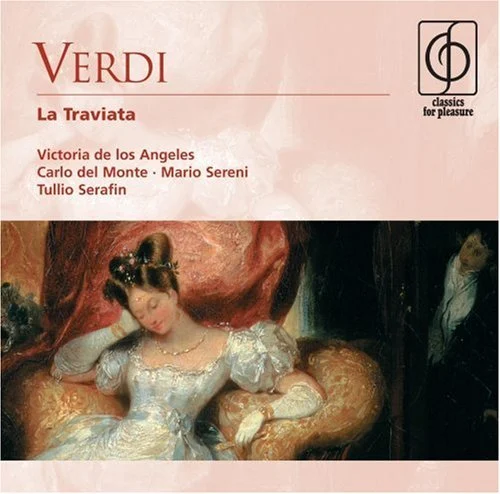
Tullio Serafin / Orchestra del Teatro dell’Opera di Roma (Warner)
The Italian master Tullio Serafin left several recordings of La traviata (his first featuring Renata Tebaldi as Violetta). Among them, the 1958 studio version with Victoria de los Ángeles stands out. Her voice combines warmth and clarity in the leading role, even if her portrayal isn’t the most virtuosic. The lesser-known Carlo del Monte delivers a solid Alfredo, while the real star here is Mario Sereni, one of the finest Germonts on record, offering both passion and nobility with his beautiful baritone.
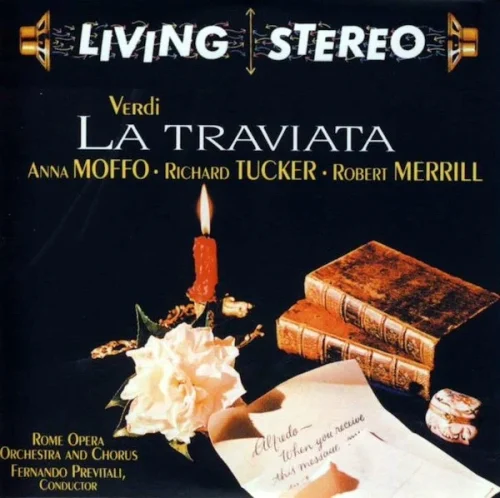
Fernando Previtali / Orchestra del Teatro dell’Opera di Roma (RCA)
Fernando Previtali’s 1960 RCA studio recording is among the most compelling, thanks to a superb all-American cast. Anna Moffo’s Violetta has it all: virtuosity, beauty, sensuality, and drama — one of the finest interpretations on record, captured in much clearer sound than Karajan’s 1964 La Scala version (Opera d’Oro). Richard Tucker brings emotional depth and expressiveness to Alfredo, while Robert Merrill’s Germont is steady and dark-toned.
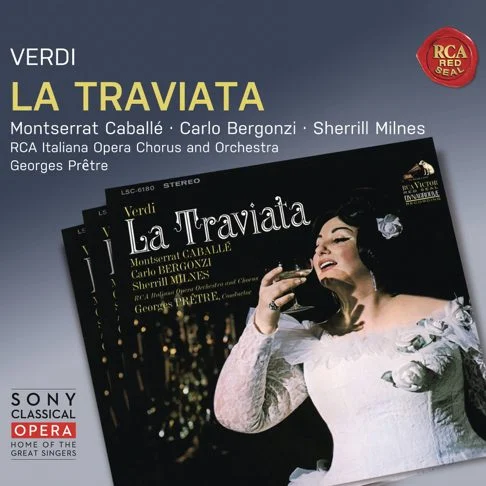
Georges Prêtre / Orchestra della RCA Italiana Opera (RCA)
Though Violetta might not be the first role one associates with Montserrat Caballé, her performance in Georges Prêtre’s 1967 RCA studio recording is indispensable. Her trademark long, sensual phrasing perfectly captures the role’s nobility and fragility. Carlo Bergonzi, one of the greatest Verdi tenors, sings a passionate and beautifully shaped Alfredo. Sherrill Milnes gives a well-sung Germont, though his voice lacks some of the lyrical warmth ideal for the part.
Jean Bobescu / Orchestra Operei Române din București (IMP Classics)
IMP Classics released several fine Verdi recordings from the Romanian National Opera in Bucharest, and the 1968 La traviata under Jean Bobescu is no exception. The outstanding coloratura soprano Virginia Zeani brings passion, rich tone, and remarkable agility to her Violetta, making the interpretation both emotional and virtuosic. While I admire her Covent Garden 1960 performance under Nello Santi, she benefits from a stronger cast in this Romanian studio recording. The underrated Nicolae Herlea sings an authoritative Germont with a warm, resonant tone, and Ion Buzea offers a respectable, if not especially distinctive, Alfredo.
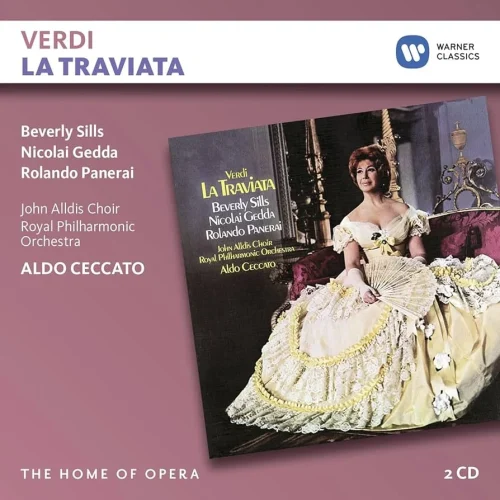
Aldo Ceccato / Royal Philharmonic Orchestra (Warner)
Aldo Ceccato’s 1971 studio recording is, in my view, one of the most essential La traviata interpretations. His conducting is direct and passionate, and the combination of the three leads feels ideal. Beverly Sills gives a sensitive, deeply personal Violetta, revealing the character’s vulnerability. Nicolai Gedda makes one of his best Italian roles as Alfredo — noble, elegant, and clear-toned. Rolando Panerai, for me, is the finest Germont on record, with a rich, ringing baritone and a portrayal full of humanity and resolve,and luckily, his aria ‘No, non udrai rimproveri’ is not cut — which, unfortunately, is the case in many other recordings.
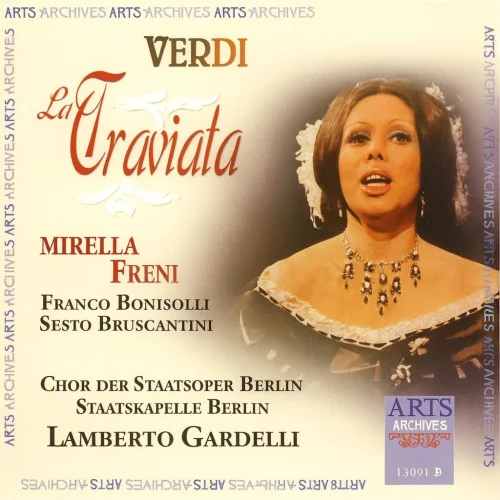
Lamberto Gardelli / Staatskapelle Berlin (ARTS Archives)
Lamberto Gardelli, known for his legendary Philips/Decca recordings of Verdi’s early operas, left a worthy La traviata legacy with his 1973 version, which originally was a film soundtrack (he also the opera it on Hungaroton). Mirella Freni, mostly celebrated for other roles, gives an impressive, dramatically charged Violetta, full of desperation and strength. Franco Bonisolli, one of Italy’s finest tenors, makes an idiomatic, passionate Alfredo, using his powerful voice to great effect. Sesto Bruscantini’s Germont is competent, though lacking some vocal richness.
Richard Bonynge / National Philharmonic Orchestra (Decca)
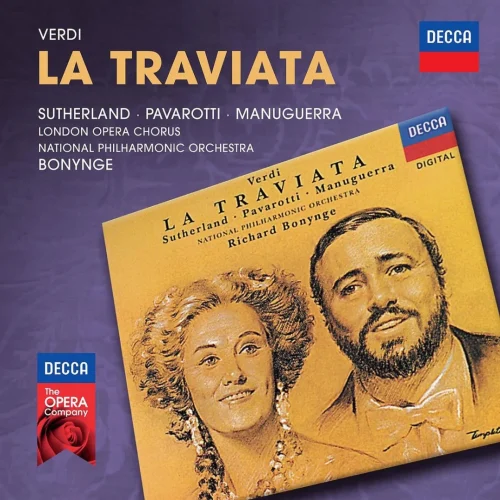
Joan Sutherland, one of the iconic coloratura sopranos of her generation, first recorded Violetta in 1962 (Decca) with Carlo Bergonzi and Robert Merrill under John Pritchard. Although her voice sounds fresher in that early version, I prefer her later 1980 recording under Richard Bonynge, where emotional maturity replaces sheer virtuosity. Luciano Pavarotti, though past his prime peak, still brings radiant lyricism to Alfredo. Matteo Manuguerra’s Germont is more sympathetic and compassionate than commanding, yet sung with fine style.
Georg Solti / Orchestra of the Royal Opera House, Covent Garden (Decca)
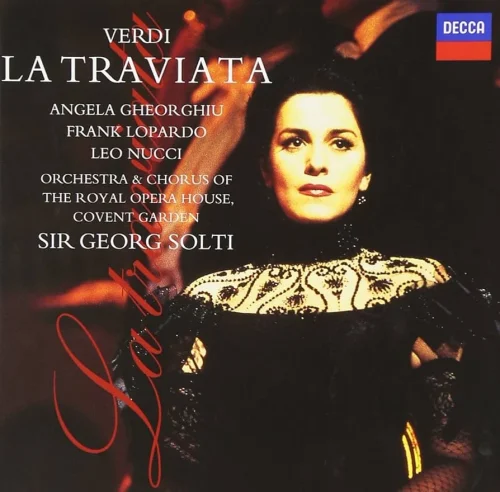
While casting for Richard Eyre’s celebrated La traviata production at Covent Garden in 1994, Georg Solti was reportedly moved to tears by Angela Gheorghiu’s Violetta. A live recording from that production was released by Decca the following year. Gheorghiu achieves a perfect balance between desperation and self-awareness, singing with both tenderness and passion. Leo Nucci offers a seasoned Germont, and Frank Lopardo a convincing Alfredo.
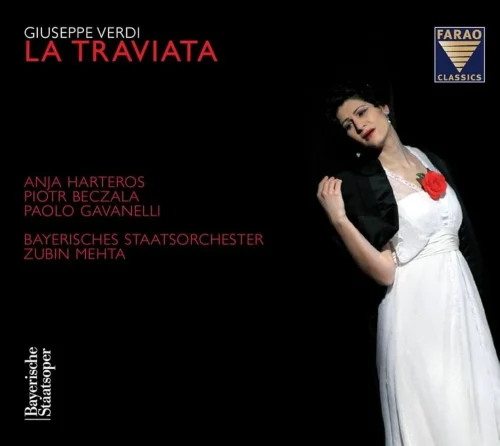
Zubin Mehta / Bayerisches Staatsorchester (Farao Classics)
Anja Harteros has been one of the finest sopranos of the modern day, celebrated for her powerful Verdi roles—many of which have been captured on video, and the famous Aida on CD under Antonio Pappano (Warner). Earlier in her career, however, Violetta was a cornerstone role, and Farao Classics released a composite recording of several performances at the Bayerische Staatsoper from 2006, conducted by Zubin Mehta. Harteros gives Violetta a sense of maturity and depth, her dark, tender soprano radiating drama and passion, with one of the most beautiful upper registers I have heard in the role. Piotr Beczała—then a great lyric tenor, before venturing into heavier repertoire—sings Alfredo with noble lyricism. Paolo Gavanelli, unfortunately, is too weak as Germont, sounding restrained for most of the performance.