Giacomo Puccini’s opera La bohème, first performed in Turin in 1896 with Arturo Toscanini conducting, quickly became a favorite with audiences, and it has also been widely recorded over the years. Puccini’s touching portrait of young love with a tragic edge is a timeless classic, just as Shakespeare’s Romeo and Juliet will always be. For more than 130 years we have been captivated by Puccini’s unique ability to combine youthful joy with deep sadness. It is hard to believe that this opera will ever lose its charm or its power to move both young and old listeners. Although there are many fine recordings, the ten below still stand out in the end. Neither Toscanini’s nor Solti’s recording (both on RCA) appear on my list, since none of them had quite the right feeling for Puccini in my opinion, and their interpretations lack warmth and magic.
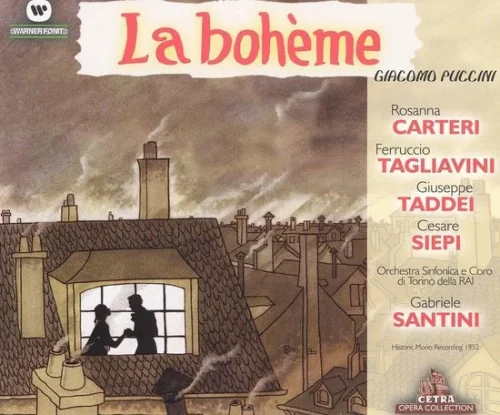
Gabriele Santini / Orchestra Sinfonica di Torino della RAI (Warner)
Gabriele Santini’s 1952 Cetra recording with the Italian Radio Orchestra in Turin is greatly underrated. His interpretation has a natural warmth and a true feel for Puccini’s musical language. Rosanna Carteri is one of the best Mimis on record, with brilliance, elegance, and sensitivity in her singing. Ferruccio Tagliavini gives a passionate and intense Rodolfo. There are also major singers like Giuseppe Taddei and Cesare Siepi as Marcello and Colline, even if Elvira Ramella’s Musetta is a little too piercing. The mono sound is perfectly acceptable, though the levels can vary a bit.
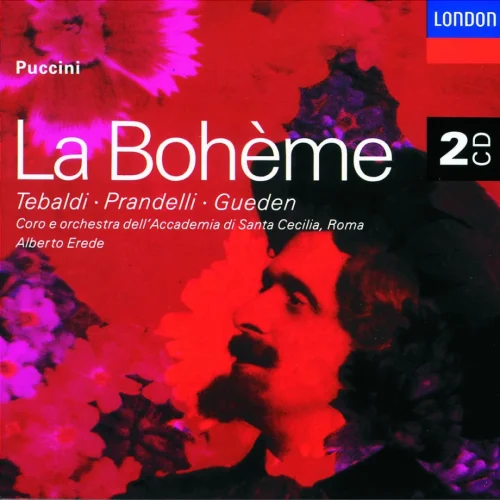
Alberto Erede / Orchestra dell’Accademia Nazionale di Santa Cecilia (Decca)
Renata Tebaldi’s first recording as Mimi is even more beautiful and moving than her later stereo version. Decca’s 1951 mono recording has impressively clear and fresh sound, and Alberto Erede’s interpretation with the Santa Cecilia Orchestra in Rome is both elegant and lively. But it is above all the singing that draws one back to this recording, with Giacinto Prandelli giving a warm and emotional Rodolfo. Hilde Güden’s brilliant Musetta also deserves mention.
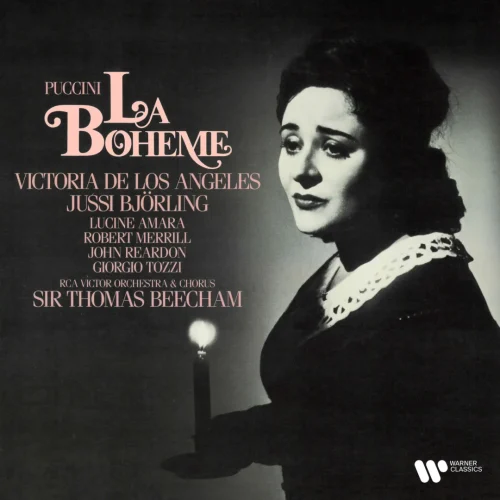
Thomas Beecham / RCA Victor Symphony Orchestra (Warner)
Sir Thomas Beecham’s 1956 mono recording with the RCA Victor Symphony Orchestra is a classic, and for many still the best. The English conductor’s slightly slower tempi — in contrast to Toscanini’s much brisker approach on RCA — later became almost standard in recordings of the opera. Beecham brings warmth and glow to the music, and vocally it is one of the finest recordings: Jussi Björling’s lyrically melancholy Rodolfo and Victoria de los Ángeles’ sublimely beautiful Mimi are outstanding. Other singers include great names such as Robert Merrill and Giorgio Tozzi.
Thomas Schippers / Orchestra del Teatro dell’Opera di Roma (Warner)
Thomas Schippers’ recording was originally intended to be a stereo remake of Beecham’s mono version. But Jussi Björling died suddenly in 1960 and Victoria de los Ángeles became ill at the time of the sessions, so the casting ended up completely different — although the tenor was still Swedish. Mirella Freni’s first Mimi shows her voice with even more freshness and beauty than in her later Karajan recording. Schippers’ 1964 interpretation with the Rome Opera Orchestra shows his special feel for Italian opera — both nuanced and intense. Nicolai Gedda also gives a virtuosic Rodolfo, even if his interpretation lacks a little Italian warmth.
Antonino Votto / Orchestra del Teatro alla Scala (Warner)
On paper, Maria Callas might seem a strange choice for the seemingly innocent young Mimi. But in fact she works well in the role and brings something new. She gives Mimi a stronger will, making her more mature and convincing as a character. EMI’s line-up of singers from this era leaves nothing to be desired: Giuseppe Di Stefano is a passionate Rodolfo and Rolando Panerai an expressive Marcello. Anna Moffo’s Musetta is also something special — brilliant and sensual. The underrated Italian maestro Antonino Votto and the La Scala Orchestra provide an elegant and thoughtful interpretation, with clear mono sound from EMI (1956).
Erich Leinsdorf / Orchestra del Teatro dell’Opera di Roma (RCA)
Anna Moffo went from singing Musetta on Votto’s recording to taking on Mimi a few years later with Erich Leinsdorf and the Rome Opera Orchestra in 1961. Moffo is the main reason to hear this set: her portrayal has great character and vocal brilliance, although Richard Tucker also offers a mature and well-balanced Rodolfo. Robert Merrill is an impressive Marcello here, and RCA provides excellent sound.
Antonio Pappano / Philharmonia Orchestra (Warner)
Antonio Pappano has a real feeling for Puccini, shown in the way he brings every musical detail to life — especially important in La bohème. Vocally, this recording cannot compete with the very best, but it is still interesting enough to deserve a place in this top ten. Leontina Vaduva gives a sensitive Mimi, and Roberto Alagna, his voice still youthfully fresh, sings an intense Rodolfo.
Riccardo Chailly / Orchestra del Teatro alla Scala (Decca)
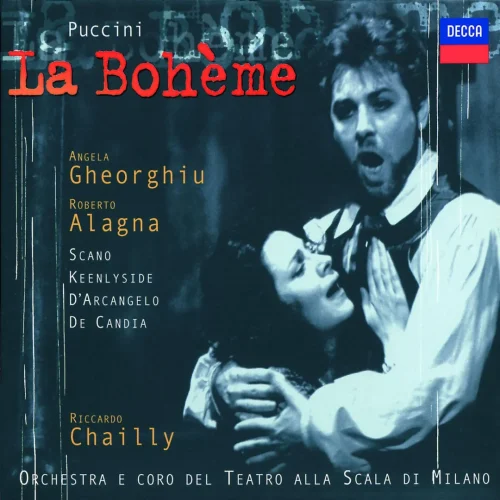
Riccardo Chailly’s 1999 Decca recording with the La Scala Orchestra is in many ways based on Toscanini’s faster, unsentimental approach to Puccini, although Chailly brings much more imagination to his interpretation. With superb Decca sound, the performance has a freshness and vitality that stand out, with the 1990s star duo Angela Gheorghiu and Roberto Alagna in the leading roles. The Romanian soprano gives Mimi a stronger personality than usual — not just a fragile, sick young girl. Alagna’s Rodolfo is robust and passionate.
Serafin / Orchestra dell’Accademia Nazionale di Santa Cecilia (Decca)
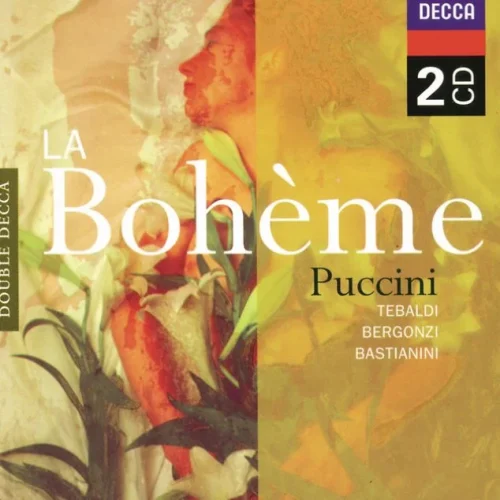
Tullio Serafin’s 1959 recording with the Santa Cecilia Academy Orchestra is a personal favorite. Serafin, who made so many memorable Italian opera recordings, shows his deep understanding of Puccini here with a slow, warmly lyrical interpretation. Vocally, the recording is almost unsurpassed: Carlo Bergonzi’s beautifully resonant Rodolfo and Renata Tebaldi — in her second recording of the role — as a sensitive yet intense Mimi. Decca’s brilliant sound also enhances the result, with fine singers like Ettore Bastianini and Cesare Siepi in the other roles.
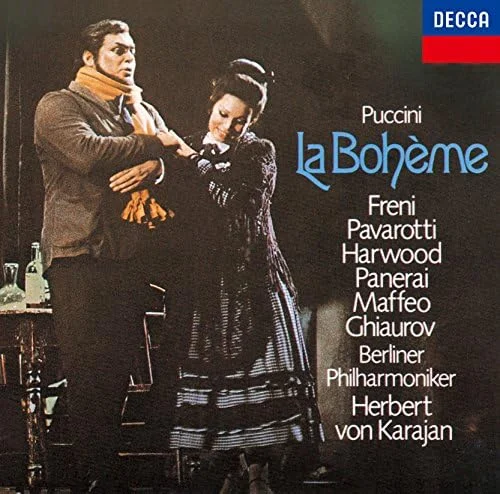
Herbert von Karajan / Berliner Philharmoniker (Decca)
The obvious first choice remains Herbert von Karajan’s 1973 Decca recording with the Berlin Philharmonic. The sound is among the finest ever achieved in this opera, and the Austrian conductor’s interpretation is something extraordinary. Puccini brought out the best in Karajan, and his performance combines orchestral brilliance with unique sensitivity and emotional power. Mirella Freni is a deeply moving Mimi, with exceptional beauty and warmth. The same can be said of Luciano Pavarotti, who sings with passion and heart like almost no one else. The rest of the cast is also impressive, including Nicolai Ghiaurov and Rolando Panerai.