
Gaetano Donizetti’s Lucia di Lammermoor has long been one of the crown jewels of Italian opera, most famous for its mad scene that has challenged sopranos for generations. In this article, we will look at ten of the greatest recordings of Lucia di Lammermoor—without ranking them in any particular order. It is, of course, a pity that some legendary interpreters were never officially recorded: Virginia Zeani and Karola Ágai, both unforgettable Lucias on stage; are sadly absent from the catalogue, though a few unofficial recordings and officially released excerpts of them in these roles do exist.
Ugo Tansini / Orchestra Sinfonica dell’EIAR di Torino (Cetra/Warner)
The 1939 Cetra recording conducted by Ugo Tansini (Warner) was one of the first complete versions of Lucia di Lammermoor, and the sound is surprisingly clear for its age. It features a generation of singers who carried the bel canto tradition directly from the late 19th into the early 20th century. Lina Pagliughi’s voice is bright and silvery, with secure technique, combining vocal brilliance with touching vulnerability. Giovanni Malipiero sings a passionate, warm Edgardo, while Giuseppe Manacchini provides a resonant, dark-toned Enrico. This is much more than just a historical document—it deserves a place in every serious Lucia collection.

Fausto Cleva / Metropolitan Opera Orchestra (Sony)
Lily Pons was one of the greatest Lucias to perform at the Metropolitan Opera. Although her voice shows evident signs of age in this 1954 recording, there are still important glimpses of the exceptional interpreter she was — one of the most notable in the role throughout opera history. Richard Tucker is outstanding as Edgardo, exemplifying the beauty of his tone and musicality while fully capturing the character’s emotional range throughout the work. Fausto Cleva conducts with both speed and elegance, and Frank Guarrera as Enrico and Norman Scott as Raimondo complete the main cast appropriately. Cuts typical of the time are made, though some are sorely missed, such as the Act III duet between Edgardo and Enrico.

Herbert von Karajan / RIAS Sinfonie-Orchester Berlin (Warner)
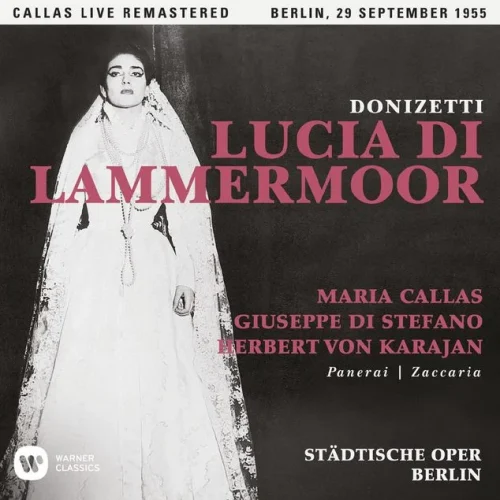
Maria Callas was, of course, one of the greatest to embody Lucia, blending electrifying intensity with deep sensitivity, and her mad scene is extremely moving and emotionally charged. There are several outstanding recordings with her in the role, including the two studio recordings with Tullio Serafin and the famous live performance from Mexico City in 1952 (Myto). My personal favorite, however, is the live recording from Berlin in 1955 with Herbert von Karajan, which has remarkable theatrical energy. The sound quality does not match that of Serafin’s studio versions, but I still prefer it to Karajan’s first Lucia with Callas from La Scala in 1954. Giuseppe Di Stefano is an elegant and dramatic Edgardo—perhaps the most furious Edgardo on record at the end of Act II. Rolando Panerai sings Enrico with both beauty and determination.
Oliviero de Fabritiis / Orchestra del Teatro Verdi di Trieste (Bongiovanni)
The live 1957 Trieste recording with Oliviero de Fabritiis (Bongiovanni) has poor sound quality, but Leyla Gencer’s portrayal is so compelling that it cannot be overlooked. Like Callas, she approached bel canto with a dramatic sensibility, and her Lucia is extremely passionate, tragic, and overwhelming, while also displaying extraordinary control and nuance in the mad scene. Giacinto Prandelli contributes elegant phrasing and lyrical beauty as Edgardo, while Nino Carta offers an authoritative Enrico. De Fabritiis, as always, brings his mastery of Italian opera to the podium.

Georges Prêtre / RCA Italiana Opera Orchestra (RCA/Sony)
Anna Moffo did not approach Lucia as dramatically as Callas or Gencer, but she gave us one of the most sensual, emotionally gripping, and beautifully sung Lucias on record in the 1965 RCA recording with Georges Prêtre. Carlo Bergonzi is magnificent as Edgardo, singing with passion and beauty—about as close to perfection as one could hope for, not least the voice combination with Moffo. Mario Sereni adds a great finishing touch to the cast as Enrico. Prêtre’s conducting is excellent, and the sound quality is first-rate. For many listeners I guess, this is their personal favorite Lucia.

Bruno Bartoletti / NHK Symphony Orchestra (Myto)
Renata Scotto recorded Lucia many times, and the choice among them depends on what one values most in terms of cast, conductor, sound quality, and her performance. My personal preference is the live Tokyo recording from 1967 under Bruno Bartoletti. Scotto combines bel canto agility with verismo passion and drama in the title role. Carlo Bergonzi is, as always, excellent—and here he is even more intense than in his studio versions. Mario Zanasi, one of the finest Italian baritones unfairly overlooked by the big labels, makes a strong and authoritative Enrico.

Thomas Schippers / London Symphony Orchestra (Westminster Legacy/Deutsche Grammophon)
Throughout her career, Beverly Sills was a fantastic interpreter of Donizetti operas. She is one of the very few who managed to blend the technical challenges with the sincere expressivity required by the role of Lucia—somewhere between Sutherland and Callas—as in Schippers’ 1970 recording. The nuance with which she shapes coloratura passages, such as in ‘Quando rapito in estasi’ or the mad scene, is beautiful, even if her voice does not always sound fresh. Carlo Bergonzi is superb as Edgardo, with his immaculate phrasing as always, though his voice sounds slightly less vibrant than in the Prêtre recording with Anna Moffo. Piero Cappuccilli and Justino Díaz, as Enrico and Raimondo respectively, are outstanding — undoubtedly among the finest exponents of their roles in recorded history. Thomas Schippers conducts brilliantly, clearly enjoying working with the soloists. Notably, this is the first recording to use the glass harmonica, invented by Benjamin Franklin, in the mad scene, as Donizetti originaly intended.

Richard Bonynge / Chorus of the Royal Opera House, Covent Garden (Decca)
After Callas, Australian soprano Joan Sutherland became the leading Lucia on the world’s major opera stages. Although very different in style — Callas was more dramatically oriented, while Sutherland was primarily vocally oriented — she was equally as astonishing and became the reference interpreter of the role. In her second studio recording of Lucia di Lammermoor, from 1971, Sutherland shines like few others. The acquired darkness in her voice and her heightened attention to interpretive detail far surpass her earlier version with Pritchard in 1961, while her coloratura and virtuosity remain essentially intact. This time, she is conducted in a deeply melancholic manner by her husband, Richard Bonynge, and is supported by an all-star cast. Pavarotti’s beautifully sung Edgardo, with his extraordinary legato and crystal-clear diction, is the perfect partner. Sherrill Milnes and Nicolai Ghiaurov as Enrico and Raimondo are equally outstanding.

Jesús López Cobos / Philharmonia Orchestra (Philips)
This 1976 recording presents itself as authentic, with few interpolations. While this approach works very well with Verdi, a composer who despised variations added by singers or conductors, it is less effective with Donizetti, who was often open to, or even expected, ornamentation and variation from the artists. Nevertheless, it remains a fascinating document, although listeners eagerly awaiting the high notes may be disappointed. Caballé’s Lucia is performed impressively: as one of the greatest belcanto sopranos in history, her legato and coloratura are outstanding, as is her ability to move seamlessly from piano to forte and everything in between. Edgardo is one of José Carreras’s signature roles, and this performance is vivid proof of that. His fresh voice, passionate interpretation and ability to convey the full emotional range of the character establish him as one of the finest Edgardos in the discography. Vincenzo Sardinero’s portrayal of Enrico is somewhat underwhelming, while Samuel Ramey, in one of his earliest recordings, is an almost flawless Raimondo. López Cobos’ conducting is somewhat erratic, bringing extra drive to the more exciting sections while stripping the elegance from the more nuanced parts of the work.

Nicola Rescigno / Royal Philharmonic Orchestra (EMI/Warner)
The main appeal of this 1983 recording is Alfredo Kraus as Edgardo. A masterclass in bel canto singing from start to finish, the Canarian tenor’s performance is elegant and stylish, and his interpretation of the role is one for the ages. As Lucia, Slovak soprano Edita Gruberová is impressive in her coloratura and high notes, but she lacks the dramatic intensity of the character — her singing often remains at the level of pretty ornamentation and little more. Renato Bruson is very effective as Enrico, while Robert Lloyd can be at times underwhelming as Raimondo. Apparently, this recording was originally intended to be conducted by Riccardo Muti, who supposedly declined due to his disagreement with Gruberová’s excessive ornamentation. Nicola Rescigno took over, conducting the score competently, if not memorably.

Bonus
As mentioned in the introduction, it’s a real pity neither Virginia Zeani nor Karola Ágai left us a complete official recording of Lucia di Lammermoor, since both brought such individuality and dramatic flair to the role. Thankfully, a few priceless excerpts that capture what made their Lucias so unforgettable are available.

