Over time, Bellini’s Norma slipped out of the standard repertoire and was rarely performed until Maria Callas brought it back to life (her role debut was in 1948), and she went on to make the opera a cornerstone of Italian opera repertoire. The role became so closely linked to Callas that many felt no other soprano could take it on. Still, several great sopranos have since mastered it, each adding their own touch. Today, though, truly outstanding performances of Norma are hard to find— perhaps because modern approaches to bel canto often favor intellectual restraint over dramatic spontaneity and risk-taking. In this article, we look at ten of the greatest recordings of Norma—in no particular order.
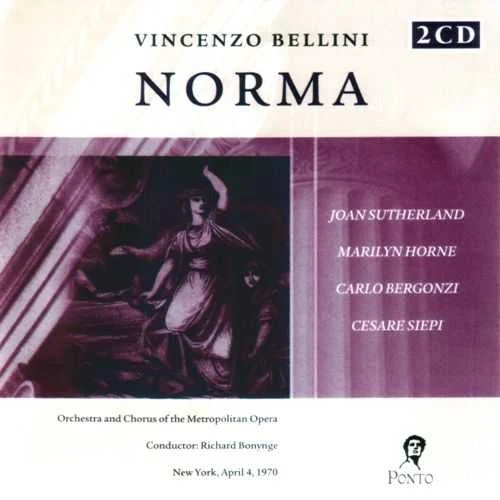
Richard Bonynge / Metropolitan Opera Orchestra (Ponto)
Although Joan Sutherland recorded Norma twice in the studio, my personal favourite rendition of hers in the title role is this live recording from the Metropolitan Opera in 1970. Norma is a very dramatic and nuanced character who leads two very different lives, which makes her conflicted and complex. The music is so beautiful that many performers simply sing it prettily and correctly from a technical standpoint, but do not convey any emotional or intellectual depth in the role. To an extent, this is what happened with Sutherland in the two previously mentioned studio recordings. The singing is fantastic, but the interpretation is dry. In this version, however, probably because she is acting the role as well as singing it, she finally conveys all of Norma’s layers of complexity while maintaining the beauty of her singing. Richard Bonynge, her husband, conducts correctly, but sometimes lacks dramatic weight. Carlo Bergonzi’s Pollione is one of the best in the entire discography, and Marilyn Horne excels as Adalgisa, interpreting the character in a way that few others can. Rounding off the cast, Cesare Siepi’s Oroveso is magnificent.
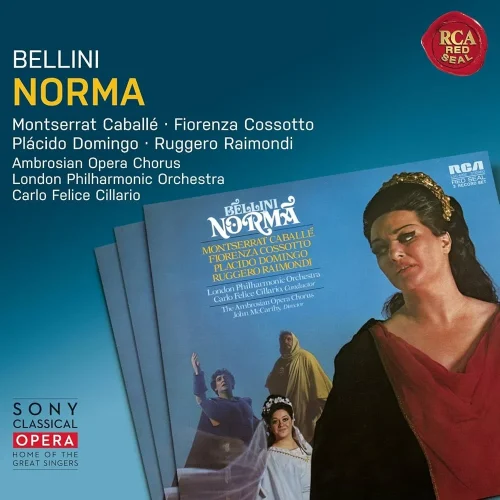
Carlo Felice Cillario / London Philharmonic Orchestra (RCA)
Although this 1972 recording is one of the best-sung versions of the work in the entire discography, the musical direction is weak. Carlo Felice Cillario strips the score of all drama and depth; he is a conductor who, like sopranos who sing Norma prettily and accurately but without emotion or intelligence, fails to bring out the piece’s full potential. The result is unimaginative and dry. Fortunately, the singers are of the highest calibre. Montserrat Caballé is an outstanding Norma that easily surpasses the role’s technical challenges, adding fierceness and personality to the character — at least until Cillario gets in the way. Plácido Domingo is a youthful and energetic Pollione. While he is erratic at times, he portrays the Roman proconsul as a very real and nuanced character. Fiorenza Cossotto and Ruggero Raimondi complete the excellent cast as Adalgisa and Oroveso respectively. Even taking into account the conductor’s shortcomings, the singing alone makes this recording worth having.
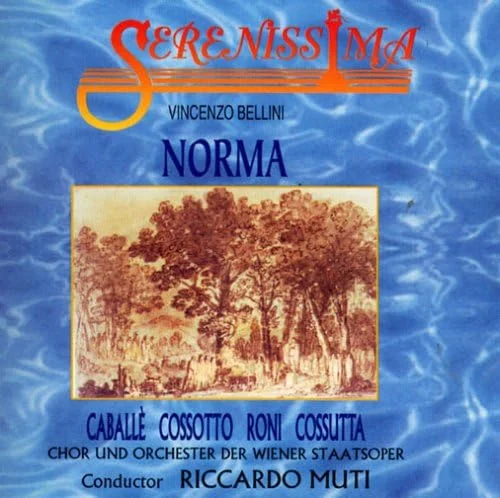
Riccardo Muti / Orchester der Wiener Staatsoper (Serenissima)
While Cillario strips the work of all depth, Riccardo Muti does the absolute opposite in this 1977 live recording. The Neapolitan maestro imbues Norma with energy, excitement and emotion without overshadowing the singers, ensuring that the orchestra maintains the elegance and restraint required by Bellini’s score. Caballé is fantastic, as always. Her Norma here equals the Cillario recording in terms of beautiful singing, but aided by Muti and the nature of the live performance, her interpretation has more depth and nuance. Carlo Cossutta is a convincing Pollione, sometimes brutish and unrefined, but consistently delivering a solid performance, both vocally and interpretively. Fiorenza Cossotto once again proves why she is one of the strongest and most reliable Adalgisas in the discography. Luigi Roni is good as Oroveso, but not outstanding.
James Levine / National Philharmonic Orchestra (Sony)
While not having the vocal capabilites of Callas, Renata Scotto is, without doubt, the one who comes closest to la divina in terms of dramatic interpretation as Norma. In fact, I would argue that no soprano in the discography — not even Callas herself — brings the text to life as well as Scotto does. Perhaps her Norma should not be judged solely on ‘Casta diva’ or ‘Ah! Bello a me ritorna’, but on her performance of the recitatives, how every word carries a specific emotion and the way she interacts and responds to the other characters. A kunstdiva in every sense of the word. Another great reason to hear this 1979 version is James Levine, who conducts the work in a highly theatrical way, allowing some of its heavier aspects to flourish. Giuseppe Giacomini’s Pollione, with his almost baritonal voice, is exciting, but, like Cossutta, he lacks nuance at times. Overall, however, he gives a strong rendition of the role. Tatiana Troyanos is superb as Adalgisa, while Paul Plishka’s Oroveso is somewhat lacklustre.
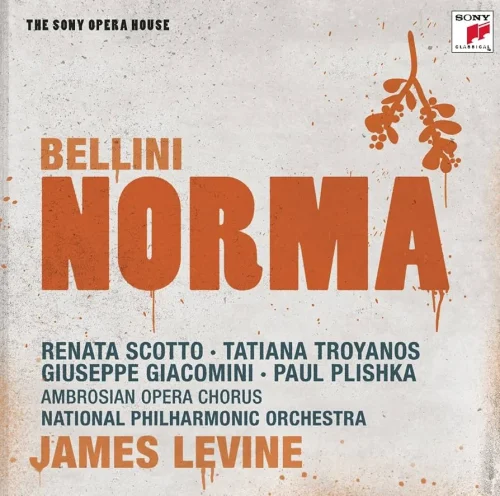
Riccardo Muti / Orchestra del Maggio Musicale Fiorentino (EMI/Warner)
Over fifteen years after the live recording with Caballé, this 1994 performance offers many positives, despite the cast being inferior to that of 1977. Firstly, although Muti’s approach is still grounded in the same principles as the earlier version, it is somehow more theatrical and immersive. This adds an extra dimension to the opera, which is evident from the very first chords of the overture. While the cast may not be as glamorous as in other recordings, they work together as an ensemble to create a dramatic and realistic depiction of Norma. Jane Eaglen’s portrayal of the title role contains many fine moments, even if she lacks subtlety at times, while Vincenzo La Scola’s Pollione is both lyrical and believable, despite his voice sometimes lacking power. This is also one of the few recordings to cast Adalgisa as a soprano, as it should be, rather than a mezzo. Eva Mei portrays the young priestess with an innocence and sweetness rarely heard before. Dimitri Kavrakos’s performance as Oroveso is solid enough to ensure the success of the recording. The sound quality is excellent.
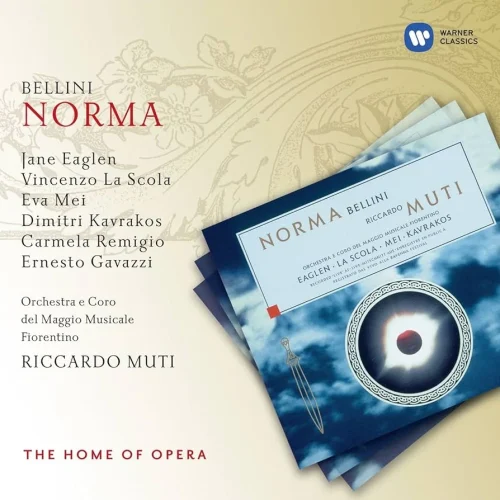
Vittorio Gui / Orchestra Sinfonica dell’EIAR di Torino (Warner)
One of the earliest complete recordings of Norma is the 1937 Cetra version (now Warner), conducted by Vittorio Gui. The sound quality is surprisingly good—clearer than many recordings from that era, even in the orchestra. You can already hear how a more dramatic approach had found its way into bel canto by the early 20th century. Gina Cigna, one of the leading sopranos of her generation, is a powerful yet deeply vulnerable Norma. Giovanni Breviario gives a heroic Pollione with a strong, straightforward tenor, while Ebe Stignani brings warmth and nobility to Adalgisa. I actually prefer her here to her later recordings from the 1950s. Gui achieves great balance between dramatic urgency and lyrical flow.
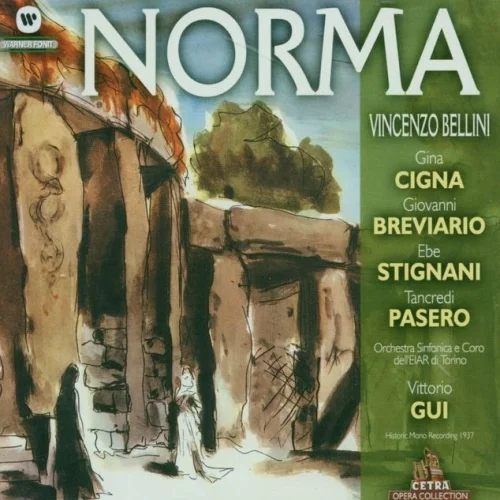
Gabriele Santini / Orchestra del Teatro dell’Opera di Roma (Myto)
Anita Cerquetti had an extremely short career, ending at just 30, but the recordings she left from the 1950s are extraordinary. A standout is the live 1958 Rome performance of Norma under Gabriele Santini, with Cerquetti at her absolute peak. Her Norma combines beauty of tone with intensity, always radiant yet gentle. Franco Corelli, needless to say, is a thrilling Pollione—here even more spontaneous and dramatic than in his later 1960 studio version with Serafin. Miriam Pirazzini, a respected but less well-known Italian mezzo, makes a very convincing Adalgisa, especially in duets with Cerquetti and Corelli. Santini leads with authority and clear dramatic buildup. The audio is not the best, but good enough to capture the full impact of the performance.
Fernando Previtali / Orchestra del Teatro San Carlo di Napoli (Hardy Classic)
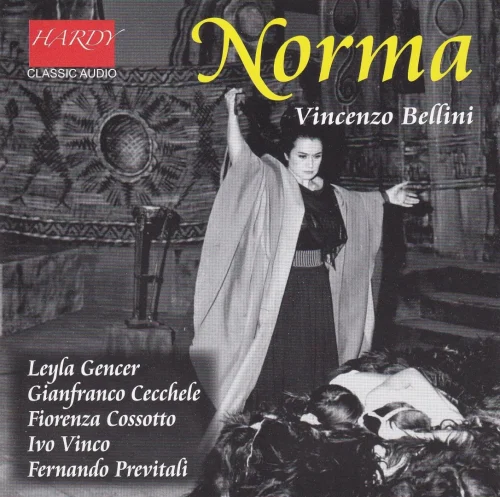
Leyla Gencer, La diva turca, never became a star for the big record labels, but there are many live recordings (and countless bootlegs) of her work, including three officially released Norma. My favorite is the 1965 Naples performance under Fernando Previtali, though Gianandrea Gavazzeni’s Milan version from the same year is also excellent—it’s mostly a matter of taste. Gencer’s Norma is brutally fatalistic yet still deeply sensitive and feminine, expressing the character’s inner suffering. Her final aria, ‘Deh! Non volerli vittime’, is one of the most moving Norma moments on record. Gianfranco Cecchele, an underrated tenor who deserves far more recognition, sings Pollione with cutting, dramatic power. Fiorenza Cossotto, at the start of her long and illustrious career, is a warm and youthful Adalgisa. Previtali brings clarity and dramatic shape to the performance. You can enjoy Gencer in this role with better sound quality in Gavazzeni’s recording, but the overall performance in Previtali’s recording is somewhat sharper.
Tullio Serafin / Orchestra del Teatro alla Scala di Milano (Warner)
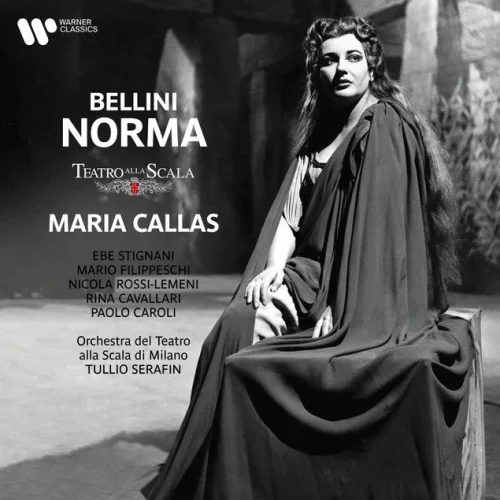
Maria Callas’ Norma hardly needs an introduction. Few portrayals in Italian opera history are as iconic, combining vocal brilliance, dramatic intensity, and musical intelligence. Among her studio recordings, my personal favorite is the 1954 version with Mario Filippeschi under Tullio Serafin. Filippeschi gives Pollione brightness and force, rooted in a strong traditional style. Ebe Stignani may not be quite as solid here as in the 1937 Cetra version, but she remains convincing, and her experience shines through. Serafin creates a perfect balance between bel canto elegance and the opera’s darker dramatic weight. His later 1960 studio recording with Callas, Corelli, and Christa Ludwig is also excellent—it comes down to preference. In both, the sound quality is excellent.
Antonino Votto / Orchestra del Teatro alla Scala di Milano (Myto)
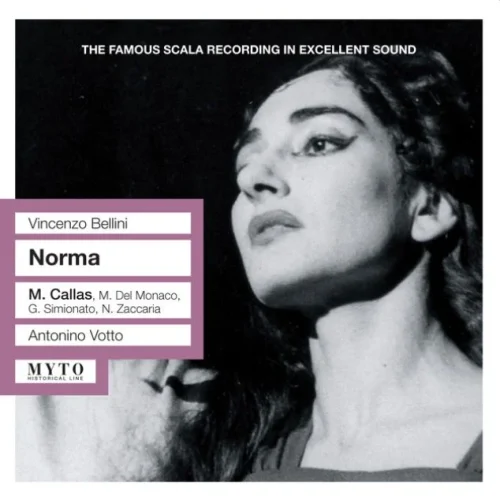
For all the advantages of studio sound, a live Norma is unbeatable. Antonino Votto’s 1955 La Scala performance captures the essence of 1950s bel canto: passion, drama, spontaneity, and risk. Callas is tremendous, portraying Norma’s authority and inner conflict with electrifying intensity. Mario Del Monaco, never subtle but always thrilling, brings his trademark dramatic power to Pollione. Giulietta Simionato is an ideal Adalgisa, her rich, warm mezzo a perfect balance. The duets and ensembles burn with volcanic energy under Votto’s direction, who drives the drama forward with great energy. Beyond being a superb recording, it’s also a great document of La Scala’s theatrical atmosphere at that time.
Bonus
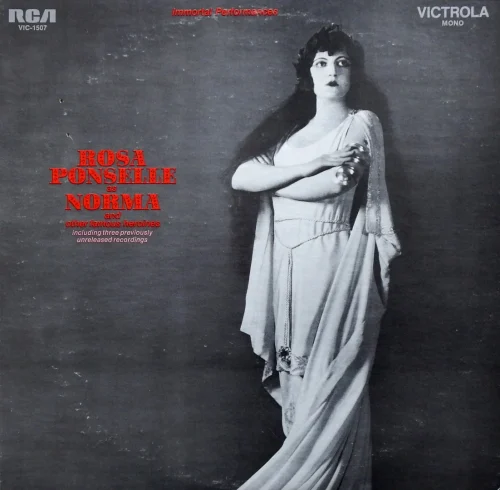
Rosa Ponselle, one of the legendary opera singers, sang Norma many times at the Met. Sadly, no complete performance survives, but the highlights released on RCA are a true treasure.