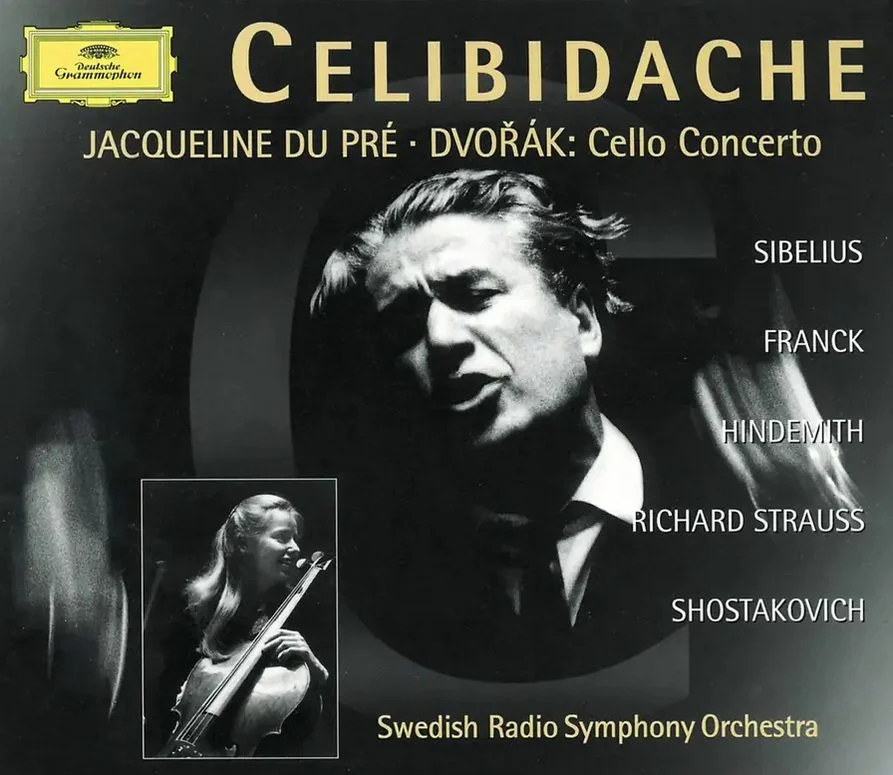
There are brilliant artists I could never have heard live, simply because I wasn’t yet born during their lifetimes. Conductors like Wilhelm Furtwängler and Bruno Walter are examples. But there is one case that pains me deeply: Sergiu Celibidache. I only began to take a real interest in him after his death—something I still regret to this day.
In the 1990s, he reached the height of his career as chief conductor of the Munich Philharmonic, an orchestra that finally fulfilled him after years of searching and wandering between Turin, Stockholm, Cologne, and Stuttgart. At that very time, I happened to be living in Munich. I had a modest job in the library of the Bavarian State Opera and soon after became an intern in the music department of Bavarian Radio. I will probably never forgive myself for not seizing the once-in-a-lifetime chance to attend his concerts—performances for which others traveled long distances. I could even have gone to his rehearsals at the Gasteig free of charge.
I still remember the negative headlines in the Munich tabloid press and it never crossed my mind that someone constantly portrayed as a dictator, with a reputation for arrogance, could ever fascinate me. I’ll never forgive myself for that either.
It was only years later that I discovered what I had missed, when I saw the documentary The Gardens of Celibidache (1996). Suddenly it struck me what an extraordinary genius he must have been, even if the few filmed excerpts of him conducting could only suggest the glow of his legendary concerts. The way he immersed himself in Bruckner, the insights he expressed, his unbending artistic convictions—it all overwhelmed me.
From then on, I wanted to know everything about Celibidache. Despite knowing that Celi himself rejected recordings, I still collected every available film and audio, contacted the Munich Celibidache Archive, and watched every documentary ever made about him: from brief postwar clips of him stepping in for Furtwängler with the Berlin Philharmonic, to little-known private Super 8 films shot in Italy, to discussions with his students, concert footage, and interviews. I immersed myself in his Phenomenology of Music, read every book on him, studied his fascinating correspondence with Furtwängler, visited the places where he worked, and sought out every testimony I could from those who had known him.
They were a diverse group: nonagenarian members of the Berlin Philharmonic, musicians from the Munich Philharmonic and Stuttgart RSO, soloists, journalists, conducting students, companions—and even, in Bucharest, a nephew of Celibidache who bears the exact same name. Their stories came together like a many-sided mosaic.
Klaus Umbach’s biography of Celibidache often described the maestro unflatteringly—as quarrelsome, hypersensitive, tyrannical, a guru, or over-delicate. But against that stood a far more positive overall picture. In the end, everyone I spoke with confirmed what I instinctively felt: Celibidache was one of the greatest geniuses of the 20th century.
Violinist Ingolf Turban, in particular, had so many wonderful things to share that I must recount them here. Turban met the conductor in 1986, just 22 years old and a few weeks before his diploma, when he became concertmaster of the Munich Philharmonic. After his audition, he stood face to face with Celibidache for the first time. “I’m Celi, you’re Turbi,” the great Bruckner conductor is said to have greeted him, urging him to postpone his plans to go to America as a soloist and instead stay in the orchestra for three years—which Turban did. After a falling-out with Anne-Sophie Mutter, Celibidache suddenly engaged his young concertmaster as soloist for Sibelius’ Violin Concerto. Turban felt utterly safe in his hands, as if in Abraham’s bosom, and Celi’s recognition was like being knighted.
Turban’s most beautiful anecdote, one that reveals the human side of this often controversial and attacked conductor, took place on a concert tour in Madrid. Celibidache sensed that something was troubling him and pressed him to speak. Turban confessed that he was embarrassed about having no cufflinks for that evening’s concert and no one to lend him any. The next morning, Celibidache summoned him to his room, where two “beautiful golden buttons” awaited him. Though Turban tried to treat them as a loan, the maestro insisted they were a gift. To this day, Turban wears them at every concert in memory of the generous giver.
Of course, Turban also experienced the other, harsher side. “Those I love, I would give the shirt off my back. Those I hate, I stab in the back,” Celibidache once said. In pursuit of his uncompromising artistic vision, diplomacy was not his strength.
That shortcoming may well have cost him the position of Furtwängler’s successor with the Berlin Philharmonic—the greatest disappointment of his life. I will probably never know exactly what happened behind the scenes that led to Karajan being chosen instead. Testimonies differ: cellist Eberhard Finke recalled that the musicians had no real say, while bassist Erich Hartmann claimed that Celi’s difficult dealings with soloists and some players turned the orchestra against him. Cellist Wolfgang Boettcher even heard rumors that Celibidache planned to dismiss half the players he deemed unworthy and replace them with younger ones. Thus legends are born. All the more striking, then, that decades later, as head of the RSO, Celibidache chose Boettcher as soloist for Hindemith’s Cello Concerto—even though Boettcher had previously played under Karajan, Celi’s most hated rival. Yet like every other musician I interviewed, Boettcher spoke with rapture about working with him.
Another telling story comes from Munich journalist Beate Kayser, once a close friend of the maestro and mother of filmmaker Jan Schmidt-Garré, who also made a fine documentary about him. She recalled a tour with the Munich Philharmonic where a clarinetist, whose participation Celi had resisted, won her place only through the works council. She joined the trip but never played a note, remaining a silent extra. Bitter.
My search also led me to St. Florian near Linz, where Anton Bruckner lies buried in the crypt beneath the great organ. Celibidache not only performed Bruckner’s Mass in F minor there, but also spent long hours meditating in the crypt. I too made my way there, longing that I could turn back time and hear that Mass.
At times I am saddened by the thought that Celibidache never succeeded Furtwängler. Yet I was heartened by the words of his nephew, whom I met in Bucharest in 2010: despite all conflicts and contradictions, his uncle was a happy man. For him, only music mattered; he lived for it and found fulfillment in it.
And indeed, nothing speaks more strongly for that than his extraordinary development: from fiery hothead to serene maestro radiating inner calm. He himself said that in his youth he had no idea what music really was. In his later years, he praised the Munich Philharmonic almost ecstatically, convinced that no orchestra in the world could play Bruckner as they did. After all these years of study and discovery, it is almost impossible for me to attend a Bruckner concert today without thinking of my beloved Celi.
There are few musicians of conviction like him left. Christian Thielemann, who carried on his legacy in Munich for a time, is one. Above all, Riccardo Muti. And what should I tell you? Not long ago I picked up a little book of Celibidache quotes and read what he had to say about the Italian: “One of the greatest talents I know.” He added that “he lacks culture”—but that was a judgment on Muti in his youth. Considering how scathing Celibidache was about almost every other great conductor of his time—from Toscanini to Karajan, Carlos Kleiber, and Claudio Abbado—this praise is exceptional indeed.
Find out more about Kirsten Celibidache in Kirsten Liese’s book Celibidache, Der Maestro im Spiegel von Zeitzeugen, available in German at Edition Karo: https://www.edition-karo.de/biografien/celibidache/
Selected Recordings