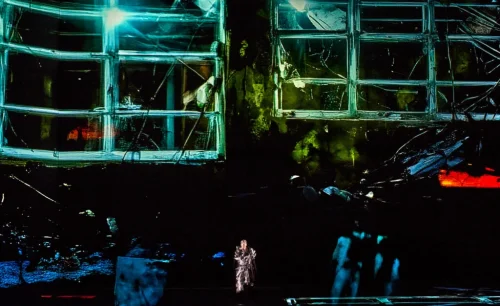
Festspielhaus, Bayreuth, 7 & 8 August 2026
Richard Wagner: Siegfried & Götterdämmerung
You are never safe from surprises in Bayreuth. For the first time in more than 40 years, I experienced two mobile phones ringing during a performance there, one of them unpleasantly shrill and very close to my ear.
The announcement commonly heard at other opera houses asking people to switch off their mobile phones does not (yet) exist in Bayreuth. Until now, it was simply taken for granted that something like this would not happen here. But certain customs on the Green Hill gradually seem to be disappearing.
What shocked me almost more, however, to start at the end, were the boos for Camilla Nylund at the end of the second cycle.
The Finnish soprano was in top form, especially in the last two parts of the tetralogy. The wonderfully tender passage “Ewig war ich, ewig bin ich” (“Eternally was I, eternally am I”) in Act III of Siegfried, with equally gentle support from the Festival Orchestra, sounded extraordinarily delicate. And the way she delivered the high notes in her great final monologue in Götterdämmerung, “Starke Scheite schichtet mir dort” (“Pile up strong logs for me there”), was truly impressive.
Were those who booed expecting the qualities of a Birgit Nilsson, who sixty years ago was able to sing Brünnhilde with crystalline beauty right to the final note? That would be asking too much. Even in her own time, Nilsson was in a class of her own. No one could or can compare with her.
Klaus Florian Vogt enjoys greater favour with the Bayreuth Festival audience, who celebrate him unanimously. He masters Siegfried magnificently, without any sign of fatigue, with his unmistakably bright, carrying voice. Only in the lower register does his tenor sound a little thin. But this does not affect either the clarity of his words or his interpretation of the text. His bright timbre gives him a certain youthfulness that suits the role perfectly.
Even so, the fact that he will sing Siegfried and Götterdämmerung in the upcoming third cycle without a single day’s break between them seems very demanding. Such a feat should remain an exception. It would be a great pity if this voice were damaged by premature wear. By the time singers themselves notice it, it is unfortunately often already too late.
Hopefully Christian Thielemann will keep an eye on this. In Vogt he has long had a reliable partner whose predominantly lyrical voice he handles with great care.
Thielemann, a favourite with the Bayreuth audience, also lives up to his reputation as a “magician” in the way the music under his direction rises above all the weaknesses of the staging. It rises above the portraits of Helmut Kohl, Willy Brandt and Barack Obama that suddenly find their way into the visual flow between some genuinely poetic landscapes. And it rises above the unfortunate decision to hide the chorus, superbly prepared by Thomas Eitler-de Lint, from the audience. As though the chorus were not actively involved in the drama, particularly at such a tense moment as when Brünnhilde notices Siegfried’s betrayal, which she cannot understand (“Ist sie entrückt?”), or when Hagen kills Siegfried before the eyes of his men (“Hagen, was tust du, was tatest du?”).
Thoroughly familiar with the difficulties of Bayreuth’s covered orchestra pit, Thielemann brings the huge musical forces together with great precision. Through the vividness of his interpretation, he creates the illusion of a dialogue despite the chorus being invisible. In this second act of Götterdämmerung, Mika Kares’s Hagen, still too harmless in the first Gibichung scene, sounds considerably darker and nastier, although not as pitch-black as Matti Salminen once did. Salminen could make your blood run cold when he began his “Hoiho!”
The refinement of the sound can also be heard in passages where only a few instruments create the atmosphere and Wagner’s brilliant skill as an orchestrator becomes clear. In the first prelude to Siegfried, for example, the contrabass tuba and bassoons, underpinned by threateningly quiet strokes of the timpani, use their deep, weighty notes to conjure up the terrifying giant worm in the mind’s eye, long before it becomes visible on the gauze curtain. Or there is the clarinet, with one of its most beautiful recurring motifs, looking deep into Brünnhilde’s soul, played with such sensitivity and tenderness that it goes straight to the heart.
One thing also becomes very clear here: how everything in music is based on vibrations, which are naturally transmitted when conductor and musicians share such a clear musical vision. This is true both in intimate chamber-music passages and in exposed entries for horns, trombones and trumpets, where every note is perfectly in place.
The frequencies passing between the invisible pit, the stage and the people in the auditorium are intensified once again, overwhelmingly, in the solemn funeral march “Siegfried’s Death”, the musical high point of this performance, taken at a slightly slower pace and heard in the full splendour of the entire orchestra.
The ensemble, which gathers somewhat towards the left side of the stage, forms a homogeneous whole. Only the three Norns are not quite balanced as a group, since the higher sopranos of Alexandra Ionis and Magdalena Hinterdobler can hardly match the enormous mezzo-soprano voice of the magnificent Anna Kissjudit. Hinterdobler, however, is very appealing as Gutrune, with her attractive lyrical vocal qualities.
The rest of the cast includes many familiar names who have long proved themselves and excelled in their roles, including Michael Volle as the Wanderer, Christa Mayer as Erda and Waltraute, and Gerhard Siegel as Mime. A promising newcomer is Michael Kupfer-Radecky, who makes a strong Gunther. Only Victoria Randem is less convincing as the Woodbird with her forceful singing. But reservations about a comparatively small role are easy to forgive in view of the magnificent overall musical impression.
A Ring that, in Richard Wagner’s sense, forms a convincing Gesamtkunstwerk both theatrically and musically has not been seen in Bayreuth for decades. Musically, it does not get better than under Christian Thielemann. But the right partner on the directing side still has to be found. It is a difficult task, but by no means an impossible one. Brigitte Fassbaender in Erl and Vera Nemirova in Frankfurt have shown with their timeless, coherent and appealing productions how it can be done. Surely one of these approaches could provide a successful starting point.