Festspielhaus, Bayreuth, 3 August 2026
Richard Wagner: Rienzi
Opinions are divided about the historical figure Cola di Rienzo (1313–1354), who inspired Richard Wagner’s early opera. Some see the man who rose up against the terror of Rome’s ruling noble families, the Colonna and Orsini, and fought for the sovereignty of the Roman people as a humanist; others see him as a megalomaniac tyrant.
Perhaps this tribune of the people was both: a hero who showed the people a way out of an inhuman system, but who also deceived them because, shortly after promising them a way out of that system, he began to exercise his own power.
The directing team Alexandra Szemerédy and Magdolna Parditka seem to see Wagner’s Rienzi more as a populist in the style of Donald Trump. This is already clear from the many texts they include in the set, sometimes as news on television screens, sometimes on scrolling displays, which are written in English. This fits neither the Italian characters nor an opera sung in German, although it does fit a festival that, in its anniversary year, has made a major point of examining the dark chapter of its reception history during the Third Reich. And an opera that went down in history as “Hitler’s favourite opera” naturally fits that purpose very well.
There is, however, another reason why this work is rarely performed. Apart from the prelude with its magnificent and solemn leitmotif, the music does not have the same qualities as the ten operas by Wagner that form the established Bayreuth canon. Instead, it still belongs more to the tradition of French grand opera and can feel rather dry, like the lengthy and equally rarely performed music dramas of Giacomo Meyerbeer. The fact that the first act alone lasts two hours, as long as Götterdämmerung, makes matters even more difficult.
During the first interval, a man sitting next to me on a bench told his wife that parts of the music had reminded him of concerts by spa orchestras and that this was not worth travelling to Bayreuth for. There is some truth in that.
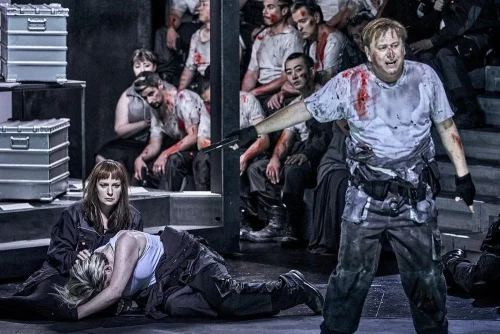
On top of this, Bayreuth offers a dull production dominated by grey concrete and long staircases, which quickly become tiring to look at. The Hungarian directors Alexandra Szemerédy and Magdolna Parditka have certainly come up with various ideas to avoid simple stand-and-sing theatre, but the invented scenes they add make little sense. This is especially true of the suggested incest between Rienzi and his sister Irene, an allusion to the Wälsung pair in Die Walküre. It does not seem convincing, however, because Irene returns Adriano’s love. Adriano, who is torn between his own opposing family and Irene’s father Colonna, is a woman in this production. This too feels like an arbitrary decision that offers no real new insight.
The sick boy who appears during the staged illustration of the prelude, first walking on crutches, visibly suffering and finally dying, may represent Rienzi’s young brother, who originally died in one of the street battles between the rival noble families. This mysterious and dark scene fits the prelude quite convincingly.
Later, during the large ballet sequence in the second act, the Capitol turns into the Bayreuth Festspielhaus, and characters from Wagner operas wearing bearskins and winged helmets from productions long past take over this theatre within the theatre. It raises a smile and is, in fact, a small coup that works well at this point.
Otherwise, the evening drags on heavily, placing a great burden on the singers. The performers are not to blame. By the second performance, all are in fine voice, above all Andreas Schager with his seemingly endless reserves. He masters the “shouter”, as Wagner himself is said to have called his title character, without the slightest sign of fatigue. Only when he finally has to sing to the melody of the lyrical and festive leitmotif does his voice sound strained and stiff as he pushes upwards. And although Schager in particular sings with mostly very clear diction, surtitles would still have been welcome.
It is true that the complete libretto in the 1871 version was included free of charge with the richly illustrated programme. But who wants to read the libretto during the interval? It is much better to be able to follow it during the opera, as 3sat made possible in its television broadcast.
The two singers Gabriela Scherer as Irene and Jennifer Holloway as Adriano also handle their demanding roles confidently and securely in the upper register, although there is still room for improvement in their tone production. Unfortunately, neither has a particularly lean vocal line, and Scherer in particular sings for long stretches with too much and too heavy a vibrato.
From the rest of the cast, Andreas Bauer-Kanabas as Colonna and Vitalij Kowaljow in the small and rather inconspicuous role of Cardinal Raimondo deserve special mention, both with deep, full and resonant voices.
The greatest musical achievement, however, belongs to conductor Nathalie Stutzmann. She handles both the special challenges of Bayreuth’s difficult orchestra pit and the heavily involved Bayreuth Festival Chorus very well. She does justice to the splendour of the music, while also bringing an almost impressionistic lightness that benefits this enormous score.
This Rienzi at the Festspielhaus was intended as a one-off experiment. And although the audience at the second performance celebrated the singers and the conductor just as enthusiastically as at the premiere, one can only hope that it remains a one-off. The work itself is simply not suited to having a permanent place in the repertoire.