
Bayerische Staatsoper, Munich, 5 April 2026
Richard Wagner: Parsifal
During Easter, few operas feel more fitting than Richard Wagner’s final work, Parsifal—or, as he called it, a Bühnenweihfestspiel. This epic piece, with all its mysticism, beauty, pain, and depth, offers directors a vast range of possible interpretations. But something more baffling than the 2018 production at the Bavarian State Opera by Pierre Audi and Georg Baselitz is hard to imagine. Audi, who has shown real skill throughout his career, here seems to have completely given in to Baselitz’s strange artistic world and let him do as he pleased. There is no clear direction in how the characters are handled, and instead one is left to view the whole thing as a series of large, moving paintings.
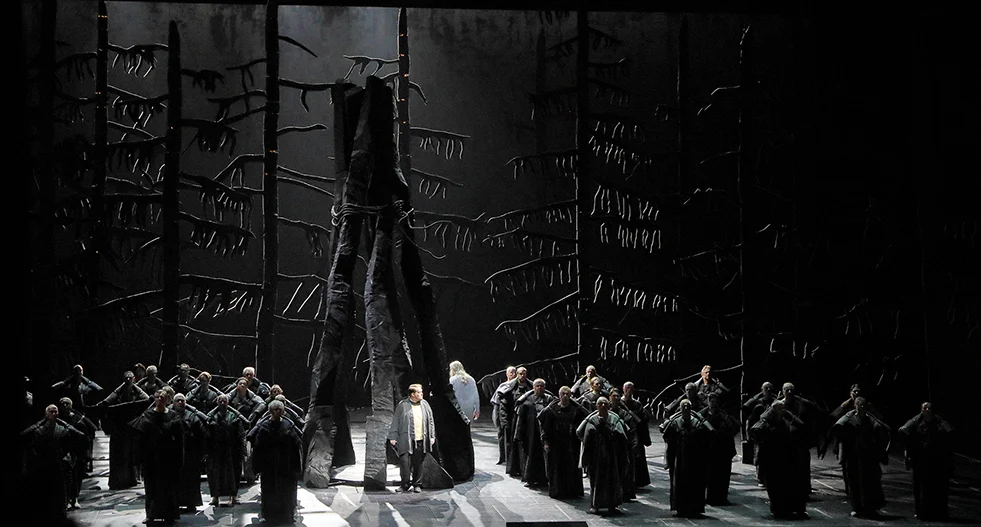
The aim of the production seems to be to create some kind of visual effect through all these disturbing images, groupings, and costumes. In recent years, it has become very fashionable to bring in visual artists to direct opera—one obvious example being Romeo Castellucci, who brought a new production of Tannhäuser at the Bavarian State Opera in 2017. This kind of work can certainly provoke strong reactions. The problem, however, is that these artists tend to forget that opera is a living art form, with a story that unfolds over time and with real human beings on stage. Opera singers are, after all, not puppets, and this kind of art belongs more in museums and galleries than on the opera stage.
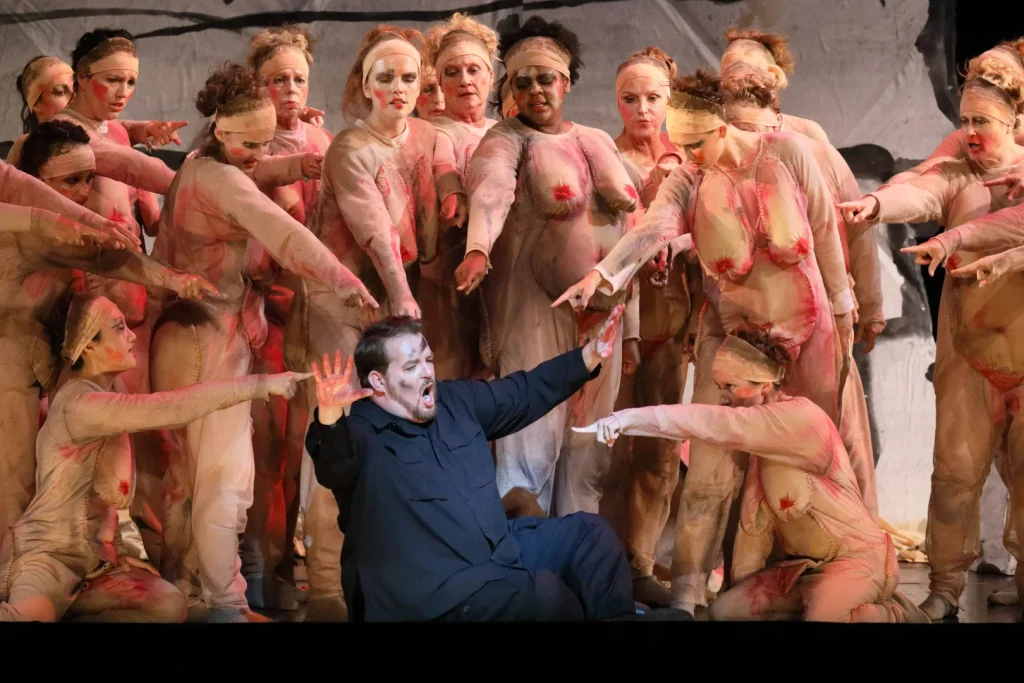
Evenhtough the vocal performance is overall quite convincing, it really never takes of and does not bring much of greater enjoyment. A good performance of Parsifal depends on having a truly strong Gurnemanz. Christof Fischesser does have a fine bass voice, with both weight and warmth, but his interpretation lacks some urgency and intensity. The role demands a much stronger sense of storytelling and interpretation to be fully convincing. Peter Mattei, one of the finest singers of Amfortas in the last century, sings with musicality and vocal control, but tends to be dry and somewhat robotic in his interpretation. As Klingsor and Titurel, Josef Wagner and Bálint Szabó give solid performances. Anja Kampe as Kundry shows better vocal control than before, but the interpretation falls short—last time I heard her in the role, she definitely had more mystery and intensity. The voice of Clay Hilley in the title role carries well enough, even if it is not especially powerful, but it has little in the way of beauty, sheen, or elegance.
The highlight—and saving grace—of the evening is the chorus and orchestra. Under the excellent direction of Sebastian Weigle, they deliver a wide range of dynamic nuance and a rich, full sound, in a musical flow that never runs dry or loses its sense of intoxicating mystery.