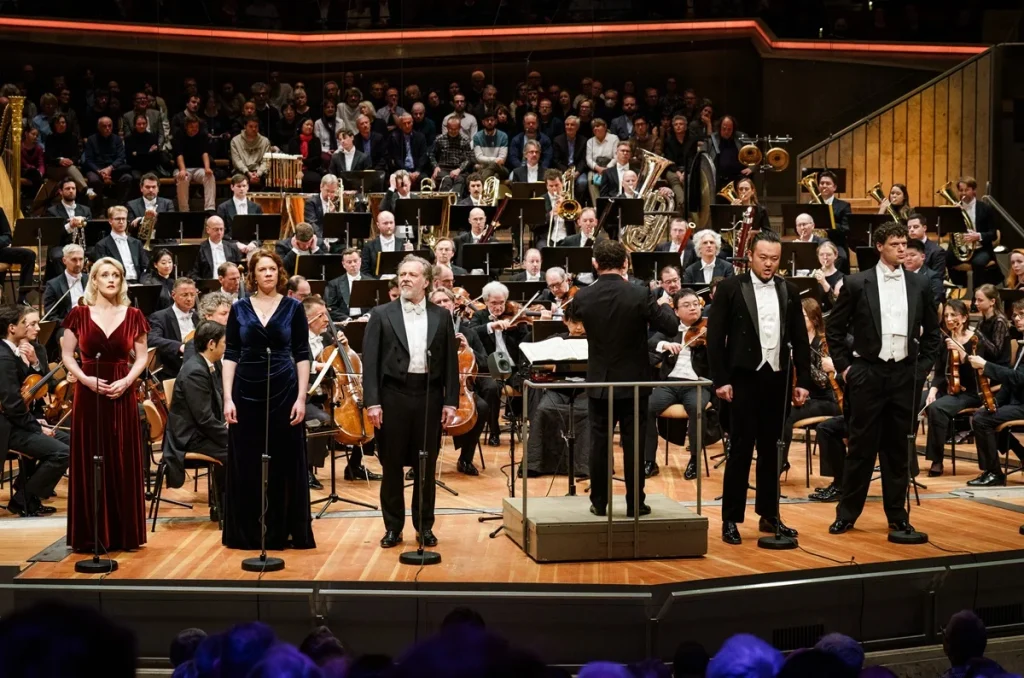
Philharmonie, Berlin, 10 April 2026
Richard Wagner: Das Rheingold
It has long been a tradition of the Berlin Philharmonic to round off their Easter Festival productions with a concert performance back home at the Philharmonie in Berlin. For anyone who prefers not to be distracted by far-fetched or overloaded staging, this is an ideal chance to focus entirely on the music.
After the orchestra’s return to Salzburg was met with enthusiastic acclaim from both audiences and critics, expectations were naturally very high. Judging by the strong applause, they were largely met for most of the audience — among them former Chancellor Merkel, as well as older couples experiencing their first Wagner opera.
Kirill Petrenko, well versed in Wagner from his highly successful years at the Bavarian State Opera, was of course not conducting his first Rheingold here. His reading stood out above all for its strong sense of drama. He is also a pleasure to watch on the podium, as he clearly shares the joy he finds in making music with his orchestra. And the Berliners’ magnificent brass alone — with its unmatched brilliance and superb ensemble playing — made this a performance that will not be quickly forgotten. Still, it should be said: what Petrenko offers is a lot, but, as comparisons with Christian Thielemann suggest, there is room for more, especially in terms of dynamics, color, and the shaping of long musical arcs.
This is already evident in the prelude, which Wagner marks piano across many bars in all parts — even adding “always piano” after 40 bars. Yet quite apart from the fact that the strings entering later — beginning with the cellos, which first suggest the flowing movement of the water — and the winds are not always perfectly together for a few bars, the horns, trombones, and contrabass tuba come in far too loudly on their low E-flat, covering the strings. With such powerful, naturally loud instruments, Petrenko should have made a point of holding them back much more.
The same issue affects some of the vocal soloists, who bring attractive but relatively small voices, such as Brenton Ryan’s Loge, Leigh Melrose’s Alberich, or Thomas Cilluffo’s Mime. They could have come across more clearly if Petrenko had reined in the orchestra more at their entrances, especially in the secondary lines.
In general, Petrenko pushes the orchestra to extremes at the top end of the dynamic range, but in doing so spends his resources too early. This leaves little room to build further in key moments such as Alberich’s curse, Fafner’s murder of his brother, or Donner’s summons before the gods’ final entry into Valhalla.
On the quieter side, he adjusts things far less often, and some passages could have sounded more delicate, more eerie, or more lyrical. For instance, when Fasolt (sung with a rich, full voice by Le Bu) rhapsodizes about Freia (“ein Weib zu gewinnen, das wonnig und mild”), when Alberich shows Wotan and Loge his Tarnhelm in Nibelheim, or when Fricka, Froh, and Donner worry about Freia, whose golden apples of eternal youth they can no longer enjoy after the giants have taken her away as a pledge.
A clear strength of the performance was how well the words could be understood across most of the cast. Above all, Christian Gerhaher’s Wotan stood out. His interpretation bears the mark of great lieder singing, and it is striking how much vocal power he can bring when needed — especially since his Amfortas in Parsifal in Munich in 2018 sounded more restrained.
Leigh Melrose’s Alberich is also easy to follow at all times — even when he spits out his lines in a whisper, every word comes through. Still, his strongly speech-driven style sometimes leaves the melodic line a little underplayed. There were also minor drawbacks with Patrick Guetti’s Fafner, whose voice did not always sit quite securely and at times sounded a bit throaty, and with Sara Brady’s Freia, which had a rather tight vibrato.
Among the less internationally known singers, there were some discoveries of real Bayreuth quality. First and foremost, Catriona Morison’s Fricka: a warm mezzo-soprano with great glow, agile across the range, and an interpreter who brings real humanity to the role, especially in her concern for her sister. And Jasmin White, blessed with one of the most beautiful and powerful contralto voices of her generation, turns the smaller role of Erda into something truly major.
The three Rhinemaidens — Louise Foor, Yajie Zhang, and Jess Dandy — were also cast above average and blended very well together.
Even so, the overall preparation may be rated a little too highly, especially when measured against the Rheingold with which Christian Thielemann opened the season at the Berlin State Opera. His subtle command of sound, fine dynamic shading, and long, carefully built musical arcs remain simply unmatched.