Bayerische Staatsoper, Munich, 6 November 2026
Giuseppe Verdi: Un ballo in maschera
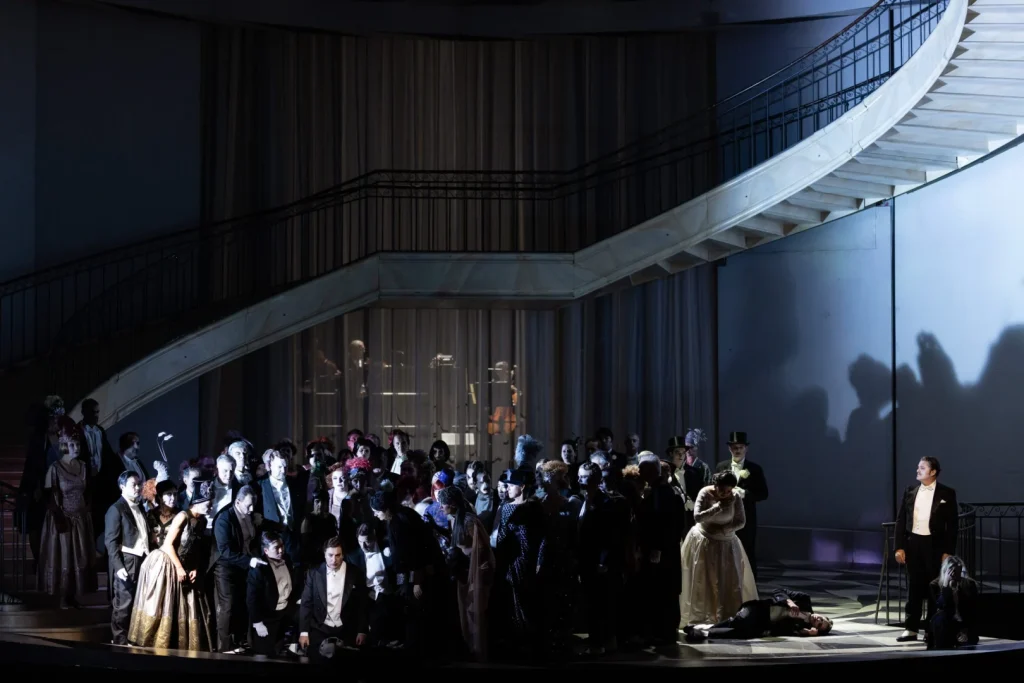
Johannes Erath’s production of Verdi’s Un ballo in maschera at the Bavarian State Opera, which premiered in 2016, is an elegant but rather superficial interpretation of the opera. Erath creates a black-and-white aesthetic, reminiscent of classic Hollywood films, with a prominent spiral staircase and a large bed symbolising the tragic love story. The stage design by Heike Scheele is visually impressive, while Gesine Völlm’s costumes contribute to the elegant appearance. However, the production favours visual effects over dramatic substance.
The large bed, which dominates the stage and is mirrored upside down above it, becomes a central symbol of the relationship between Riccardo, Amelia and Renato. The idea is effective, but Erath does little to develop it further. The characters often seem to move through a series of carefully arranged images rather than developing genuine dramatic relationships. Particularly the conflict between friendship, love and betrayal lacks psychological depth and dramatic tension. Although visually attractive, the production remains dramatically rather unconvincing.
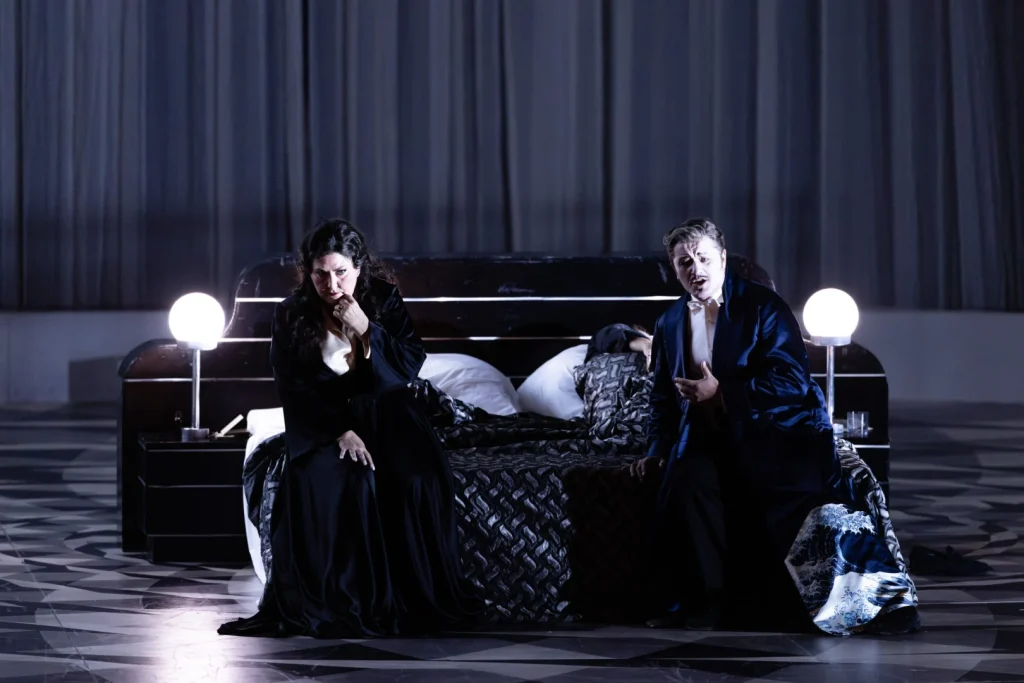
Musically, however, the performance was of a very high level. Piotr Beczała gave a magnificent Riccardo, undoubtedly one of the roles that suit his voice best. His beautiful, brilliant tenor has the perfect timbre for the character, combining power with lyrical elegance and delicacy. His singing was passionate and expressive, with excellent phrasing and remarkable vocal control. Boris Pinkhasovich was equally convincing as Renato, with his rich, resonant baritone, combining dramatic depth with great elegance. His beautiful phrasing and vocal intensity brought both authority and emotional expression to the character.
Anna Pirozzi gave a solid performance as Amelia, with a powerful soprano that has the necessary volume and dramatic weight for this demanding Verdi role. However, her singing sometimes lacked variation and nuance, particularly in the more lyrical passages, where greater sensitivity would have been desirable. Yulia Matochkina was excellent as Ulrica, with her dark, powerful mezzo-soprano and impressive vocal depth. Her singing was full of mystery and intensity, giving the character a convincing and almost threatening presence. Erika Baikoff was brilliant as Oscar, with her clear, agile soprano and excellent coloratura technique, singing with great freshness and elegance.
Marco Armiliato conducted the Bayerisches Staatsorchester with his characteristic understanding of Verdi’s music, delivering a passionate and dramatically convincing interpretation. His direction was full of energy, although some passages could have been a little more sharp-edged to achieve greater dramatic effect. Nevertheless, he maintained an excellent balance between singers and orchestra, allowing the music to unfold naturally. The Bayerisches Staatsorchester delivered its usual outstanding performance.