Metropolitan Opera, New York, 8 October 2026
Giuseppe Verdi: Macbeth
Shakespeare and Verdi represent one of the most successful pairings in operatic history. Although their births were separated by some 250 years, the Italian composer was a lifelong admirer of the Bard, obsessively determined to do justice to his works whenever he adapted one of his plays for the operatic stage. His determination was such that, while composing Macbeth, he enlisted the help of a second librettist, Andrea Maffei, when he felt that his trusted collaborator, Francesco Maria Piave, was failing to capture the dramatic essence of Shakespeare’s writing.
A remarkably innovative opera, Macbeth marked an important step in Verdi’s departure from some of the established conventions of belcanto, paving the way for the groundbreaking Rigoletto, which would forever change the course of operatic history. The absence of a conventional love story and the heightened importance of dramatic expression over vocal display were among the innovations that contributed to its success at its 1847 premiere in Florence, but which may also have played a part in the disappointing reception of its 1865 revision in Paris, where audiences were more attached to operatic conventions.
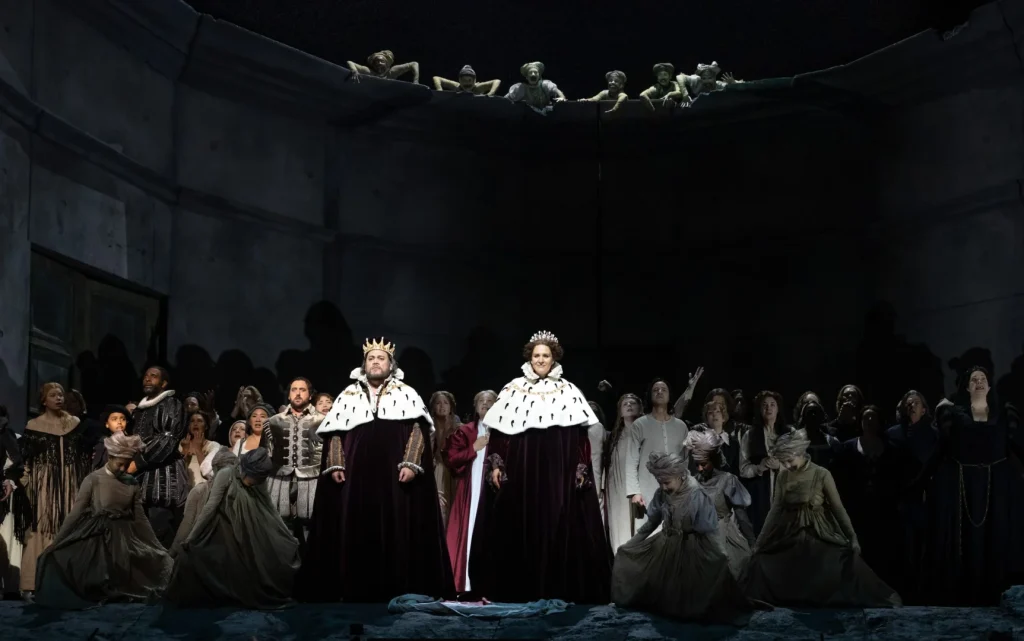
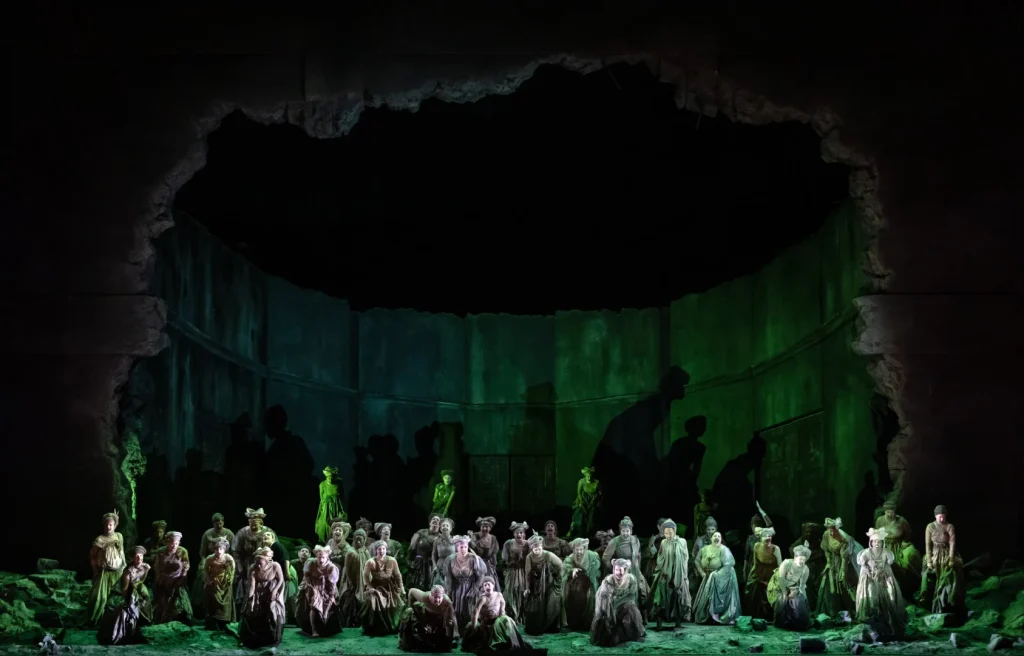
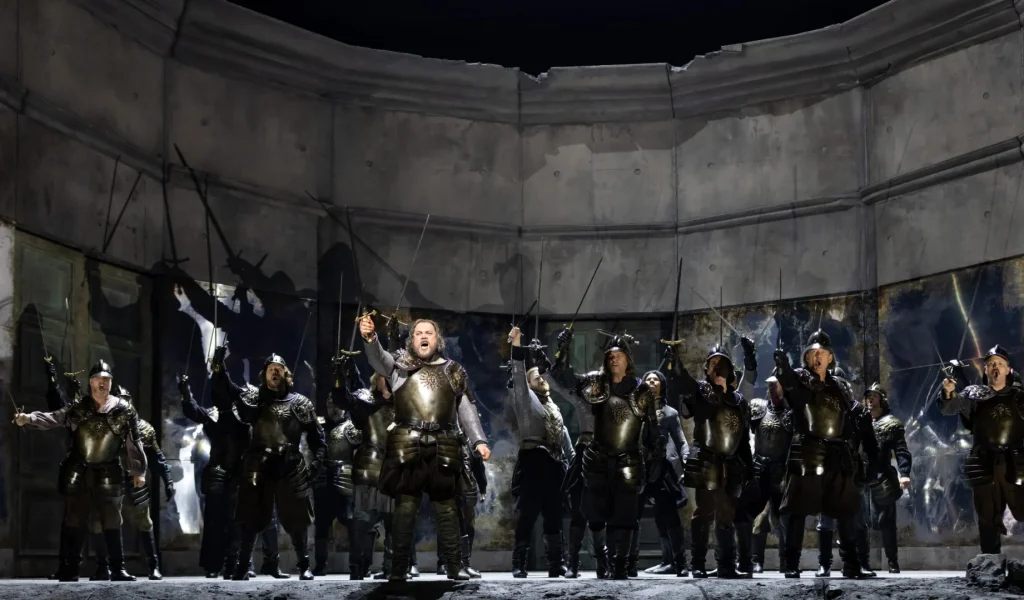
Don’t go to the Met expecting the story to unfold in 11th-century medieval Scotland, as German stage director Louisa Proske opens the opera amid what could be described as the ruins of a modern building. A massive, jagged opening dominates the set, its exposed metal bars suggesting a violent breach that left the building in ruins. It separates the relatively small front section from the much larger space behind it, revealing the Met’s revolving stage, where much of the action unfolds. The return of this ruined setting in Act III suggests that it may be the witches’ domain.
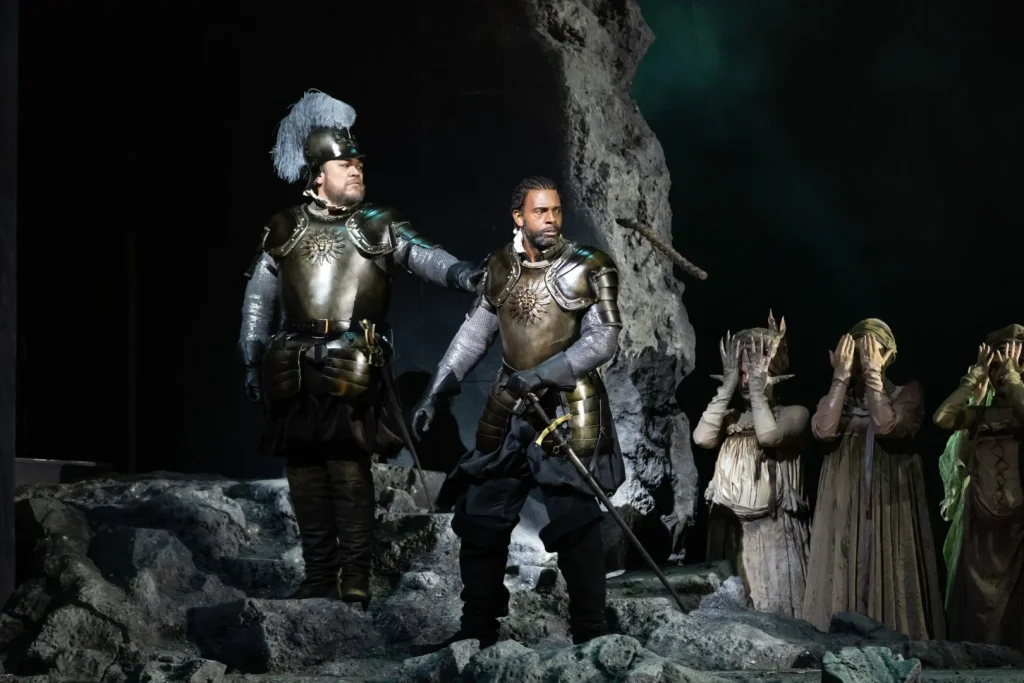
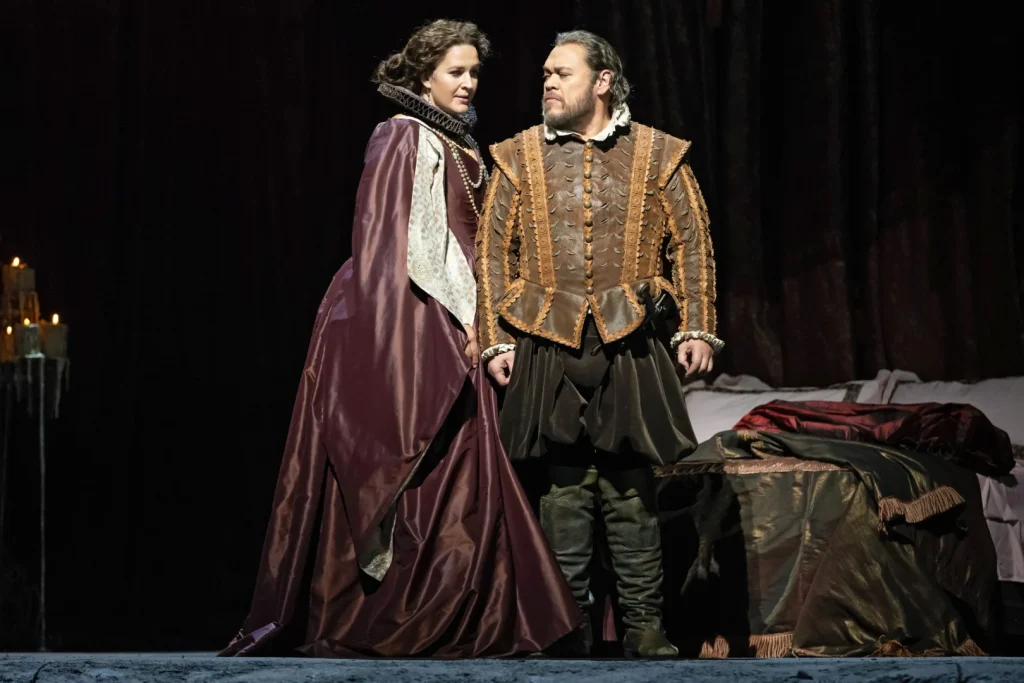
The Macbeths, along with the rest of the characters, with the exception of the witches, are dressed in Tudor-era attire, evocative of the late 15th and 16th centuries. After the opening scene, Macbeth’s castle is revealed through the Met’s revolving stage. In stark contrast to the modern-looking ruins of the opening, the castle initially presents a regal and elegant, Renaissance-inspired appearance that complements the characters’ costumes. It gradually deteriorates as the opera progresses, culminating in a ruinous version of itself in Act IV, complete with uneven, sloping floors resembling a series of ramps, almost mirroring the declining psychological states of the two murderous protagonists.
Unlike the other characters, the witches seem to exist outside any recognisable historical setting, dressed in loose, earth-toned garments and distinctive fabric headwraps that give them an almost otherworldly appearance. They behave like a disorderly mob, savage and almost cannibalistic in their demeanour, and remain present throughout the opera, watching the events unfolding inside Macbeth’s castle through the jagged opening, as though they were controlling the characters’ actions or eagerly anticipating their consequences. This striking contrast between the modern ruins, the Tudor-inspired costumes and castle, alongside the witches’ otherworldly appearance and feral behaviour, creates a disjointed and cursed world that, in my opinion, provides the perfect setting for a story as dark as Macbeth. It seems to be a world beyond redemption, so much so that, at the end of the opera, the witches themselves crown Fleance, Banquo’s son, as the new king, almost as if to suggest that the cycle is destined to continue.
The production boasts superb choreography and action direction throughout the opera. The opening scene, Banquo’s murder and Act IV feature plenty of convincing military action, with exhilarating fight sequences involving not only the supernumeraries but also the principal singers, who are seamlessly integrated into the action. Meanwhile, in Act III, the witches move from one perversely disturbing choreographic sequence to another, including the ballet composed for the opera’s 1865 Paris revision. These sequences are the cherry on top of an already excellent production of Macbeth.
Musically, however, the results were considerably more uneven.
At the podium was Met Music Director Yannick Nézet-Séguin, conducting the always-outstanding Met Orchestra. A great conductor of German opera, as demonstrated by his recent Tristan und Isolde, Salome and Lohengrin, he has been less consistent when it comes to Italian opera at the Met, in my opinion. His Tosca, for instance, was marred by occasional coordination issues with the singers, while his La forza del destino suffered from excessively drawn-out tempi. In this Macbeth, however, he fared much better, maintaining consistent tempi throughout while displaying a solid rapport with his singers. My main reservation was the recurring tendency of the orchestra to overpower the singers, though never to an intolerable degree.
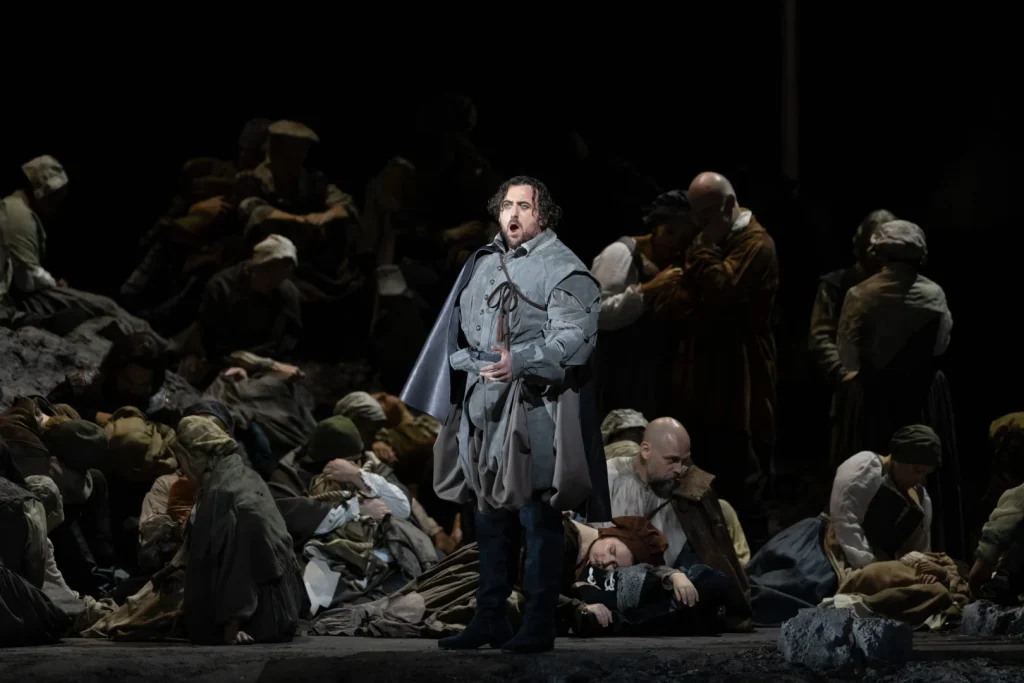
Hawaiian baritone and Met favourite Quinn Kelsey took on the title role. While his voice is big and resonant enough to fill a house the size of the Met—already a considerable achievement—it lacks some of the weight and grit that the role demands. Throughout the evening, his singing was often excessively nasal and occasionally straight-toned, depriving his performance of some of the vocal richness and expressive variety that one expects from a Verdi baritone. While Macbeth is undoubtedly pusillanimous and even pathetic on occasion, Kelsey’s portrayal was often too monotonous, lacking the dramatic range that the character requires.
One questionable choice was the decision to sing the words ‘Pietà, rispetto, amore’ (Mercy, respect, love) rather than ‘Pietà, rispetto, onore’ (Mercy, respect, honour) in Macbeth’s Act IV aria. Verdian musicological research has advanced considerably in recent decades, and we now know that the latter reflects Verdi’s intended text. Macbeth is not an opera about love. The relationship between Macbeth and Lady Macbeth is not one defined by love, and love itself has little place in this opera. It therefore makes little sense for Macbeth to lament its absence in his aria, whereas lamenting his loss of honour is entirely consistent with his character and downfall. While Kelsey’s rendition of the aria was solid, there is simply no reason in 2026 to continue disregarding Verdi’s intended text. Of course, responsibility for this choice does not fall on Kelsey alone. Nézet-Séguin, as the production’s musical director, should have a decisive say in such matters.
Making her role debut in this run, Norwegian soprano Lise Davidsen portrayed Lady Macbeth. An absolute vocal powerhouse, it’s no secret that she is more comfortable in German opera (her Marschallin remains one of the best things I’ve ever heard at the Met) than in the Italian repertoire, which she has only recently begun to explore. Lady Macbeth is an extremely difficult role, one whose demands make it almost impossible for any soprano to tick every box. Given the weight and size of her dramatic soprano voice, it was hardly surprising that Davidsen struggled with the role’s most agile passages, such as ‘Or tutti, sorgete‘, even with the help of Nézet-Séguin’s rallentandi. Her lower and lower-middle registers also lacked some of the projection of her formidable upper register, a contrast made more apparent by Nézet-Séguin’s tendency to let the orchestra overpower her in those passages. In the more dramatic passages, by contrast, she truly thrived. ‘Vieni! t’affretta!’ was very well sung, while the sleepwalking scene in Act IV revealed a degree of vocal nuance I hadn’t expected from her. Above all, ‘La luce langue’ was my personal highlight of the evening, sung absolutely superbly.
In some of her previous outings in Italian opera, such as the title role in Tosca and Leonora in La forza del destino, I found her acting somewhat uncomfortable and emotionally distant. Here, however, she was noticeably more convincing, fully engaged in the action and effectively portraying Lady Macbeth’s manipulation of her husband. Her portrayal in the sleepwalking scene was particularly compelling.
As Banquo, American bass-baritone Ryan Speedo Green struggled to project his voice over the orchestra. This was particularly evident in the opening scene, where he shared the stage with Kelsey, whose far more resonant voice clearly overshadowed his. Acting-wise, however, he fared much better. His camaraderie with Macbeth at the beginning was convincing, his participation in the fight sequences was excellent and his appearance as Banquo’s ghost in Act II was particularly impressive, aided by Proske’s imaginative staging. Nevertheless, his commendable dramatic performance could not entirely compensate for his vocal shortcomings. British-Italian tenor Freddie De Tommaso, on the other hand, was one of the high points of the evening as Macduff, delivering a performance marked by a strong voice and a convincing dramatic portrayal. His rendition of ‘Ah, la paterna mano’ was a particular highlight, even if his high notes occasionally sounded a little sharp.
The Met Chorus, as always, delivered a first-rate performance. ‘Patria oppressa’ was sung flawlessly, while the witches’ choruses were thoroughly compelling, their singing capturing the sinister and grotesque nature of Verdi’s writing.
All in all, Proske’s staging is a resounding success, making this Macbeth well worth seeing despite the highs and lows of its vocal performances. The Metropolitan Opera has undoubtedly found a production of Verdi’s tragedy that deserves to remain in its repertoire for years to come.