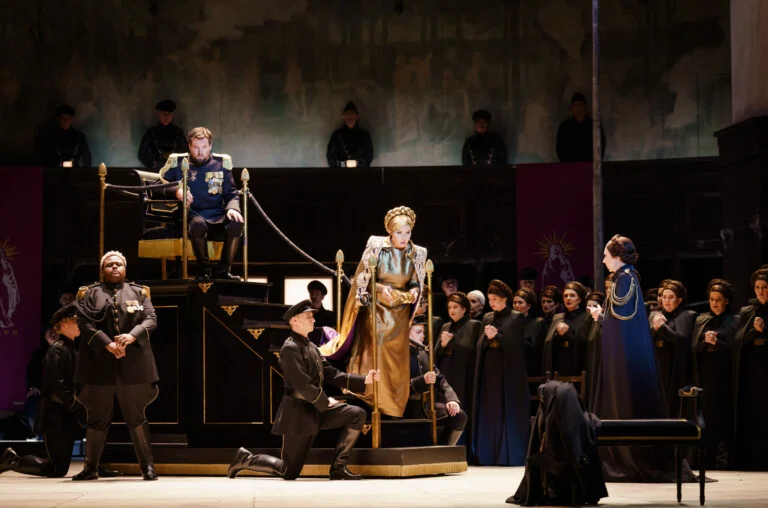
Staatsoper Unter den Linden, Berlin, 26 September 2026
Gaspare Spontini: La Vestale
Without Maria Callas, La Vestale would probably have been completely forgotten, like Gaspare Spontini’s other 21 music dramas. In 1954, in a production by the legendary director Luchino Visconti, she triumphed in the title role at La Scala in Milan, naturally sung in Italian.
In later decades, the work appeared only rarely on opera-house schedules: in 1993, again at La Scala under Riccardo Muti, or in 2019 at the Theater an der Wien in a production prepared by Bertrand de Billy.
Now, for the first time since Spontini’s own lifetime, the Berlin State Opera has brought his best-known drama back into its repertoire. Spontini shaped the history of the house from 1820 to 1841 as its first General Music Director and made a strong impression on the young Richard Wagner. In 1844, Wagner invited his colleague to Dresden to conduct La Vestale. He later adopted Spontini’s famous three-note “fate motif” in his Ring des Nibelungen and took inspiration from his vast choral tableaux.
But Spontini left his mark not only in Berlin but earlier in Paris, where he wrote La Vestale in 1805. This explains why the Palazzetto Bru Zane strongly supported the opera’s revival in 2022, and why the Berlin State Opera and the Opéra national de Paris joined forces for a co-production.
The fact that the result is only partly convincing is mainly due to the staging. Lydia Steier translates the repressive system of the cult of Vesta — from which the priestess Julia breaks free under threat of death by declaring her love for the general Licinius and breaking her vow of chastity — into rather far-fetched images of a totalitarian military regime. Drawing on Margaret Atwood’s futuristic novel The Handmaid’s Tale, which has been adapted for the screen several times, she unsettles the audience from the very overture with drastic images of hanged bodies against a black wall. Beneath them is a piece of graffiti that, in the face of such misery, feels like sheer cynicism: “Talis est ordo deorum” (“Such is the order of the gods”). The music, however, is by no means as threatening or dark. Stylistically, it sounds more like a mixture of Gluck, Rossini and the later grand opera of Giacomo Meyerbeer.
The gap between the brutal events on stage and the far more harmonious music continues throughout the evening and already reaches a peak in the first act with scenes of physical violence, blood-covered bodies and terror. Chief among them is the High Vestal, portrayed with terrifying grandeur by Marina Prudenskaya as a sadist who brutally torments all the other Vestal Virgins. At times this may also bring to mind disturbing films such as The Magdalene Sisters or Pray for Us, which has just premiered at the San Sebastián Film Festival. In these films, “fallen girls” and “rebellious young women” who have had premarital sex are placed at the mercy of cruel nuns who abuse and tyrannise them. Taken on its own, the story Steier tells is compelling. It simply does not correspond to the score and libretto. Nor were the Vestal Virgins of early Christian Rome merely victims. They were certainly subject to patriarchal constraints and the demand for virginity, but they also enjoyed special privileges and, through their appointment, gained legal independence from their fathers.
When Steier places the sacred fire of the goddess Vesta, which under the priestesses’ supervision must never be allowed to go out, in the amphitheatre of the Sorbonne in Paris — the set is by Etienne Pluss — and has books burned there, associations with the Nazi book burnings directly beside the opera house inevitably arise.
By then at the latest, one suspects that the lieto fine, the happy ending, will not survive in this production. As expected, dark scenes follow that sit very uneasily with the light-footed ballet music of the finale.
In the process, the director has badly neglected one of her main tasks: working with the singers so that they can make their emotions believable on stage.
The title role is certainly cast with a star soprano in Sonya Yoncheva, who makes clear from the very first note that she has the vocal resources the part requires. But Julia’s fatal passion for Licinius remains something we are simply asked to accept. There is little spark between her and David Butt Philip’s rather understated Licinius, both vocally and dramatically. The two sing alongside each other rather than with each other, and it does not help that video flashbacks show how they once loved one another. This is not to say that Philip is unequal to the role. He sings and shapes it with confidence, but he is blessed with a noticeably smaller tenor voice than the much sought-after Michael Spyres, who sang the role in Paris.
The direction, so focused on terror, horror and gruesome images, fails when it comes to the great emotions that are, after all, at the heart of this work.
That is particularly unfortunate for Yoncheva, one of the few singers in her field capable of coping with such a massive role at all. At first, in the heavily strained upper register, she may come close to shouting. But in her great monologues, her tone production becomes much more secure. The Bulgarian soprano handles her Julia with great volume, agility, the necessary dramatic force and a timbre that, in a less exposed register, can certainly be called beautiful.
Alongside Butt Philip, Siyabonga Maqungo, by now an established member of the company, provides another tenor with more substantial vocal gifts as Licinius’s friend Cinna. His noble timbre suits the French language in which the opera is sung here very well.
Musically, in fact, the production is more fortunate. At the beginning, however, conductor Carlo Rizzi shows a certain uncertainty in coordinating the score with what is happening on stage. After the first act, the impression is of a solidly playing Staatskapelle Berlin, with some slight roughness in the brass and an audible uncertainty between the relaxed character of the music and the cruelty of the stage action.
After that, however, the orchestra increasingly finds its freedom. The sound becomes more transparent, the playing more refined, and the horns — especially the virtuoso solo in the aria “Toi que j’implore avec effroi” (“You whom I invoke in terror”) — sound as exquisite and flawless as they last did under Thielemann in Bruckner’s Fourth. Only, of course, more graceful.
It was always likely that a work from the fringes of the repertoire would struggle even at a major opera house in Berlin. Seats in the stalls were already empty at the premiere. With more compelling direction, La Vestale might nevertheless have had a chance to win over an audience. The ensemble, the superbly prepared and much-employed Staatsoper chorus, the conductor and orchestra all received loud applause. The production team, by contrast, was met with a storm of boos.