Bayerische Staatsoper, Munich, 9 November 2025
Pietro Mascagni: Cavalleria Rusticana
Ruggero Leoncavallo: Pagliacci
There are two main challenges when Cavalleria rusticana and Pagliacci are presented together in one production. The first is finding singers who can truly perform in the verismo style, where passion is intense and unrestrained. The second is creating a natural link that connects the two stories into one continuous sequence.
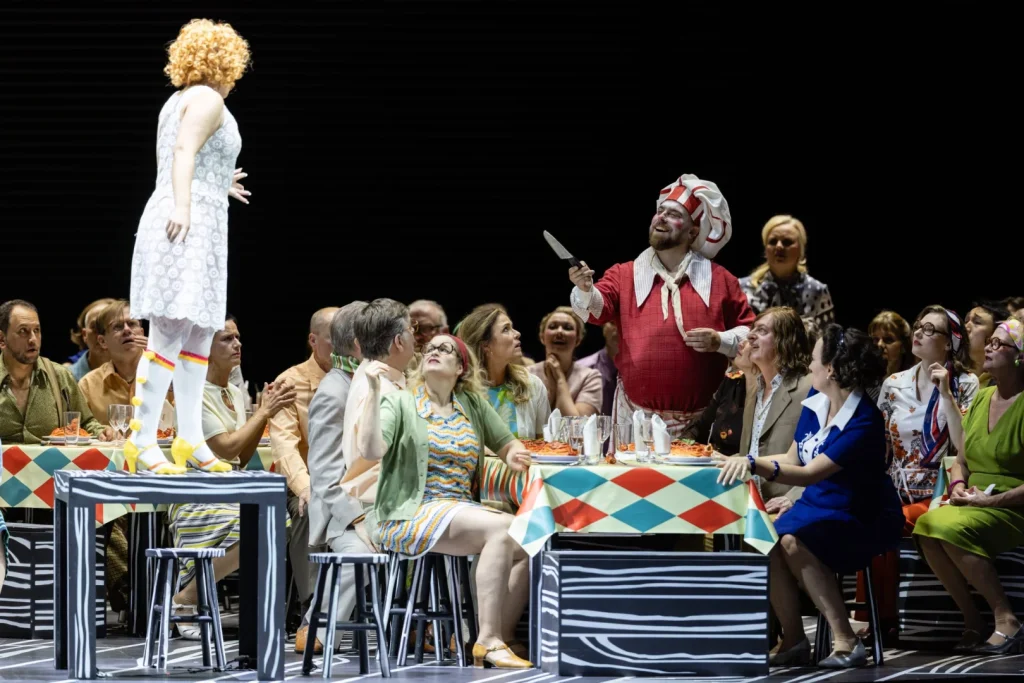
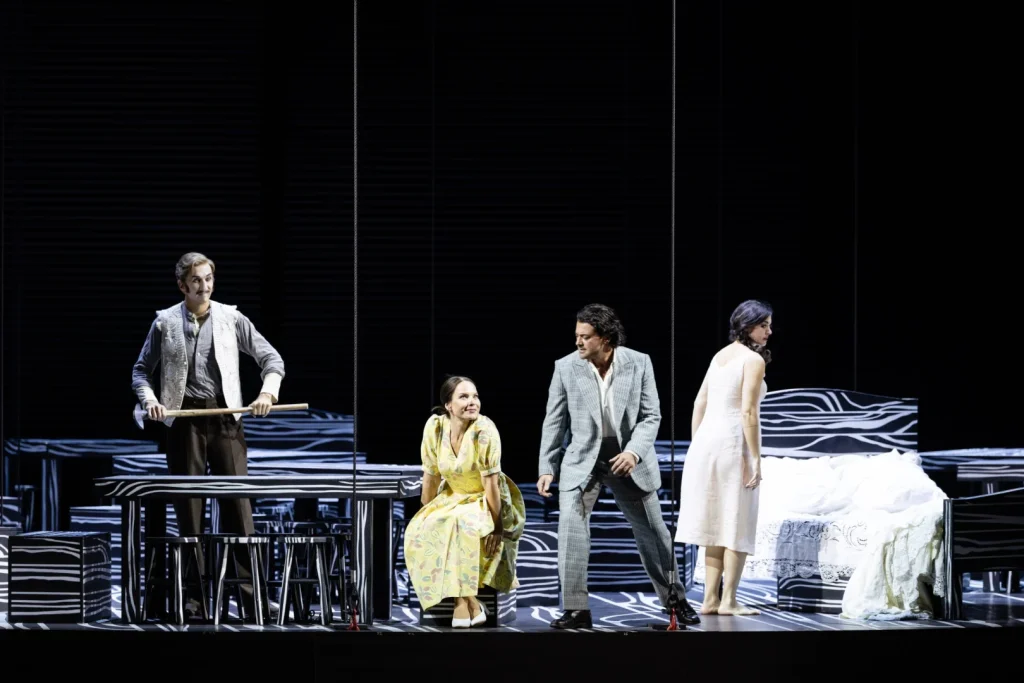
In Francesco Micheli’s production of “Cav&Pag” at the Bavarian State Opera, which premiered last season, he does exactly that: he turns the two operas into one life story. Turiddu loses his footing and his roots in Sicily and then reappears in the second opera, now in Munich, as Canio—the same man, but uprooted and living within an Italian migrant community. Edoardo Sanchi’s stage design makes this journey clear, and Daniela Cernigliaro’s costumes show a carefully thought-out sense of period and style. Cavalleria plays out in a small, enclosed space that feels almost ritualistic, but it is unfortunately quite static, with little dramatic movement or development. In Pagliacci, by contrast, the setting opens into a busy scene, full of life, with moving market stalls, a restaurant, a street stage, and a television showing the 1970 World Cup semifinal between Italy and Germany. The first part of the production felt rather lifeless, but the second part burst into a world built on constant improvisation.
Antonino Fogliani gave a masterful verismo interpretation of both operas, shaping the tempo with a lively and flexible pulse. The Bayerisches Staatsorchester played with clear, expressive colors—never heavy, always immediate. The result felt direct and alive, as if the emotions were unfolding in front of us rather than coming from a distant past.
Unfortunately, this season’s cast was not very successful. Vittorio Grigolo does not have the vocal weight needed for Turiddu; without the natural power of a spinto tenor, he ends up seeming almost parodic, especially with his exaggerated acting. Elina Garanca has more than enough volume and technique for Santuzza, but her interpretation feels too restrained and careful. Luca Salsi is the only one fully convincing in Cavalleria, giving an idiomatic and solid portrayal of Alfio with his strong baritone.
As Canio, Yonghoon Lee certainly has the necessary vocal power, but his performance lacks natural verismo drama, and his almost robotic acting makes this even more noticeable. Gabriele Viviani, on the other hand, does not have a massive voice, but still gives a convincing Tonio. Ailyn Pérez is the star of the evening, offering a superb Nedda—emotionally charged, technically excellent, with beautiful legato lines and delicate piano singing.