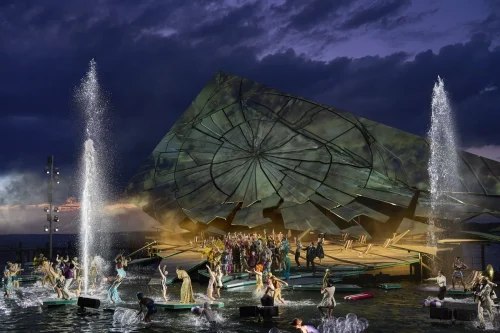
Seebühne, Bregenz, 22 July 2026
Giuseppe Verdi: La traviata
There are still several popular operas that can be performed without an interval in two and a half hours and have not yet been staged on the Lake Stage. Giuseppe Verdi’s La Traviata is one of them, and expectations were high for the 80th anniversary of the Bregenz Festival, especially after the promising debut of the new artistic director, Lilli Paasikivi, with Enescu’s Oedipe last year. All performances have long been sold out, and the festival on Lake Constance needs this kind of financial success in view of strict budget cuts and a €2.1 million reduction in public funding.
Such strong demand cannot be taken for granted, since attending the festival has become an expensive pleasure. A double room in a mid-range three-star hotel can cost €300 for a single night, unless visitors stay in the surrounding area of Vorarlberg. But prices there have also risen during the festival season, as they have in restaurants. Even so, many classical music fans are willing to spend more because of the magnificent location and the beautiful natural setting on Lake Constance. Alongside artistic quality, this is probably the festival’s greatest asset.
Bringing such an intimate love story to such a large stage is not easy, although Andreas Homoki proved that it could be done with his delicate production of Puccini’s Madame Butterfly in 2022.
The Italian director Damiano Michieletto, who has rightly received much attention for his recent cinema debut Vivaldi and Me, finds this challenge more difficult. His production feels cold and unconvincing in many of its details.
A shattered mirror rising at an angle into the sky dominates Paolo Fantin’s set. It is a metaphor for the broken life of the desirable “fallen woman,” who, marked by illness, moves alone towards death outside the grand parties where she meets her admirers and suitors.
Michieletto shows several fragments of her memories as video projections on the enormous wall, including meetings with her doctor.
These ideas are certainly understandable and coherent, although from a distance the structure could just as easily be mistaken for a volcanic crater.
The lavish party scenes naturally include several spectacular show numbers. Some synchronised water-ballet sequences are attractive to watch, but they are no more essential to the story than the revue numbers in the style of the 1920s, with glamorous glittering costumes and feather boas by Carla Teti, as well as impressive fountains.
In the final scene, a huge black sphere moves eerily out of the broken mirror, leaving the audience to wonder what it means. Is it a symbol of illness and death, like the black mark on Violetta’s dress?
The story, based on Alexandre Dumas’s novel The Lady of the Camellias, is actually set in Parisian salons around 1850, and Verdi’s music, which has nothing at all of the musical about it, is written accordingly.
Strictly speaking, the Lake Stage, with the enormous pool of water in the foreground left over from the previous production of Der Freischütz, is therefore not especially well suited to this opera. It also raises the question of why Alfredo and his father Germont repeatedly wade through the water as though they were taking a Kneipp cure.
The greatest problem, however, is that Michieletto keeps the heroine, her lover and Germont, the father who forces her to give up her chance of happiness in love, far too distant from one another on stage. The lovers rarely touch. They do not even look each other in the eyes, let alone create a single moment of charged attraction between them.
Passion, desire, melancholy, disappointment, jealousy and pain: the great emotions literally fall into the water in this cold production.
Above all, Julien Behr’s Alfredo, with his stiff and reserved manner, is not convincing as an ardent lover. He often stands rooted to the spot, several times in the water, for no apparent reason. His declarations of love and his pleading remain mere assertions. Vocally, however, the French tenor improves over the course of the evening. His upper register gradually gains more warmth, and his singing becomes cleaner and lighter in the higher range.
Marjukka Tepponen, his partner as Violetta, has more to offer. She is the discovery of the opening night, impressing as a virtuoso with secure high notes. She effortlessly reaches the high E-flat at the end of the cabaletta “Sempre libera,” sings beautifully and with devotion, and at least makes Violetta’s suffering believable.
Vladimir Stoyanov is also in commanding voice, acting and singing Germont with the necessary severity.
Musically, the production was entirely convincing, with respectable casting even in the smaller roles. Alongside Tepponen, the Vienna Symphony Orchestra under Kirill Karabits became the evening’s second major highlight, bringing extraordinary dynamic and tonal subtlety to the score. The prelude and the corresponding passages in the third act sounded softly iridescent, while the orchestra opened up fully when the music demanded the high spirits of the party scenes.
Throughout the performance, one quality could be heard that is rarely found elsewhere. With the exception of the ecstatic choral scenes, Verdi’s accompanying figures did not sound like jaunty “oom-pah” rhythms, but fitted naturally into the music’s underlying melancholy. Perhaps Karabits learned this from the brilliant Verdi conductor Riccardo Muti, who repeatedly stresses this point in his opera academies until he is almost hoarse.
In any case, Karabits proved to be a far better Verdi conductor than the overrated Enrique Mazzola, who has appeared several times at this venue.
The brief and polite applause at the end also made one thing clear: the audience has seen better productions here and has high expectations. It is fortunate that Wagner’s The Flying Dutchman is scheduled for 2028. Its story is far better suited to the Lake Stage.