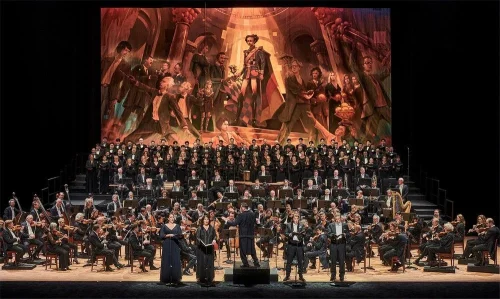
Festspielhaus, Bayreuth, 25 July 2026
Richard Wagner: Overture to Die Meistersinger von Nürnberg
Richard Wagner: Entry of the Guests from Tannhäuser
Ludwig van Beethoven: Symphony No. 9
What a rare and unusual sight: the Bayreuth Festival Orchestra on the stage. Yet even there, its sound, in every dynamic shade, is every bit as impressive as when it plays, unseen by the audience, in Bayreuth’s unique covered pit.
Beethoven’s Ninth Symphony, chosen to open the Wagner Festival’s 150th anniversary season, has a long tradition on the Green Hill. Among living conductors, Christian Thielemann is the only one to receive the distinction of conducting the work here after Richard Strauss (1933), Paul Hindemith (1953), Wilhelm Furtwängler (1951 and 1954), and Karl Böhm (1963). Nor is this his first anniversary performance: he also stood on the podium in 2001 for the festival’s 125th anniversary.
After keeping a somewhat lower profile in Bayreuth in recent years and not taking on a new production for quite some time, the festival’s biggest audience draw is once again at the very heart of proceedings. For 26 years he has helped shape Bayreuth’s artistic history, over a longer period than anyone else. He is also the musical director of the eagerly awaited anniversary Ring, featuring AI-generated visuals.
It is hard to imagine anyone else leading this ceremonial occasion, which also included the Prelude to Die Meistersinger von Nürnberg and the Entry of the Guests from Tannhäuser, interspersed with a series of speeches. Wagner and Beethoven are a combination that Thielemann brings together like no one else.
The speeches, delivered by German Chancellor Friedrich Merz, Bavarian Minister-President Markus Söder, festival director Katharina Wagner, and her cousin Nike Wagner, could be summed up quite briefly. Unsurprisingly, they returned to the issue that has dominated the cultural pages for weeks: the withdrawal and subsequent reinstatement of Michel Friedman, and with it the festival’s dark history during the Third Reich.
In that context, it was particularly well received when Nike Wagner remembered her aunt Friedelind, who emigrated to the United States in the early 1940s and, alone among the family, openly opposed the Nazi regime and especially her mother Winifred, who was closely associated with Adolf Hitler.
Nike Wagner also, thankfully, acknowledged that the Wagner family’s long stewardship of Bayreuth had its positive side. After all, who knows what would have become of the Bayreuth Festival Theatre without the brothers Wieland and Wolfgang Wagner, whose achievements laid the foundations for New Bayreuth in post-war Germany? It was good to hear someone with real authority say so so clearly. All the more because a new film by the acclaimed Polish director Paweł Pawlikowski, Fatherland, featuring a distinguished cast of German actors and premiered to considerable attention at Cannes a few months ago, will soon reach cinemas. Seen through the eyes of Thomas and Erika Mann, it offers a nuanced portrait of post-war Germany’s cultural elite, but it portrays Wagner’s grandsons in an unfairly negative light. In one scene, they approach Thomas Mann, who has returned to Germany for a lecture tour, asking for his support in rebuilding Bayreuth. His response, spoken by Hanns Zischler, is: “The best thing would be to level the Green Hill—and their mother with it.”
Pawlikowski has certainly exaggerated Thomas Mann’s ambivalence. After all, the writer briefly considered becoming president of the newly founded festival. But how many people watching the film will know that? At a screening I attended recently at the Karlovy Vary Festival, many in the audience laughed at that scene.
Against that background, one feels all the more grateful that history took a different course, especially when such outstanding music-making marks this important anniversary.
Once again, it was remarkable how Christian Thielemann managed to keep the Meistersinger Prelude lean while still allowing it to glow with the dignity the occasion demanded. Personally, I would have welcomed a slightly broader opening, though that would hardly have suited the strongly politicised speeches about Wagner that preceded it. Even so, Richard Wagner once again found in Christian Thielemann his finest advocate on the podium. Here, and again in the Entry of the Guests from Tannhäuser, with the excellent Festival Chorus, he conjured a sound of irresistible nobility.
Yet this was only a foretaste of the symphonic masterpiece to come, in which Thielemann once again revealed the full range of his mastery in the Classical and Romantic repertoire, fresh and free of routine.
The first two movements of the Ninth offered a textbook demonstration of how tonal perfection can be combined with elasticity and flawless legato. Above all in the Molto vivace, the playing had an effortless lightness, making the movement’s intricate polyphony exceptionally clear, while sounding less abrasive than in many historically informed performances. For long stretches, the music unfolded in the finest gradations of pianissimo, creating an almost chamber-like intimacy. Then, as individual themes collided and intensified, Thielemann—who moments earlier had been tracing the violin lines with expressive gestures—responded with commanding force.
But the truly magical moment came in the Adagio, when the first violins sang their dolcissimo melodies with a warmth and expressiveness that no singers could have surpassed, producing a velvety tone of extraordinary beauty. The wind players—especially the oboe, clarinet, bassoon, and horn—matched that legato playing at every turn, whether in their playful or lyrical contributions. Their dialogue was so perfectly balanced that for several bars Thielemann simply stood and listened.
A first-rate, experienced conductor knows when to make the smallest adjustments, when to rein in a great orchestra, and when simply to let it play. Zubin Mehta once said as much, and this performance could hardly have illustrated that wisdom more clearly.
Often it is simply the atmosphere that the magician on the podium communicates to the orchestra—the immense calm he radiates, nowhere more so than at the entrance of the lower strings when they first introduce the “Ode to Joy” theme. In the charged silence before that moment, it felt as though Thielemann had stopped time. The pause seemed to last three minutes, filled with such tension that no one dared breathe, and that was exactly what was needed to prepare inwardly for the almost impossibly soft, seemingly quadruple pianissimo that followed. Once again, it seemed to me that Thielemann had surpassed himself. Then again, perhaps it only felt that way because every time he conducts this work, with whatever orchestra, he approaches it with the same devotion as though it were his very first performance.
The quartet of soloists was equally well chosen. Above all, Georg Zeppenfeld and Klaus Florian Vogt, stepping in for the indisposed Piotr Beczała, delivered their prominent solos with depth, clarity of diction, and conviction. Only Elza van den Heever, in her duet with Christa Mayer, sounded strained in the demanding high passages, at times almost bordering on hysteria. Or was that intentional?
In his book on Beethoven, Thielemann writes that Schiller’s vision of universal brotherhood in the “Ode to Joy” finds expression in Beethoven’s score through the chorus’s seemingly boundless dramatic and dynamic climaxes, which carry an element of hysteria. That was not really the impression this opening concert gave. Instead, the highly committed Festival Chorus, superbly prepared by Thomas Eitler-de Lint, projected a joyful fervour that inspired hope. If nothing else, there was hope in Markus Söder’s promise that politicians would continue to give Bayreuth’s artistic and cultural life the support it needs. One can only hope he will be held to his word, because the festival’s financial situation is deeply worrying.
The applause, cries of “bravo”, and stamping of feet seemed endless after the final chord. It is hard to imagine this music being performed with greater emotional intensity or greater sensitivity.