Musikverein, Vienna, 3 and 4 October 2026
Anton Bruckner: Symphony No. 8
Several great conductors gave their finest Bruckner performances late in life: Eugen Jochum, Günter Wand, Zubin Mehta and, above all, Sergiu Celibidache. It is no coincidence that Celibidache’s name is more closely associated with Bruckner than any other conductor’s. No one of his time devoted himself to the composer with such love and dedication.
It comes as no surprise that Riccardo Muti is now joining this distinguished company with such passion. In 2024, he had already given a magnificent performance of the Eighth Symphony with the Vienna Philharmonic in Salzburg. Even then, it was impossible not to hear how close he was coming to Celibidache, particularly in his wonderfully broad tempos, his expressive range from the deepest sorrow to overwhelming bliss, and the sheer power and density of sound in the fortissimo passages.
Muti’s outstanding recent performance of Bruckner’s Eighth at Vienna’s Musikverein also provides further proof, after Celibidache’s death, of the Romanian conductor’s unerring instinct. It is worth recalling that Celibidache once said of the then young Muti, with great admiration, that he was the greatest talent he knew. What a pity he could not hear him now.
For everything that made the wise Romanian’s interpretations so special, qualities rarely encountered in concert halls today, was present here, even more strikingly in the second performance on Sunday morning than the day before. It was an exceptionally rare listening experience.
Muti’s slow tempos, with performances lasting around 93 to 95 minutes (Celibidache, by comparison, took between 97 and 107 minutes), were ideally chosen even for the first concert in the afternoon. But it was noticeable that the musicians were still having some difficulty with them. Hardly any other conductor asks them to play at such slow tempos.
At certain points in that first performance, the strings seemed inclined to speed up slightly, which almost, but only almost, caused the different sections to lose their precise coordination. Most of the audience probably did not notice anyway, and this slight uncertainty had already disappeared by the following morning’s concert.
On closer inspection, however, there was something good about it. Perfect performances of the kind we are used to hearing on recordings, where everything can be edited in the studio until it is flawless, can seem almost inhuman. Musicians, even the very greatest, occasionally make mistakes. Thank God. That is, fortunately, what distinguishes them from robots and artificial intelligence. Small inaccuracies and slips have a charm of their own.
Both performances were pure magic in every respect. Bruckner’s many stairways to heaven, rising throughout all four movements, were impressive not merely for their dynamic power. They made the whole body vibrate, beginning with an extraordinarily sensitive range of expressive nuances.
This was especially intense in the solemn Adagio, when the music moves towards its climax in a state of supreme bliss and reaches it in a rush of profound ecstasy. This must be what paradise feels like, one thinks, filled with happiness as though flooded with endorphins. One wants to remain there, already longing for the next moment of ecstasy.
And it follows immediately. But alas, this time it does not lead to supreme happiness. Instead, within a single bar, everything suddenly plunges into catastrophe. The hope of redemption has vanished. All that remains is the longing for it.
Yet anyone familiar with Bruckner knows that although these moments of festive ecstasy repeatedly collapse into desolate emptiness, his music never ends there. In the end, there is always catharsis, hope, redemption and reconciliation. Only gods can truly express such things in music, as Celibidache once said. And with Muti, that is exactly how it feels.
This was true not only of these radical emotional roller-coaster rides, but also of the quiet, chamber-like passages between them: the lonely dialogues between horn and oboe, accompanied by just a few strings in the Allegro moderato, or the infinitely tender melodies of the lower strings, whose sound was wonderfully rich, full-bodied and robust.
The crowning glory of the Adagio, however, was the ethereal beauty of the strings in one of the loveliest lyrical passages in all of Bruckner’s symphonies. The music shimmered above the silvery glow of the harps, like light over a lake, shifting from bar to bar between gentle melancholy, wistfulness, consolation and grandeur.
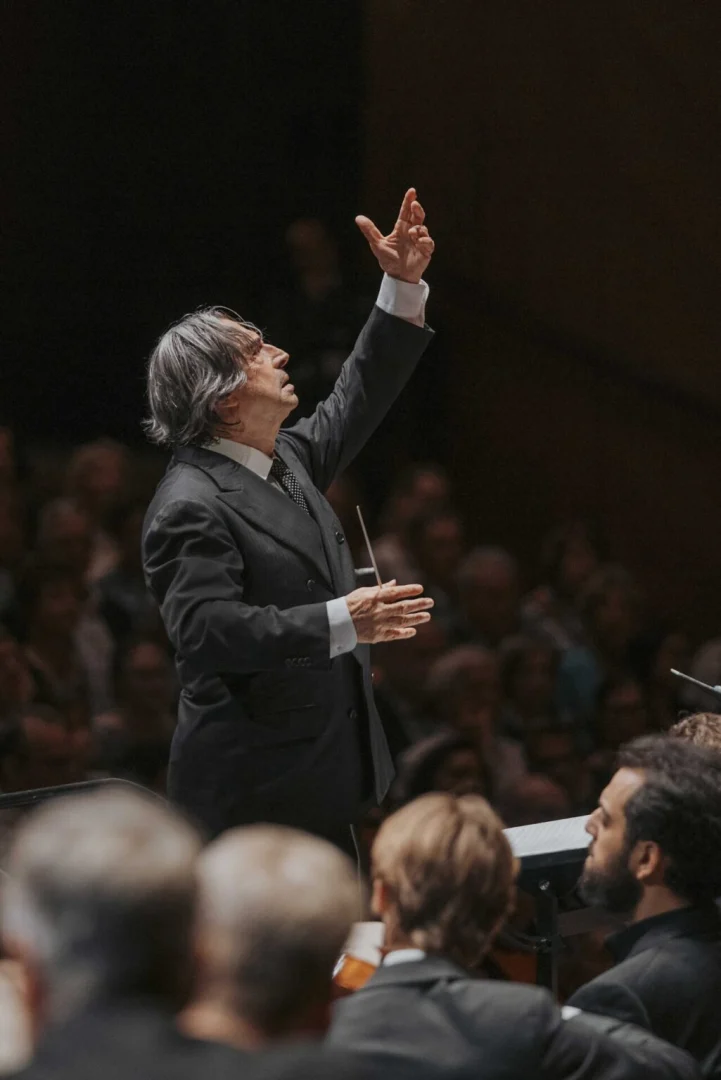
Throughout all this, one could see how sensitively Muti responded to the musicians, almost like a seismograph. When some of them were still struggling a little with the slow tempos in the first concert, he had to give more emphatic cues at certain points. This was especially true in the second movement, where, after numerous changes of tempo, Muti thankfully became considerably slower than most conductors today.
He also gave appropriately powerful signals for the sudden fortepiano effects in many of the high strings’ melodies, which he shaped with long, sweeping phrases, celebrating them with the devotion of a priest.
But there were also moments when he lowered his baton for a few seconds. This happened when the Vienna Philharmonic’s superb wind soloists were confidently exchanging phrases in chamber-like passages, or when a crescendo led by concertmaster Volkhard Steude developed naturally on its own.
After 55 years of working together, Muti knows exactly when to keep a tight rein on the orchestra and when to let it play freely. Sometimes a glance exchanged with Steude is enough.
The finale, unfortunately so often taken much too fast, revealed another small miracle of a very different kind. The wonderfully moderate, slow tempo was one thing. But there was also the fugato towards the end, beginning in the finest shades of piano and unfolding with remarkable transparency and lightness.
This requires an inner calm and serenity that only someone who possesses these qualities himself can bring about. Muti has them, and communicates them through his mere presence.
At the end of this deeply moving musical journey, which concluded in a single great triumph, one was left with a profound sense of gratitude.
The richness of Bruckner’s sound, with its solemn brass fanfares, can only unfold fully when the music is given the time it needs to reveal all its splendour. We are unlikely to hear it performed quite like this again anytime soon.