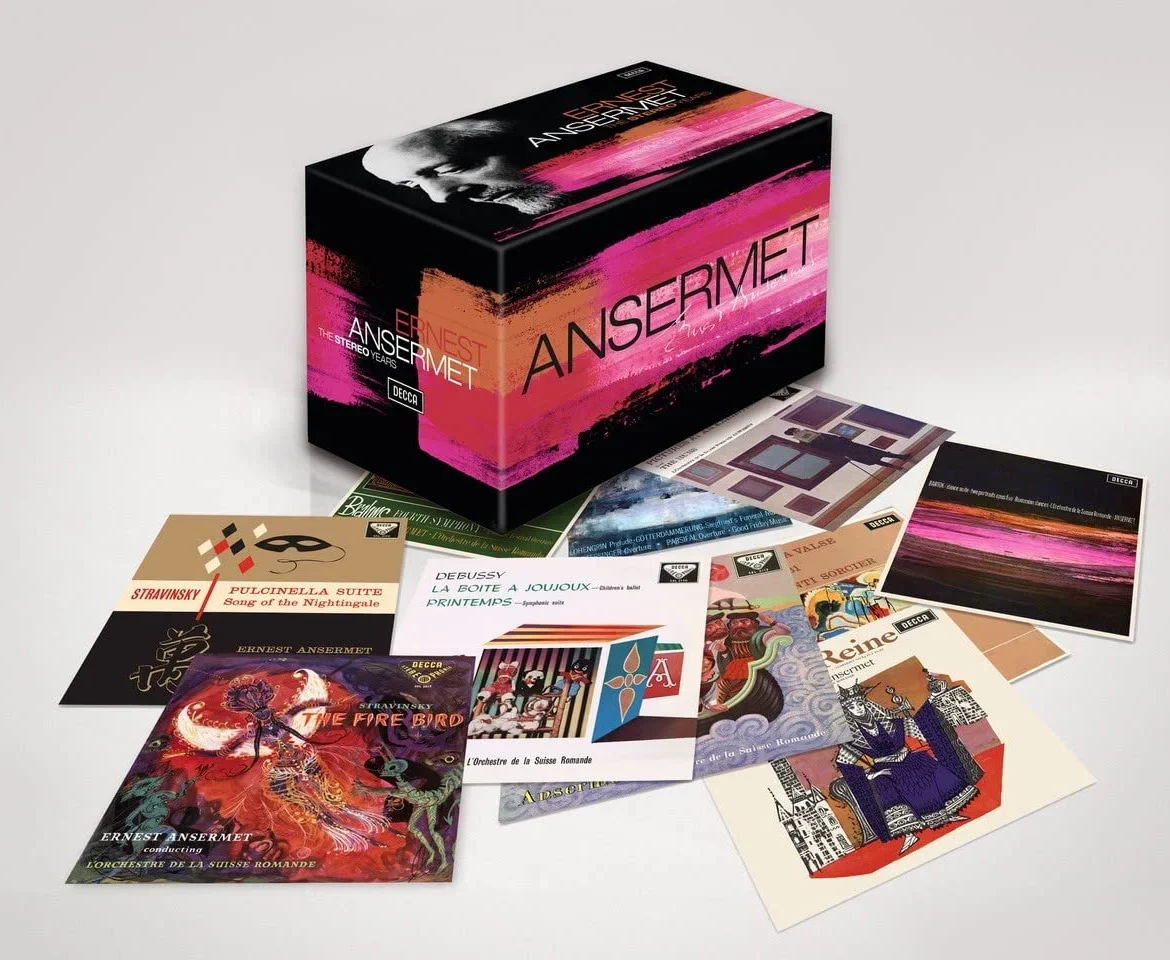
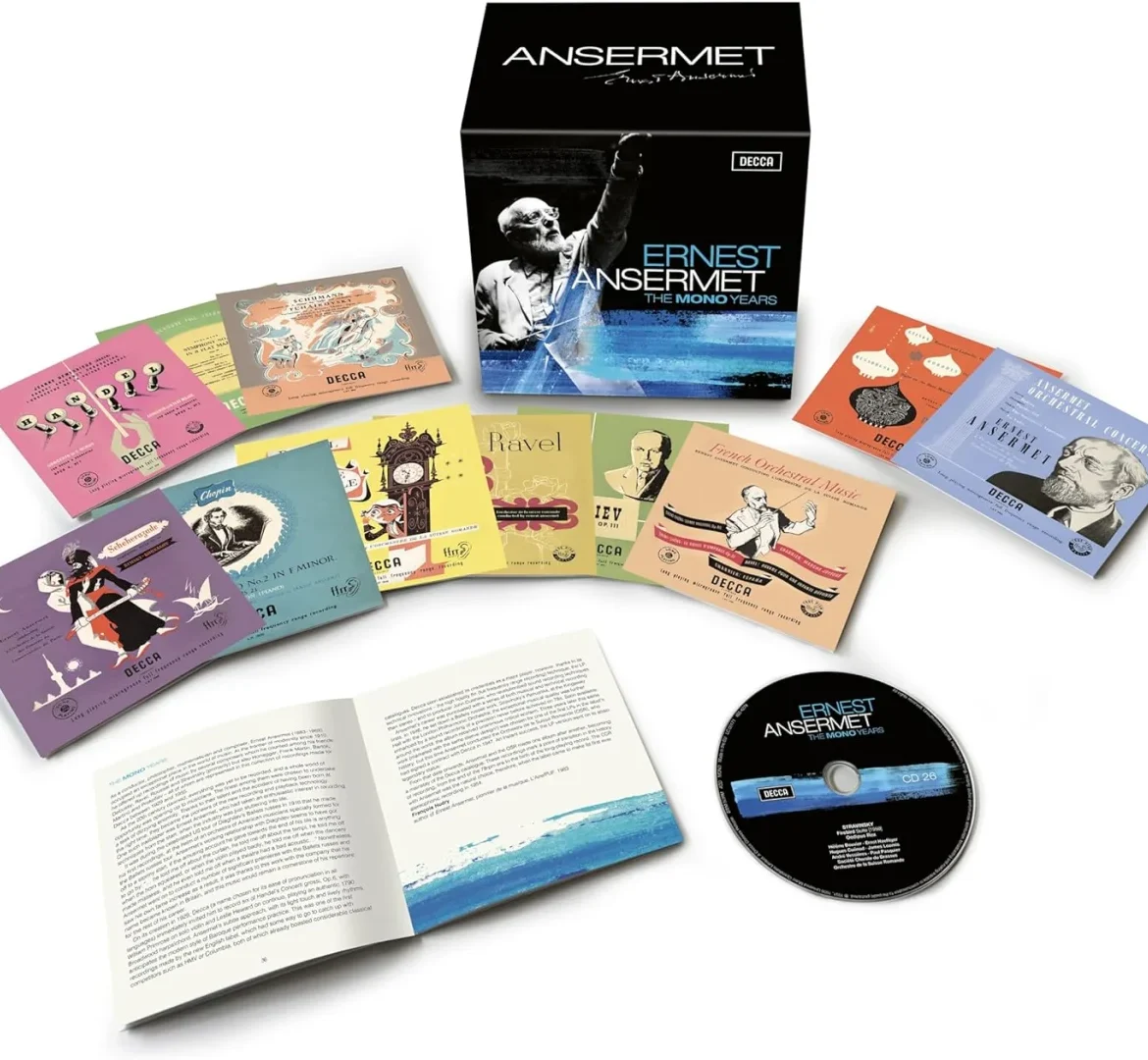
It’s impossible to write the musical history of the 20th century without mentioning the Swiss conductor Ernest Ansermet (1883–1969). He knew most of the century’s leading composers and gave the first performances of countless works. Between 1915 and 1923 he was also chief conductor of Diaghilev’s famous Russian Ballet. With his long beard and sharply defined features—traits that made many assume he was Russian—he seems always to be there in the background somehow. Some years ago Decca released an 88-CD box set of all his stereo recordings for the label, where his greatness as a conductor is evident throughout (a box set for mono recordings too).
He was, in many ways, a controversial figure because he never minced his words. In his 1961 book Les fondements de la musique dans la conscience humaine, he used philosophical arguments drawn from phenomenology to try to prove that Schoenberg’s atonal doctrine was misguided. This put Ansermet at odds with the avant-garde of his time. Yet he had much stronger ties with many other leading composers—Debussy, Ravel, Stravinsky, Martin, Roussel, de Falla, Bartók and Honegger—whom he championed tirelessly in the concert hall and on record.
Ansermet was one of Decca’s most important conductors, and his recordings always sold well. He was also technically curious, which is why the label chose him in 1954 to launch its new stereo sound together with the orchestra he had founded in Geneva in 1918, the Orchestre de la Suisse Romande. When Decca’s engineers played back the results in the control room, the Swiss maestro was astonished and immediately decided to re-record everything he had previously done in mono. Even today, the clarity, brilliance and dynamic range of these more-than-70-year-old recordings is astonishing—and ought to make a few of today’s record producers blush, at least a little.
The Orchestre de la Suisse Romande, which appears on virtually all the recordings in the box sets, has taken some criticism over the years for its orchestral execution. And yes, the ensemble certainly does not have the brilliance of, say, the Berlin or Vienna Philharmonic. But it has an idiomatic feel above all for French repertoire and for 20th-century music. The results are usually highly convincing, surely thanks to Ansermet’s carefully thought-out—and exceptionally well-rehearsed—interpretations. He combines an almost mathematical precision (he had originally been a professor of mathematics) with sensitive phrasing and nuance. His performances of Debussy, Ravel and Stravinsky, in particular, have an authenticity that is unique and indispensable.
The box sets also reveals the breadth of the Swiss conductor’s repertoire, which goes far beyond the French and Russian. In the 1960s, Decca also recorded Haydn, Mendelssohn, Schumann, and complete cycles of Beethoven’s and Brahms’s symphonies with Ansermet and his Swiss orchestra. Sibelius’s Second and Fourth Symphonies appear as well, somewhat unexpectedly. The Haydn Paris Symphonies are given with an ideal mix of elegance and vital drive. The Beethoven and Brahms interpretations, while not among the very greatest, stand out for a freshness that distinguishes them within the vast number of recordings on the market.
Ansermet has been criticized for his objectivity, but I personally believe that this is his strength. It lies in his instinctive feel for small details—details that create a special atmosphere and draw us listeners straight into the music without anything getting in the way—combined with an unfailing sense of musical architecture as a whole. Perhaps that, in the end, is the real heart of the matter.