Bayerische Staatsoper, Munich, 21 October 2026
Gaetano Donizetti: Lucrezia Borgia
Gaetano Donizetti’s Lucrezia Borgia, premiered at La Scala in 1833, is based on Victor Hugo’s drama of the same name, with a libretto by Felice Romani. The opera portrays the notorious Renaissance noblewoman not only as a ruthless murderer, but also as a desperate mother trying to protect her son Gennaro, who does not know her identity. It is precisely this contradiction between cruelty and maternal love that gives the opera its dramatic intensity.
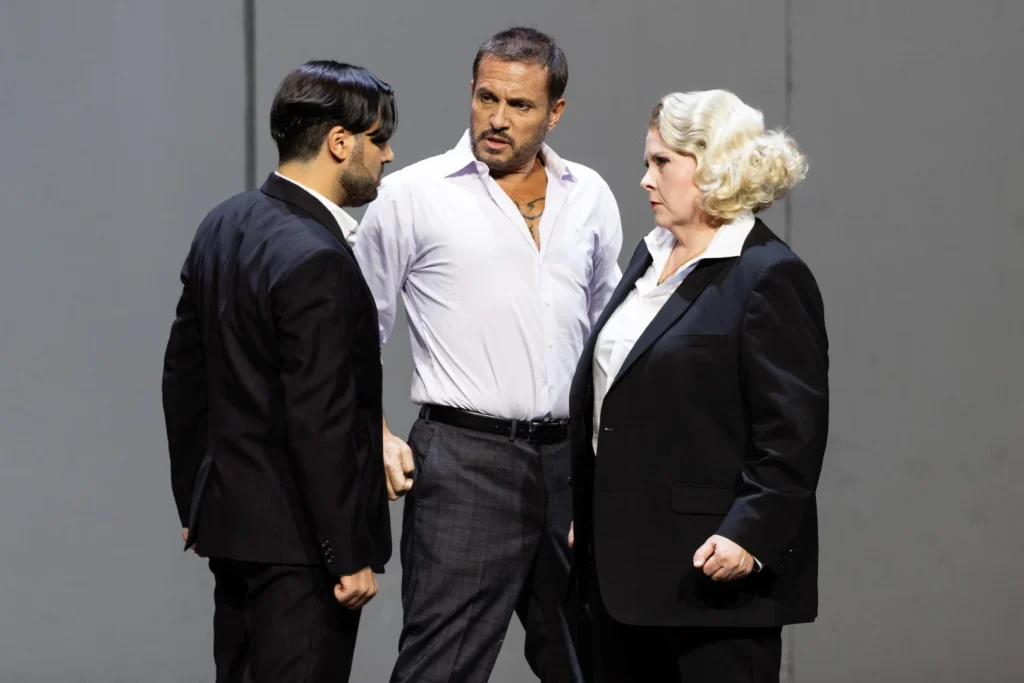
Christof Loy’s production at the Bavarian State Opera, which premiered in 2009 with the legendary Edita Gruberova in the title role, returns to the Nationaltheater after several years. I actually saw this production at Göteborgsoperan in Gothenburg, Sweden, back in 2012, and due its lack of scenic details, it has remained surprisingly clear in my memory. Loy places the action on a largely empty, sloping stage, with a white backdrop and a few chairs. Although this minimalist approach gives the singers considerable freedom, the production remains dramatically and stylistically rather poor. Loy usually belongs to the most thoughtful and creative of today’s opera directors, with an exceptional ability to explore the psychological relationships between characters. Unfortunately, very little of this can be found here. The direction is often static, and the staging offers little to support the dramatic intensity of Donizetti’s music. It is certainly one of the weakest productions by Loy that I have seen so far.
Musically, however, the performance was of a very high level. Paolo Arrivabeni conducted the Bayerisches Staatsorchester with a masterful Italian touch, delivering a flawless and sweeping interpretation of Donizetti’s score. His conducting combined great dramatic intensity with an exceptional sense of phrasing and musical elegance, allowing the orchestra to unfold the full beauty of the music without ever overwhelming the singers. The orchestral playing was outstanding throughout the evening, with a beautiful balance between lyrical tenderness and dramatic power.
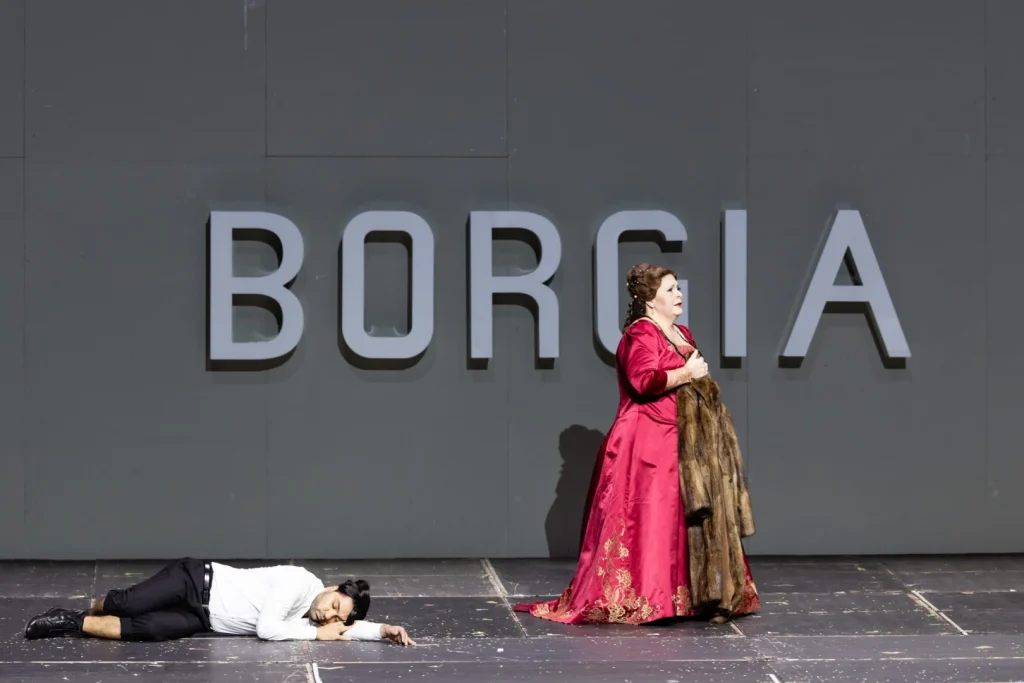
Angela Meade gave a magnificent performance in the title role, combining remarkable vocal technique with great emotional depth. Her rich soprano has both the dramatic weight and the flexibility required for this extremely demanding role, while her nuanced phrasing brings tenderness and sensuality to the character.
Liparit Avetisyan was equally impressive as Gennaro, with his beautiful, lyrical tenor and passionate singing. His warm, expressive voice carries the melodic lines with great elegance, while his dramatic commitment gives the character the necessary youthful intensity.
Erwin Schrott delivered a commanding Don Alfonso with his deep, resonant bass and determined stage presence. His dark vocal timbre and authoritative interpretation brought considerable weight to the role.
All in all, a musically outstanding evening, with excellent singing and an inspired interpretation from the orchestra under Paolo Arrivabeni. It is only unfortunate that Christof Loy’s rather uninspired production does so little to match the extraordinary musical quality of the performance.