Festspielhaus, Bayreuth, 4 & 5 August 2026
Richard Wagner: Das Rheingold & Die Walküre
It was probably a bad idea from the start to leave the visual side of Bayreuth’s anniversary Ring to AI. Even after the devastating reports from the first cycle, I had expected something even worse.
But each performance is apparently meant to be different anyway, and only someone who has seen both the first and second cycles could really compare them.
Perhaps there is also something useful in this, to make one point in advance: everyone who places such high hopes in AI now has to admit, rather soberingly, that it can do far less than many people think. God forbid that it should be used in medicine, politics or even more widely in the media.
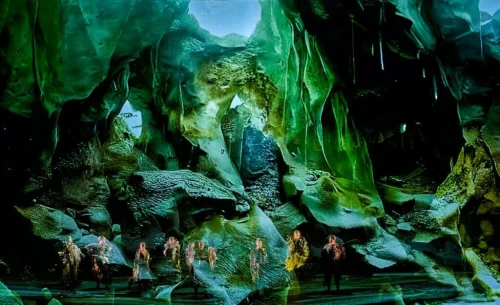
This artificial “intelligence” does not even seem to know the plot of the Ring tetralogy very well. Otherwise it would at least have found more suitable images for Alberich’s transformations under the Tarnhelm in Das Rheingold, and made better use of the possibilities of cinema that can add something to opera.
To be fair, the AI did at least turn Alberich’s transformation into a monster into the head of a huge creature with sharp teeth, somewhere between a wolf and a crocodile. But the small toad into which Alberich then transforms – for years one of Jochen Schmeckenbecher’s signature roles – was nowhere to be found in an abstract image.
And it is certainly true that the visual side is far too overloaded and often has little meaning. There are all kinds of landscapes, images that look like abstract paintings and associative brainstorming. One example comes in the Wälsung act of Die Walküre, when a black-and-white portrait of Thomas Mann briefly appears in the visual collage. Mann was inspired by the story of the incestuous siblings in his novella Wälsungenblut. That is still one of the more acceptable examples.
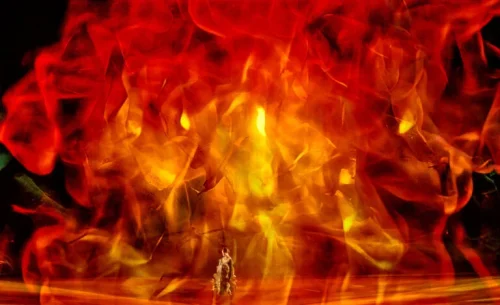
It seems less appropriate when, shortly before Siegmund’s death, a workman is shown painting the whole image red with a broad brush.
But where is the performance history that the AI was supposed to refer to?
I had imagined the semi-staged concept as something quite interesting, but completely different: more like a slide show with stage images from many historical productions, similar to the magnificent stage models by Wieland Wagner from the early 1950s that can be seen in the basement of Villa Wahnfried. I would also have welcomed reconstructions or large photographs of the stage designs from Chéreau, director of the centenary Ring, as well as Alfred Kirchner, Jürgen Flimm, Tankred Dorst and, for that matter, Frank Castorf. That would still have been a hundred times better than such failed productions as those by Castorf or Valentin Schwarz.
But that would have required giving a filmmaker a specific commission. Such a filmmaker could have matched the sequence of images much more closely to the music and, ideally, worked hand in hand with the conductor.
Instead, only occasional props, details or production photographs from earlier performances could be picked out of the visual jumble, and some of them were difficult to recognise because the images were so blurred.
Bayreuth has always had something of a workshop character, which raises the question: to what extent can Marcus Lobbes and Nils Corte, who are responsible for the artistic and technical concept, bring the history of past productions more strongly into focus in the remaining performances of the second and third cycles? Do they even have any influence over such fundamental matters of concept?
The semi-staged setting does have at least one advantage: the singers usually stand in the centre of the stage and can be heard well, while the contact between stage and pit is ideal.
In any case, this one-off anniversary Ring is making musical history. Above all, this is because of the conductor, Christian Thielemann. With the Bayreuth Festival Orchestra, he lives through this story of power and love with intense emotion: gripping in the dramatic moments, touching and endlessly tender in the lyrical ones, in a way that is unique in Wagner performance today. And all this in high temperatures that turn the Festspielhaus into a sauna.
The prelude to Die Walküre alone, with its stormy movement in the cellos suddenly becoming so quiet that you have to strain your ears to hear it at all, sounded more eerie than I can remember from what feels like ten Thielemann Ring cycles. Of course, the special acoustics of the pit play a part: elsewhere, a four- or five-fold pianissimo like this would probably no longer be audible. And there is no visual distraction. At least during the preludes, the curtain remains closed, almost as if Thielemann were saying: these belong to me. When the cellos begin to gather threatening momentum again from this almost silent starting point, the heart races.
There were new listening experiences in the prelude to Das Rheingold as well. After the wave-like movement of the water in the strings, there was a clarinet solo that sounded more assertive than in the conductor’s recent performances at the Berlin State Opera – almost cheeky, in fact. The anvils also had unusual weight, bright and intense in the foreground, making it easy to imagine the Nibelungs forging the gold, even though it was barely visible in the video projection.
Only someone with a deep love for Wagner’s music can conduct it with such richness of sound, sensitivity and emotional depth. With Thielemann, you feel this from the first note to the last. I would not be surprised if he conducts the music from memory, as he recently did with Die Meistersinger and Tristan in Dresden.
The singers also make this anniversary Ring a celebration. Two performers deserve my particular admiration: Michael Volle and Klaus Florian Vogt.
Volle’s Wotan is powerful and deep-toned, secure and clear in the text, beautiful in timbre, flexible throughout the range, and moving as a genuinely sad god whose actions are controlled by forces beyond him. For all the anger he shows when punishing Brünnhilde for what he sees as her disobedience, his final monologue still reveals the deep pain of saying goodbye to his “glorious, brave child”.
Vogt, meanwhile, is one of the few singers today with a distinctive and instantly recognisable voice, as well as seemingly endless reserves. He is scheduled for a total of 12 performances as Loge, Siegmund and Siegfried, and so far he is managing them remarkably well. With great brilliance and not the slightest sign of tiredness, he continues to sing his roles in the second cycle securely across the entire range. And perhaps, very probably, the boyish brightness of his tenor, together with the strong element of head voice, means that he can move through the upper register with ease and without strain. He may therefore have less to fear from vocal wear than someone who constantly has to push hard for the high notes. He is especially good as Loge, where his timbre and excellent diction recall Peter Schreier a little.
With Camilla Nylund as Brünnhilde and Christa Mayer as Erda, Thielemann also has two other long-standing and trusted musical partners on stage.
In the louder high passages, Nylund’s vibrato can become rather wide, but overall she handles the role very respectably, with the necessary power as well as lyrical sensitivity in tense quiet moments such as “War es so schmählich” in her confrontation with her father Wotan.
I am less convinced by Elza van den Heever’s Sieglinde. The middle register is secure and lean, but the highest notes sound rather stiff and pointed. By contrast, the magnificent Anna Kissjudit, with her dark, full-blooded, large mezzo-soprano, establishes herself as one of Bayreuth’s most beautiful female voices: a Fricka to be feared.
The rest of the cast is also excellent, right down to the Rhinemaidens and smaller roles such as Froh and Freia, although the characters are dressed rather uniformly and can be difficult to tell apart. Pia Maria Mackert’s silver costumes are splendid.
The boos for the failed stage concept are gradually becoming less intense. People increasingly seem to ignore it. But the singers and conductor receive the emphatic storms of applause they deserve, recalling the golden days. At times it feels as if the house might collapse under all the stamping feet. Such loud enthusiasm for a Ring has not been heard here for a long time. More precisely, not since Thielemann’s last cycle 20 years ago.