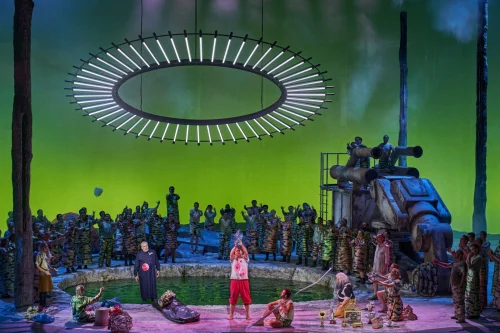
Festspielhaus, Bayreuth, 31 July 2026
Richard Wagner: Parsifal
American director Jay Scheib’s production of Wagner’s opera Parsifal has been performed at the Bayreuth Festival since 2023. The production attracted attention because some members of the audience could buy special 3D glasses that provided additional images alongside the performance itself. Scheib makes a clear environmental and political statement, setting the story in a post-apocalyptic society destroyed by mankind. Despite the bleak setting, the staging itself is surprisingly colourful, especially in the second act.
Scheib makes extensive use of digital technology. During the performance, a cameraman often moves around the stage, following the actions of certain characters, with the footage shown at the back of the stage. There are also two Kundrys: the real one and a silent character who follows the original Kundry around the stage. Scheib questions the image of Kundry as a dangerous woman, making her less demonic and trying to present a more balanced picture of her. He also gives her a new possibility. At the end of the opera, Kundry does not collapse and die, but slowly moves away from the centre of the stage to become one of the Knights of the Grail.
Scheib is also clearly anti-religious in his staging, with Gurnemanz portrayed as the leader of a cult who treats his Knights of the Grail without respect. At the end of the opera, when Parsifal saves Amfortas with the Holy Spear, he also destroys the Holy Grail. Should this be interpreted as a statement against Christianity, or does it mean that the ritual has lost its meaning and needs to be renewed? Overall, the staging is rather problematic and not entirely consistent. Surprisingly, there were hardly any boos afterwards, despite Scheib’s criticism of religion and his environmental and political message. One reason may be that although the ideas behind the staging can be seen as provocative, visually it is quite attractive to watch and therefore perhaps does not create that much hostility.
Vocally, the performance is of a very high standard, with many of today’s leading Wagner singers and regular performers at the Bayreuth Festival. Once again, Andreas Schager sings the title role and is as impressive as usual on stage, especially in his portrayal of Parsifal’s development from an immature boy into a wise and compassionate adult. Unfortunately, his voice is beginning to show signs of a long career, with a certain hardness and too much vibrato.
Georg Zeppenfeld, as before, gives a balanced and beautifully sung Gurnemanz, a thoughtful and wise interpretation both on stage and vocally. The greatest cheers from the audience afterwards were for Michael Volle as a tormented and dramatic Amfortas. Volle’s performance was in many ways the highlight of the evening, thanks to his stage presence and vocal brilliance. The evening’s big surprise came from Finnish soprano Miina-Liisa Värelä. Her Bayreuth debut as Kundry was extremely impressive, combining great vocal power with lyrical sensitivity.
The Bayreuth Festival orchestra and chorus also shone throughout the evening. Spanish conductor Pablo Heras-Casado’s interpretation was monumentally powerful in the ceremonial scenes, while also showing lyrical warmth throughout. It felt as if Heras-Casado wanted to build a bridge between more traditional interpretations and a leaner, more modern approach in this thoughtful and fresh reading of the opera.