Teatro Mayor Julio Mario Santo Domingo, Bogotá, 18 July 2026
Giacomo Puccini: La bohème
Although Manon Lescaut was Puccini’s first major operatic success, its creation was chaotic, with Puccini and his publisher Giulio Ricordi repeatedly replacing librettists who failed to realise their vision for the work. Luigi Illica and Giuseppe Giacosa ultimately helped bring the opera to completion, in what proved to be the ideal trial run for the three-way creative partnership that would later produce La bohème, Tosca and Madama Butterfly. These works secured Puccini’s place in the pantheon of Italian opera, establishing him as Verdi’s most convincing successor and the last of Italy’s great operatic masters.
La bohème confirmed the consolidation of Puccini’s career. Although rooted in the Italian operatic tradition, it also incorporated techniques from abroad, above all the Wagnerian leitmotif. Puccini employed it with remarkable assurance, achieving in barely two hours and through the lives of four impoverished bohemians a thematic cohesion comparable to that which Wagner developed across vast mythological Musikdramen populated by gods and heroes.
When one thinks of La bohème, it is almost inevitable to picture the grand productions associated with the world’s leading opera houses, particularly Franco Zeffirelli’s stagings at La Scala or the Metropolitan Opera. However, the prominence of these large-scale productions in the collective consciousness of opera-goers can sometimes distort expectations, to the point that some audience members attend La bohème mainly to see how more than one hundred people can be accommodated onstage during Act II. Yet La bohème is far more than a display of theatrical spectacle. Despite what these famous productions may have led many opera-goers to believe, it is not a work conceived on the monumental scale of Don Carlos or Les Troyens, but an intensely intimate opera filled with revealing character moments. Its greatest emotional intensity often emerges from its quietest passages, particularly when only a few characters are onstage, as their feelings and relationships become the opera’s true centre of gravity. The Teatro Mayor production, led by stage director Pedro Salazar, fully understood this essential quality of the work.
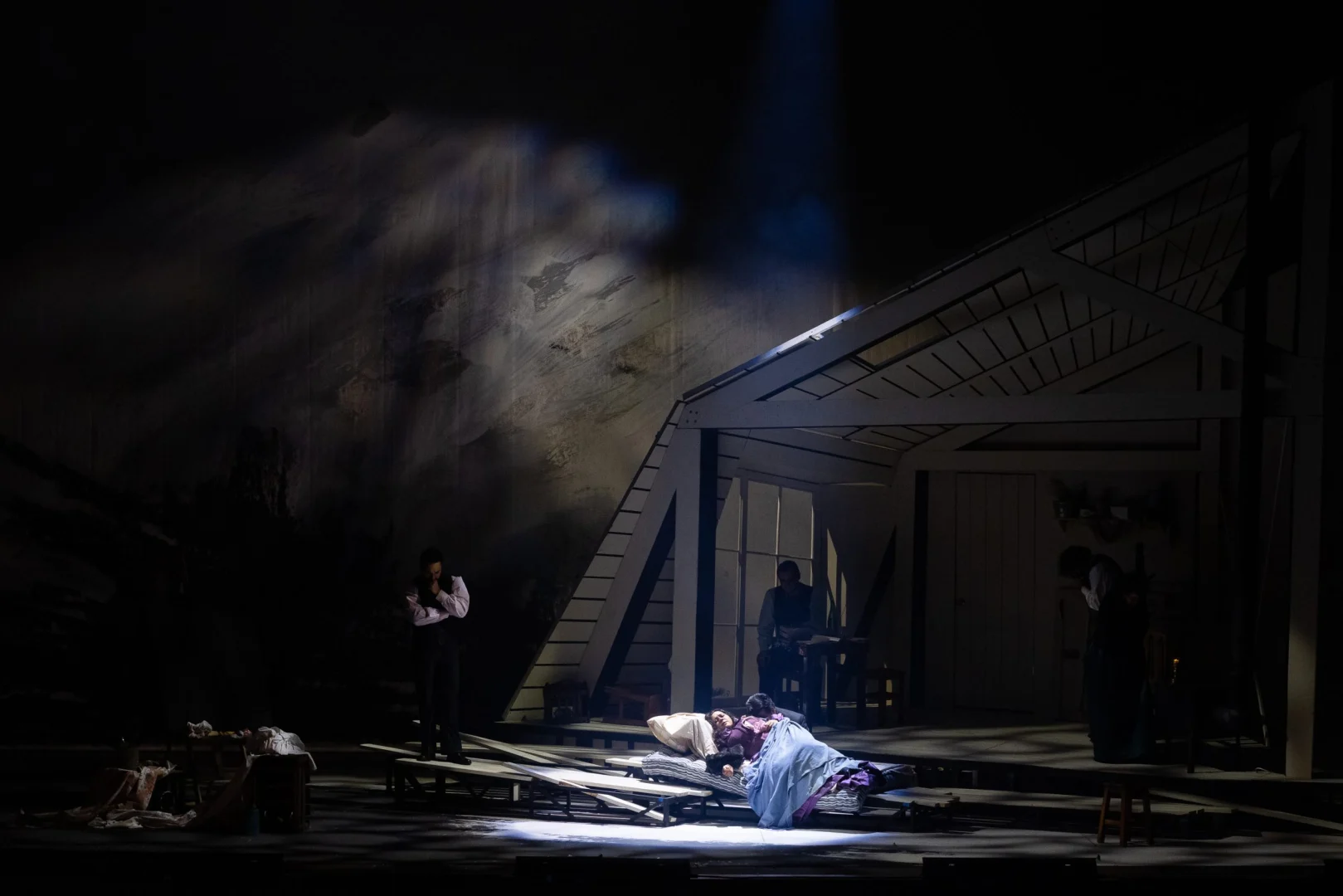
Pedro Salazar, who has recently enjoyed success at the Teatro Mayor with productions of Le nozze di Figaro, Tosca, La traviata, L’incoronazione di Poppea and Nabucco, created a staging in which the characters’ emotions always remained at the forefront. The garret in which the bohemians live in Acts I and IV was deliberately small and positioned on the right-hand side of the stage, but an opening connected it to the rest of the set through a series of white planks. This preserved its sense of confinement while still giving the singers enough space to express themselves. In my opinion, the garret could perhaps have shown slightly more wear and tear to appear more authentic and better reflect the bohemians’ lifestyle, although this is only a minor criticism.
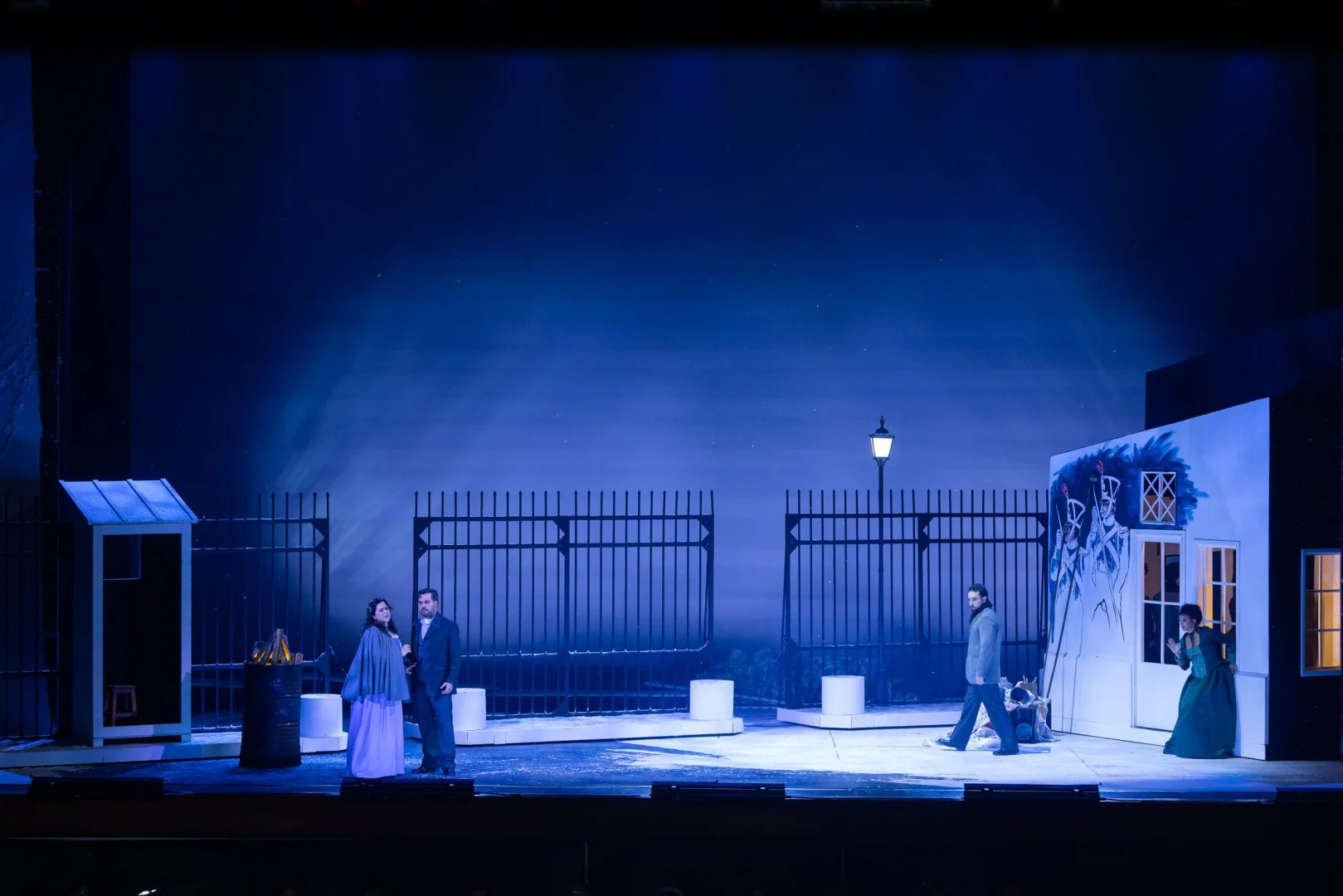
The exterior of the tavern in Act III was also very well realised, avoiding some of the awkward oversights found in other productions. For example, the warriors Marcello is painting on the wall outside the tavern were clearly visible, while Mimì was given a convincing place to hide behind the guard booth. These may appear to be small details, but I have seen them neglected in other stagings, even at larger opera houses.
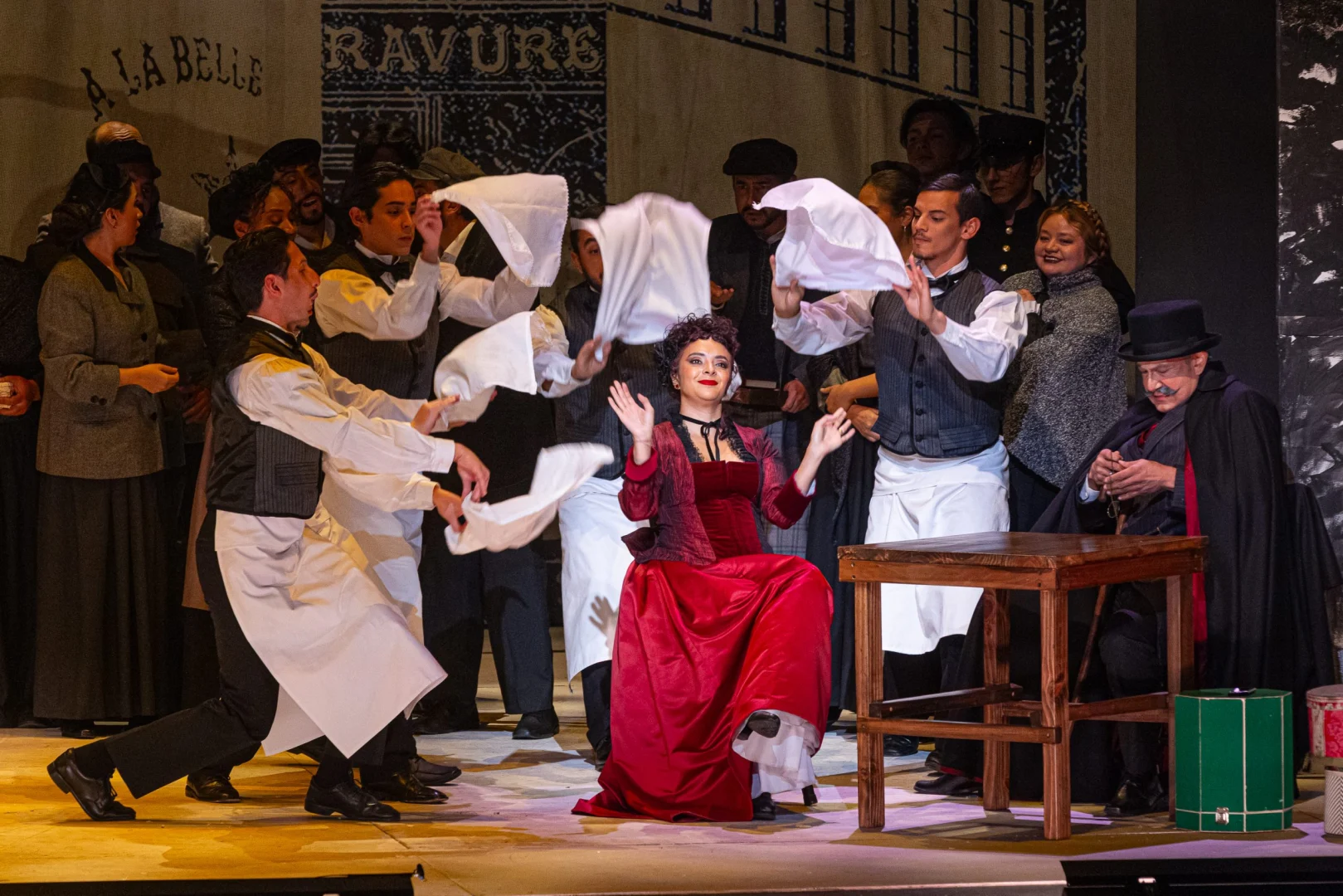
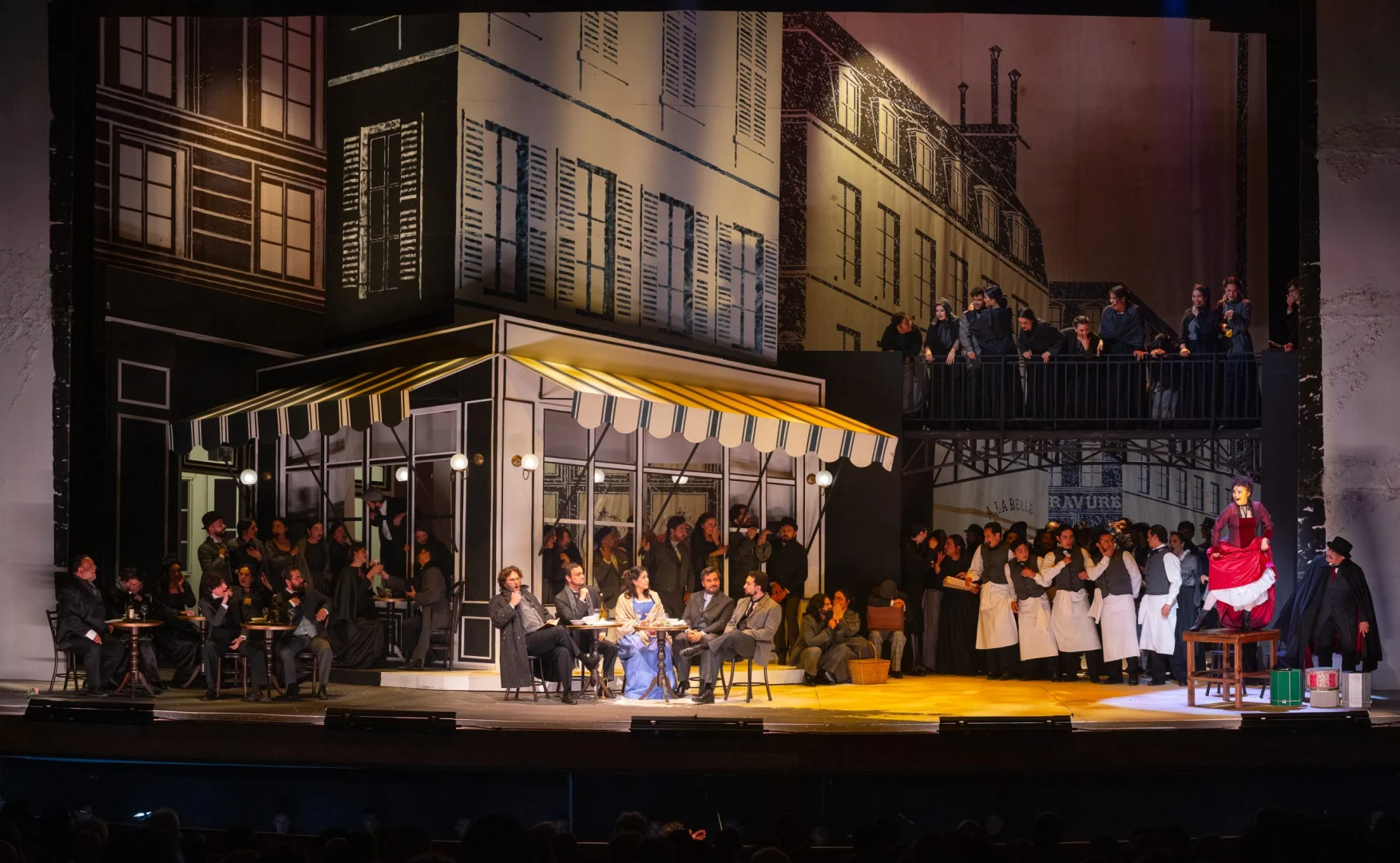
Although I previously suggested that Act II is sometimes given more importance than it deserves in relation to the rest of the opera, I must admit that it was handled with considerable success here. Salazar created a Café Momus bursting with life. The stage began almost completely empty, before buildings emerged from the sides and descended from above, transforming it in under a minute into a vivid and bustling recreation of the Latin Quarter in the 1830s. In my opinion, this is Salazar’s finest production to date at the Teatro Mayor.
I am, and probably always will be, of the stubborn opinion that, although opera is fundamentally a vocal art form, the most important cog in the operatic machine is the conductor. A poorly conducted opera, even one featuring world-class singing, is ultimately destined to fail. Colombian conductor Andrés Orozco-Estrada, currently General Music Director of the City of Cologne, with musical responsibility for Oper Köln and the Gürzenich Orchestra, as well as Principal Conductor of the Orchestra Sinfonica Nazionale della RAI, brought his considerable experience and insight to the pit, leading the Orquesta Sinfónica Nacional de Colombia with authority through a highly successful evening.
Orozco-Estrada has always been a nuanced conductor, distinguished by his impressive attention to detail and his refusal to rush the music. His handling of dynamics was particularly effective and he took great care never to overwhelm the principal singers with the orchestra. What I enjoyed most were the intimate moments between Rodolfo and Mimì in Acts I and IV, with the strings tenderly accompanying first a love beginning to blossom and later one slowly fading away. As always, he demonstrated a natural rapport with the performers onstage.
For an opera such as La bohème to work, it requires an ensemble cast whose members share convincing chemistry. Leading the Teatro Mayor cast was rising Guatemalan soprano Adriana González, making her South American debut after appearing in leading roles at some of Europe’s foremost opera houses, including the Teatro Real, the Gran Teatre del Liceu and the Opéra Bastille. González dazzled as Mimì. Her warm voice filled the auditorium effortlessly, while her portrayal of the ailing seamstress was both compelling and credible. She conveyed Mimì’s fragility with nuance, yet also revealed her burning passion when required, an aspect of the character that is often overlooked in other interpretations. She was, without question, the vocal highlight of the evening.
Opposite González, Colombian tenor Andrés Agudelo portrayed the poet Rodolfo, a role he recently debuted at the Glyndebourne Festival. His performance can best be described as very solid, as he navigated the role confidently and without any apparent difficulty. It had been some time since I had heard a live performance of La bohème in which the tenor sang ‘Che gelida manina’ without transposing it down, which was most welcome. Agudelo delivered the high C successfully, setting the tone for what would prove to be a consistently reliable performance. One minor reservation, purely a matter of personal preference, was his decision to conclude ‘O soave fanciulla’ on the high C alongside Mimì. Although more vocally impressive, I find this less intimate than Puccini’s original conception, in which Rodolfo’s separate line descends to E beneath Mimì’s high C, giving the duet a gentler and more tender resolution.
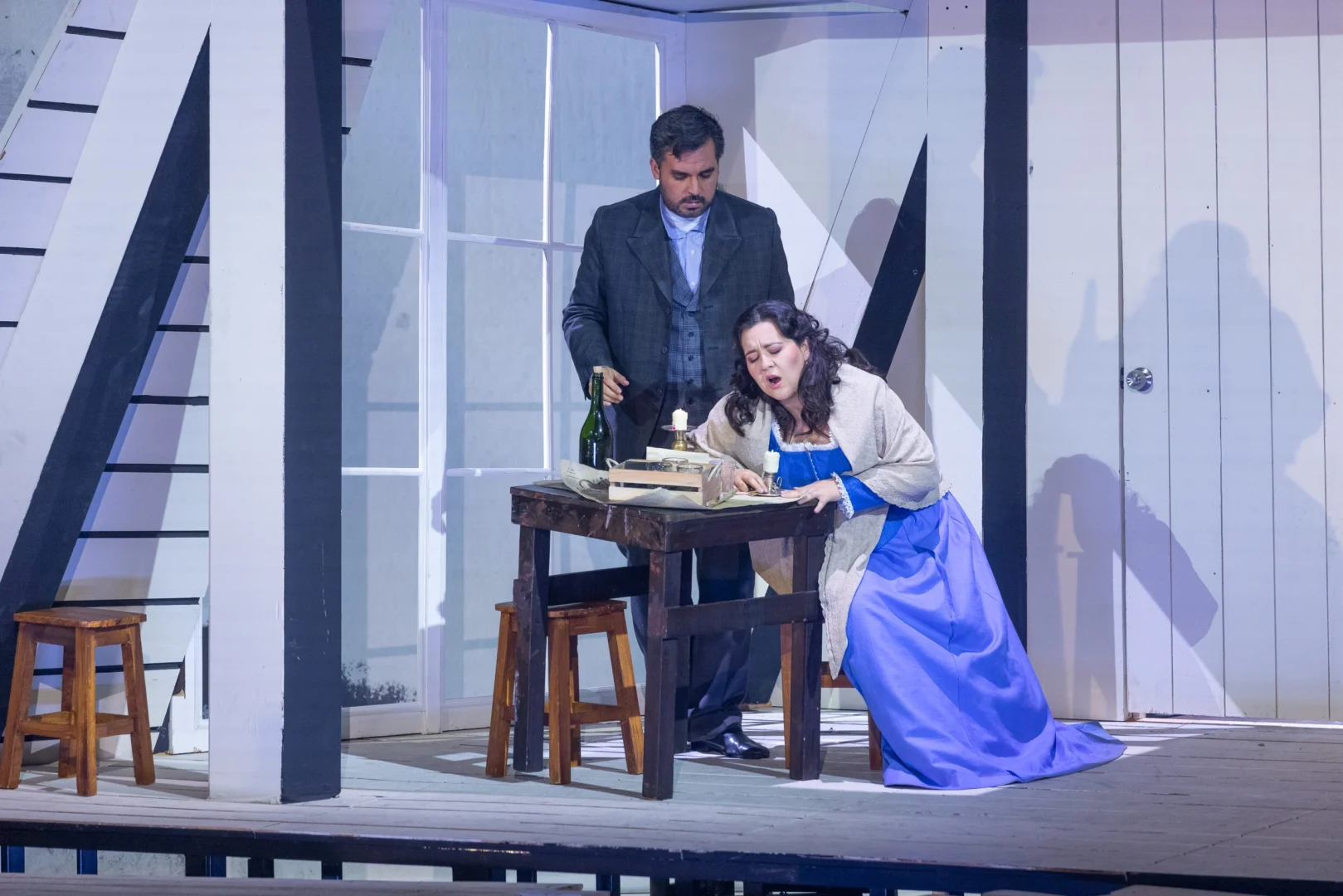
Colombian soprano Julieth Lozano, winner of the Dame Kiri Te Kanawa Audience Prize at the 2023 BBC Cardiff Singer of the World competition, portrayed a Musetta brimming with wit and personality. Every time she appeared onstage, she brought a burst of energy with her and immediately commanded the audience’s attention. Her performance was not only vocally assured, marked by clarity and precision, but also dramatically compelling, supported by vivid acting throughout. Her antics in Act II as she attempted to attract Marcello’s attention were hilarious, following a spirited rendition of ‘Quando me’n vo”. In Act III, her argument with Marcello felt like the genuine bickering of a real couple, while in Act IV she revealed a more humble and compassionate side, taking charge of the efforts to raise money for Mimì’s medicine and a muff.
As Marcello, the painter, Colombian baritone Jacobo Ochoa gave a somewhat uneven vocal performance, but any inconsistencies in the singing were considerably offset by his strong musicality and convincing chemistry both with his fellow bohemians and with Musetta. His Act IV duet with Rodolfo was a particular highlight. As Schaunard, the musician, Juan David González gave an engaging performance throughout. His voice projected effortlessly over the orchestra and he consistently brought energy and comic spark to every scene in which he appeared. Hyalmar Mitrotti gave a commendable performance as Colline. His demeanour was suitably introspective, reflecting the philosopher’s reserved personality, while his rendition of ‘Vecchia zimarra’ was polished and well sung, earning warm applause from the audience. Most important of all, however, was the camaraderie shared by the bohemians throughout the performance. It was palpable in every scene, from the most uplifting moments to the most tragic, and the cast passed that crucial test with flying colours. Alexis Trejos was genuinely funny in the dual roles of Benoît and Alcindoro, bringing sharp comic timing and a strong stage presence to both characters.
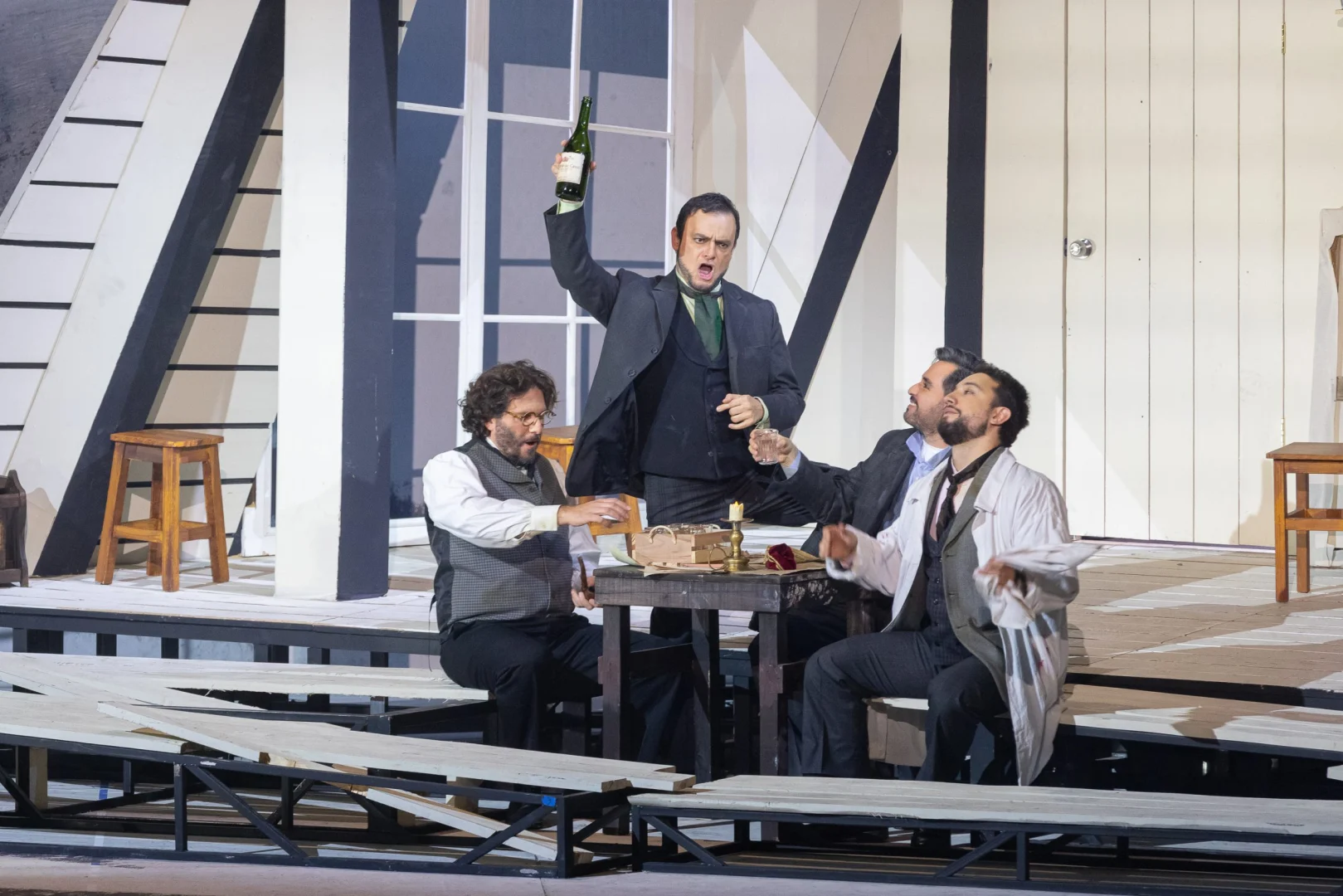
The Coro Nacional de Colombia was superb, particularly in Act II. Beyond the quality of its singing, the chorus worked seamlessly within Salazar’s vision, creating the impression that every chorister was an individual character with a specific reason for being at Café Momus at that particular moment. Some members even acted with the commitment often expected of supernumeraries rather than choristers. Special mention must also go to the Coral Infantil ¡Canta Bogotá Canta!, which performed the children’s chorus, and to the Banda Sinfónica Nacional de Colombia, whose musicians appeared onstage as the military band.
Overall, Salazar and Orozco-Estrada’s La bohème at the Teatro Mayor can be called nothing short of a resounding success, demonstrating an institution increasingly confident not only in producing opera on a grand scale, but also in recognising when intimacy matters more than spectacle.