
Gärtnerplatztheater, Munich, 28 June, 5 & 10 July 2026
Franz Lehár: Der Graf von Luxemburg
Gottfried von Einem: Der Besuch der alten Dame
Giuseppe Verdi: La traviata
Munich is fortunate to have two very different opera houses within only a few kilometres of each other. While the Bayerische Staatsoper concentrates largely on the standard international repertoire, the Gärtnerplatztheater has built a strong identity by exploring less frequently performed works, especially operettas and twentieth-century opera. Three new productions from this season seen there this summer showed the range of the company: Lehár’s Der Graf von Luxemburg, Gottfried von Einem’s Der Besuch der alten Dame and Verdi’s La traviata.
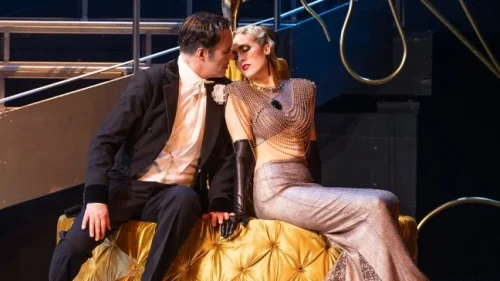
Peter Lund’s production of Der Graf von Luxemburg was the lightest and most immediately entertaining of the three. His adaptation gives Lehár’s operetta a fresh, modern energy without losing its elegance. Updated dialogue, mistaken identities and witty details make the old-fashioned plot feel surprisingly lively. The colourful costumes, rotating stage and large show staircase create a bright image of Paris around 1910. The visual movement fits Lehár’s graceful and flowing music very well. Daniel Prohaska was excellent as Count René. His warm, flexible tenor was matched by natural charm and fine comic timing. Andreja Zidaric was equally impressive as Angèle, singing with a clear, radiant soprano and bringing plenty of confidence and humour to the role. The two performers had strong chemistry, and their scenes together were among the highlights. Most importantly, the production was genuinely funny. The comedy grew naturally from the characters, the dialogue and the fast-moving stage action. Although it was a full-length evening, the time passed quickly.
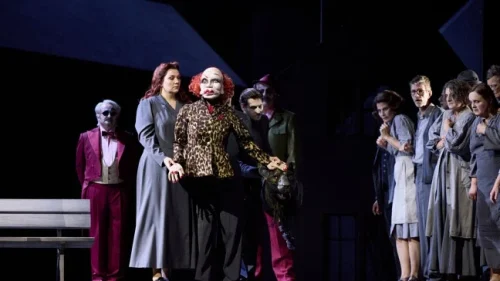
Very different in tone was Gottfried von Einem’s Der Besuch der alten Dame. Based on Friedrich Dürrenmatt’s famous tragicomedy, the opera is rarely performed, despite its strong theatrical impact. The Gärtnerplatztheater’s production showed clearly that it deserves a more regular place in the repertoire. Director Nikolaus Habjan approached Dürrenmatt’s dark and grotesque world with imagination and care. His most striking idea was to divide the central character into two figures: the living and singing Klara, and the cold, almost inhuman Claire, represented by an expressive puppet. This added psychological depth to the character and made her transformation especially disturbing. The black panther was another memorable feature, while Heike Vollmer’s flexible stage design supported the drama well. Michael Balke led a strong orchestral performance, bringing out both the rhythmic tension and the darker, more lyrical colours of von Einem’s score. Sophie Rennert was outstanding as Klara and Claire, singing with brilliance, flexibility and emotional depth. Ludwig Mittelhammer gave a moving performance as Alfred Ill, showing his development from a comfortable and self-confident citizen into a dignified victim. The chorus and smaller roles were performed with great commitment. Together, they made the people of Güllen frighteningly believable as a community gradually abandoning its moral values. This was a bold, intelligent and highly theatrical production of an opera that should be heard much more often.
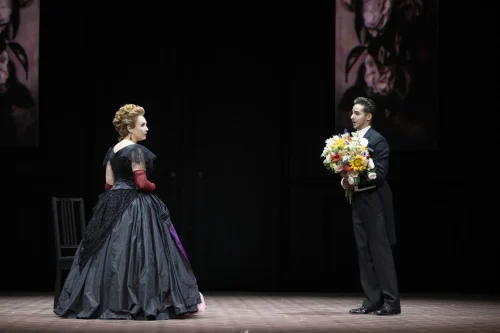
The third production, Isabel Ostermann’s staging of La traviata, belongs to standard repertoire but presented it in an elegant and deliberately timeless setting. The strong contrasts between black, white and red created an attractive visual world, while the mixture of historical costumes and contemporary details prevented the action from belonging to one fixed period. Several images remained in the memory. Violetta appeared beside a childlike version of herself, the country scene became an artificial idyll with painted scenery and deer, and the stage grew increasingly empty as she approached death. The suggestion that Violetta and Alfredo’s happiness was only a fragile theatrical illusion worked well, although some symbols and changes of style were not fully developed. The musical centre of the evening was Sophia Theodorides as Violetta. Her soprano combined secure coloratura, warmth and dramatic strength with beautifully controlled quiet singing. Matteo Ivan Rašić was a very good Alfredo. His youthful tenor had strength while keeping its lyrical quality, and he was an engaged and believable stage partner. Together, the two singers gave the performance an emotional directness that the production itself sometimes lacked. This Traviata did not take many risks, and it was less adventurous than the other two stagings. Even so, it was beautiful, well sung and musically rewarding, with little of real importance to criticise.
Taken together, these productions showed the Gärtnerplatztheater at its best: committed ensembles, imaginative staging and a willingness to move beyond the safest repertoire. Three good performances during a hot Munich summer made a fine ending to the current opera season.