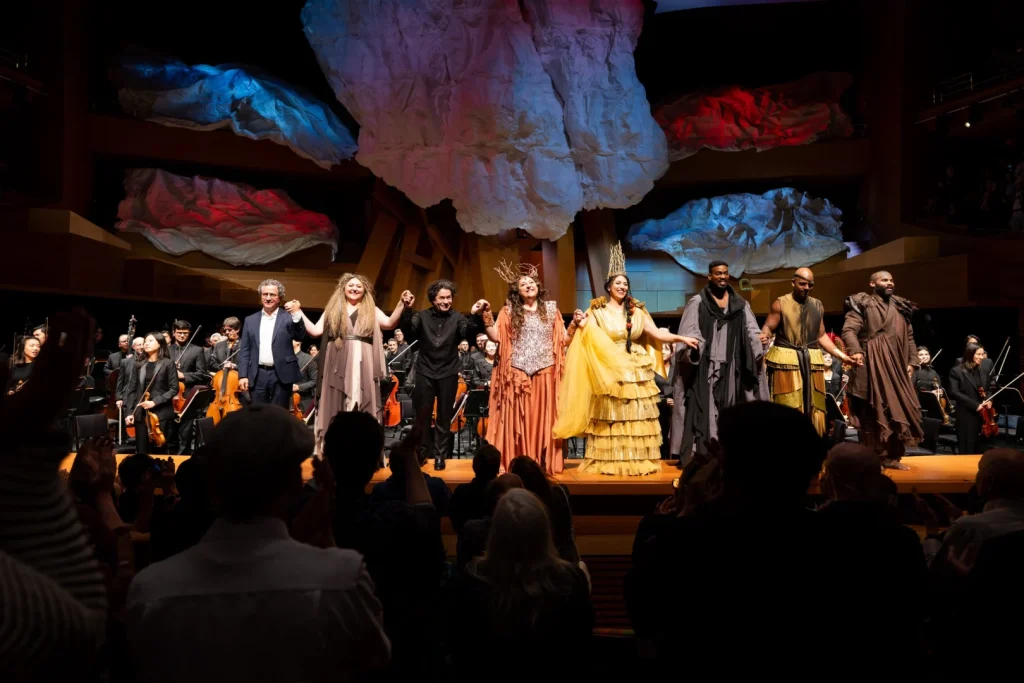
Walt Disney Concert Hall, Los Angeles, 19-21 May 2026
Richard Wagner: Die Walküre
Dudamel continues his Wagner Ring cycle two years after his promising performance of Das Rheingold. This is one of his final programs during his 17 year term as music director of the Los Angeles Philharmonic and leaves the orchestra in fantastic sounding shape. One of Dudamel’s strengths as a conductor is to clearly articulate every episodic detail in a score with plenty of character but also keep a flowing through line making even the most dense and colorfully complex orchestrations unfold with a natural grace. This is best demonstrated on the Grammy winning recording of Mahler’s monumental 8th Symphony or their recent release of Prokofiev’s ballet, Romeo and Juliet.
Wagner’s epic orchestral writing is the ultimate test of these skills and the orchestra along with its cast of singers rises to the occasion. Unlike Das Rheingold, which is short enough to be performed in a single evening, he chose to split Die Walküre across three nights, one for each act. This is a controversial choice from a viewing and especially cost perspective, requiring three tickets instead of one to see the entire opera. The benefit is it allows the orchestra and vocalists to put all their energy into each act that runs a little over one hour. The musicians are essentially able to sprint instead of pace themselves for a full 4 hour performance. This concentration of effort pays enormous dividends in the intensity of the performance. I was struck how every section delivered their best. You can hear the work they must have put in during rehearsals and sectional work. I was told they had eight rehearsals for this performance, more than the usual handful that is typically given to each program. From the opening Act I the strings really dig in to deliver an explosive and propulsive Vorspiel. Tempos are generally on the faster side, some listeners accustomed to slower renditions may quibble with this choice but I found it dramatically effective. The cast has the strength of voice necessary to bring Wagner’s mythic characters to life with Christine Goerke as Brünnhilde being the highlight. She effortlessly sings some of Wagner’s most demanding vocal challenges with plenty of power such as the iconic ‘Hojotoho! Hojotoho!’.
The late great Frank Gehry, architect of the Walt Disney Concert Hall, designed the sets. The first two Acts feature large paper-sculpted clouds that provide visual flexibility with different colors and angles of light to transform the space. The sparse but memorable imagery is a touching reminder of his legacy and creativity, able to make the most of the limited space to stage an opera within the confines of a concert hall.
Act III was the highlight for me starting with “The Ride of Valkyries”. Gehry’s set expands to include several horses and Goerke again shines along with her fellow Valkyries with an apocalyptic accompaniment Dudamel elicits from his orchestra. What the sets lack in scope, Dudamel’s performance more than makes up for it in crafting a cinematic sound world. By the end he turns in a beautifully sculpted performance of “Magic Fire Music”, capping an immersive performance that does justice to Wagner’s “Gesamtkunstwerk” (total work of art). You don’t need to be in Bayreuth or a traditional Opera House to appreciate Wagner’s vision with a performance of this caliber.
Dudamel is able to demand the most from his musicians but is so in tune with his orchestra he does not exhaust. This is the difference between a conductor who is merely talented and one who has a close personal connection with the orchestra and what will be so difficult to replicate when Daniel Harding takes over as music director in 2027. I along with many who witnessed these first two operas that make up Wagner’s Ring cycle hope he continues this project in his future appearances with the Los Angeles Philharmonic in his new titles as Artist and Cultural Laureate of the LA Phil. If so, they will be must see events.