
Bayerische Staatsoper, Munich, 10 April 2026
Giuseppe Verdi: Macbeth
Verdi admired the way Shakespeare captured human psychology and saw in his plays the perfect material for opera. Macbeth, Otello, and Falstaff trace Verdi’s artistic growth from his early years to his final masterpiece. The first of these, Macbeth, already shows how Verdi approached Shakespeare, shaping the dark story into something intense, dramatic, and very much his own.
Martin Kušej’s production of Macbeth at the Bavarian State Opera from 2008 presents a stark and unsettling interpretation that strips the work of any romanticism and instead confronts the audience with a harsh, almost clinical vision of power and violence. The direction feels unclear at times and seems to rely heavily on striking stage effects to reach the audience. The set design, apart from a beautiful ceiling lamp, is not especially appealing: skulls cover the stage floor, a tent stands at the edge, and plastic curtains surround the space. Overall, the staging is provocative, visually aggressive, and unsettling. In this season’s revival, however, the musical performance reaches a very high level, offering a strong contrast to the staging.
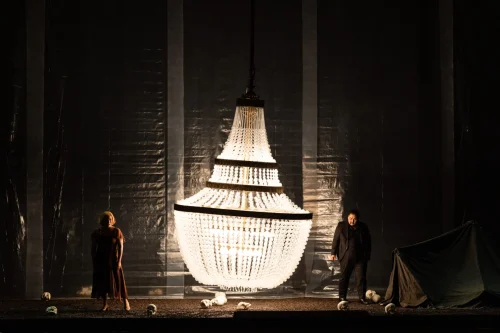
Roberto Tagliavini and SeokJong Baek deliver convincing performances as Banco and Macduff. Amartuvshin Enkhbat, who won first prize at the Operalia Competition in 2012 and the audience prize at the BBC Cardiff Singer of the World in 2015, has since appeared regularly at major opera houses around the world. His voice suits Verdi’s baritone roles well, including Macbeth—the timbre is dark and the voice has both the weight and technique the role requires, even if the interpretation feels somewhat static.
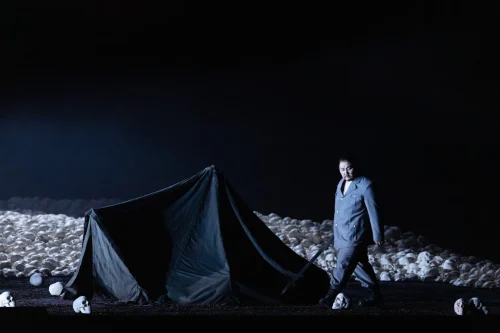
Lady Macbeth has been sung over the years by both mezzosopranos and sopranos; mezzos often bring more intensity and power, but sometimes at the cost of flexibility in the coloratura and stability in the high notes. Saioa Hernández, however, offers the full package: a focused soprano voice with brilliance, combining strength and sensitivity. She delivers everything from the dramatic first aria to an impressive sleepwalking scene, with both control and beauty.
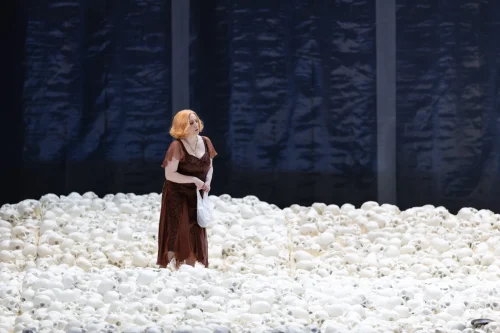
Andrea Battistoni’s approach to Verdi’s score recalls earlier Italian conductors such as Gianandrea Gavazzeni, Fernando Previtali, and Oliviero de Fabritiis, who had a deep understanding of Italian operatic style. Battistoni keeps the choir and orchestra closely together and brings a fiery, passionate energy to the music. At the same time, he maintains a clear balance between singers and orchestra throughout the evening. All in all, a pleasant Verdi evening at the Bavarian State Opera.