Lohengrin was Richard Wagner’s last project before embarking on his four-part epic music drama Der Ring des Nibelungen. Widely considered his final conventional “romantic” opera, Lohengrin nonetheless represents a significant step toward what Wagner would later call a Gesamtkunstwerk, or “total work of art”. The use of leitmotifs is already close to the level found in the Ring and the vocal writing is as lyrical as Wagner ever allowed himself to be.
As with most Wagner operas, Lohengrin has an extensive discography, greatly expanded by the numerous recordings made at the Bayreuth Festival, but also supported by several important studio versions. The role of Lohengrin is often an entry point for tenors wishing to approach Wagner, and while the heroic qualities required are evident, one should not be misled: the part demands a degree of lyricism many tenors overlook from the outset, often resulting in an incomplete portrayal of the Knight of the Holy Grail.
The opera also requires two contrasting types of soprano, not only in vocal character but in dramatic personality, to make the dichotomy between Elsa and Ortrud convincing. The first needs a more lyrical voice capable of introspection and nuance, while the latter demands a dramatic soprano (or mezzo) with a darker timbre who can assert herself over the orchestra. To complete the principal cast, a baritone and a bass of substantial means are essential for the roles of Telramund and King Heinrich respectively.
Without further ado, here are ten essential recordings of Wagner’s Lohengrin, presented in no particular order.
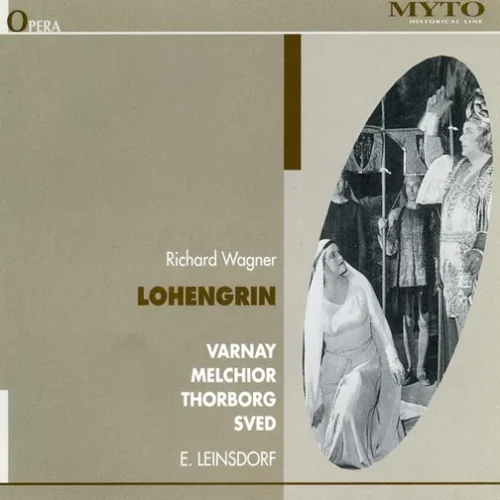
Erich Leinsdorf / Metropolitan Opera Orchestra (Myto Records)
Erich Leinsdorf conducts this 1943 live recording from the Metropolitan Opera with great vitality and theatrical flair, well supported by a strong leading pair clearly lifted by the conductor’s energy. Lauritz Melchior is an outstanding Lohengrin, heroic and convincing, and opposite him Astrid Varnay, still in her earlier years when her voice was clearer and lighter, is exceptional as Elsa. Kerstin Thorborg (Ortrud), Alexander Svéd (Telramund) and Norman Cordon (King Heinrich) complete the cast adequately.
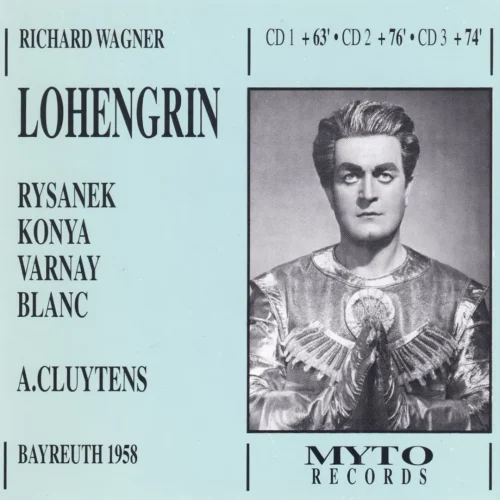
André Cluytens / Orchester der Bayreuther Festspiele (Myto Records)
André Cluytens conducts a Lohengrin from the 1958 Bayreuth Festival full of refinement and elegance, almost as if it were a Grand Opéra. Sándor Kónya has the ideal voice for Lohengrin, yet he tends to sing everything the same way and falls short in nuance and interpretation, unlike someone like Windgassen. Leonie Rysanek is a brilliant Elsa, with a beautiful voice and a strong, nuanced interpretation. Astrid Varnay, who had previously been a superb Elsa, is an equally superb Ortrud, and Ernest Blanc, refined in his own way as Telramund, partners her effectively. Keith Engen as King Heinrich delivers an average performance, while Eberhard Wächter’s Herald is one of the finest in the discography.
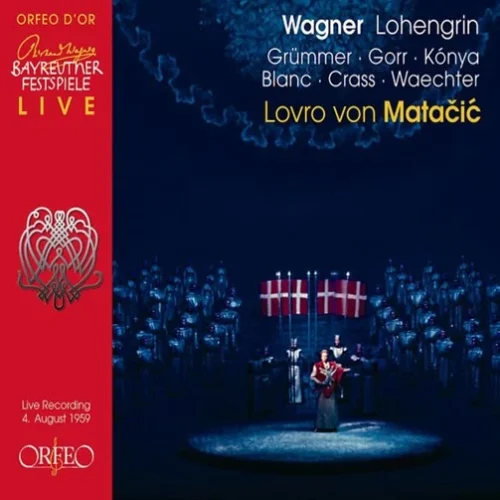
Lovro von Matačić / Orchester der Bayreuther Festspiele (Orfeo)
This superb live recording from 1959, excellently conducted by Lovro von Matačić, features the Bayreuth Orchestra in top form, enhanced by the conductor’s passionate and natural view of the work. As with Cluytens, Sándor Kónya is a wonderfully voiced Lohengrin, who falls short in nuance and interpretation. Elisabeth Grümmer delivers perhaps the finest portrayal of Elsa on record, expressive yet delicate and especially moving in her Act III doubt. Rita Gorr and Ernest Blanc are sensational as Ortrud and Telramund and Franz Crass is equally impressive as King Heinrich.
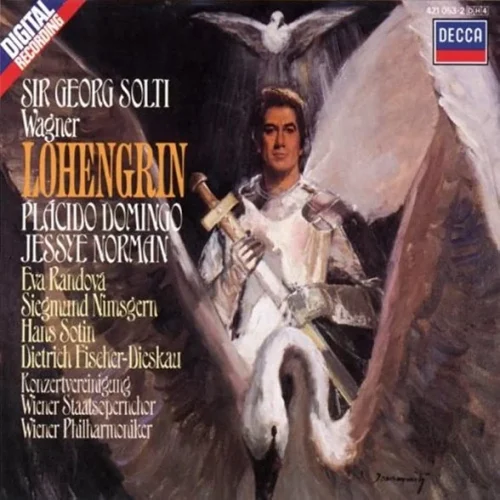
Sir Georg Solti / Wiener Philharmoniker (Decca)
As always, anything involving Georg Solti conducting Wagner for Decca delivers a product of the utmost quality. The sound quality of this 1986 recording is outstanding, with the Wiener Philharmoniker in superb form. Solti conducts with firmness and precision, though he lacks a touch of fantasy and expressive freedom. Plácido Domingo once again shows how he can manage a role that is not entirely natural to his voice by being musically intelligent and interpretatively compelling, delivering not a perfect Lohengrin but an interesting performance that is worth hearing. Jessye Norman’s Elsa is full of nuance and musicality, though she may lack a bit of the tenderness the role demands. Eva Randová’s Ortrud is theatrical and convincing, while Siegmund Nimsgern is superb as Telramund. Hans Sotin and Dietrich Fischer-Dieskau complete the cast adequately as King Heinrich and the Herald.
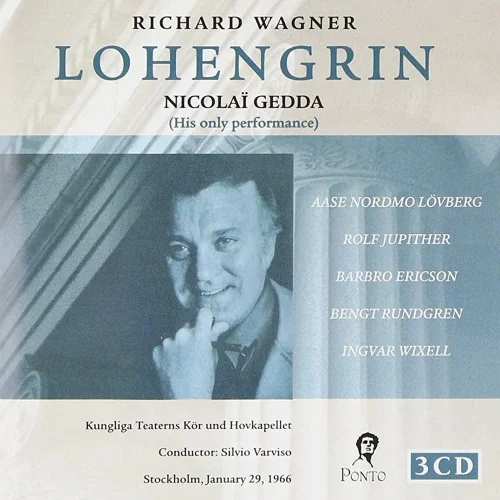
Silvio Varviso / Orchestra of the Royal Swedish Opera (Ponto)
Of all the Heldentenor roles in Wagner’s operas, perhaps Lohengrin is the most lyrical and, in my opinion, if sung well, can be successfully performed by a lyric tenor, which is precisely what happens in this 1966 live recording from Sweden, conducted adequately by Silvio Varviso. Nicolai Gedda’s beautiful timbre alone gives his Lohengrin an otherworldly and ethereal quality unmatched by any other tenor in the discography, while his elegant phrasing and musical sensibility make his interpretation a highlight of the recording. Barbro Ericson and Rolf Jupither are superb as Ortrud and Telramund. The weakest link, perhaps, is Aase Nordmo Løvberg’s Elsa, who is by no means terrible but not quite on the same level as the rest of the cast, especially Gedda.
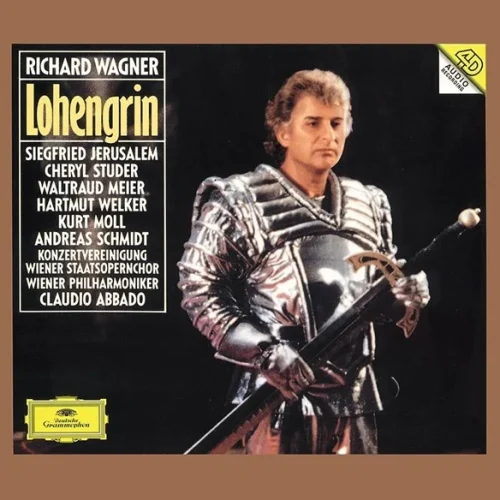
Claudio Abbado / Wiener Philharmoniker (Deutsche Grammophon)
Claudio Abbado’s vision of the work in this 1992 studio recording—intellectual and analytical yet intense and full of emotion—gives us possibly the best-conducted Lohengrin on record. Not only that, but the sound quality of this set rivals, and perhaps even surpasses, Solti’s Decca studio version. The singers operate mostly on a lower plane, yet they remain effective for what the conductor asks of them. Siegfried Jerusalem as Lohengrin is not at his best here, sounding a bit screechy and strained, although dramatically he conveys the character almost to perfection. Cheryl Studer as Elsa, powerful of voice, lacks a bit of expression and delicacy. Waltraud Meier’s Ortrud is convincing, though somewhat short on power, while Hartmut Welker as Telramund barely manages to sing through the role. On the other hand, Kurt Moll’s King Heinrich is superb, arguably the finest on record.
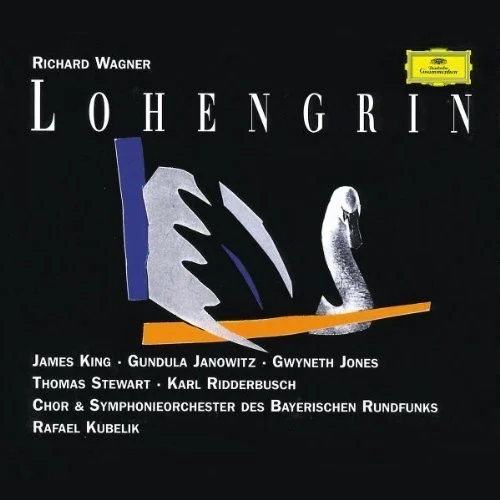
Rafael Kubelík / Symphonieorchester des Bayerischen Rundfunks (Deutsche Grammophon)
This 1970 studio recording is superbly conducted by Rafael Kubelík, perhaps a bit lacking in otherworldliness and poetry, but consistently clear and dramatic. James King as Lohengrin does very well; the voice is certainly powerful, and while his high notes lean toward the harsh side, he manages to convey the character with conviction and solid musicality. Gundula Janowitz as Elsa, perhaps a little plain-toned, nevertheless captures the character’s naïveté and depth remarkably well. Gwyneth Jones’s Ortrud is somewhat controversial, but if one can get past her signature vocal manner, she delivers a wicked and ferocious performance. Thomas Stewart is effective as Telramund, while Karl Ridderbusch’s King Heinrich is noble and well sung.
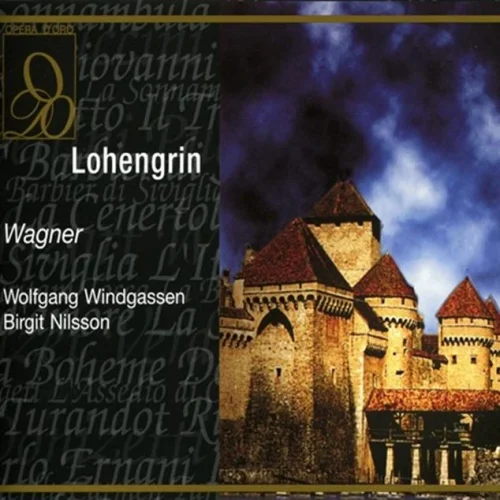
Eugen Jochum / Orchester der Bayreuther Festspiele (Opera D’Oro)
This live recording from the 1954 Bayreuth Festival has Eugen Jochum at the podium, conducting the work with considerable depth and a distinctly spiritual approach, perhaps even a bit too much, as it occasionally lacks energy and dynamism. Wolfgang Windgassen, perhaps the finest Lohengrin in recorded history, delivers a portrayal that is not only vocally strong but compelling in its dramatic nuance, with superb phrasing and a keen dramatic sense. Birgit Nilsson, in her Bayreuth debut, offers a magnificent Elsa, though she may lack a touch of tenderness. Astrid Varnay, as always a sensational Ortrud, partners splendidly with Hermann Uhde’s exceptional Telramund, their exchanges are almost demonic in the best possible way. Theo Adam is effective as King Heinrich, while Dietrich Fischer-Dieskau is splendid as the Herald.
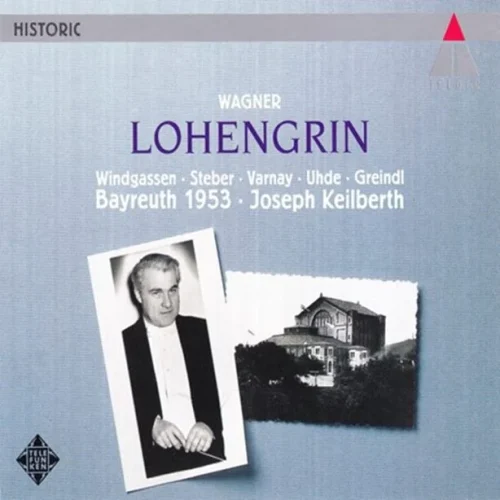
Joseph Keilberth / Orchester der Bayreuther Festspiele (Teldec)
With a cast similar to Jochum’s previously discussed version, Joseph Keilberth’s Lohengrin, recorded live at Bayreuth in 1953, is lively and exciting. Wolfgang Windgassen may be a bit less precise here than in the Jochum recording, but the way he inhabits the character and shapes his phrasing makes this interpretation highly compelling. The major difference in cast between the two versions is the presence of Eleanor Steber as Elsa; her portrayal, lyrical and full of mystery and doubt, makes her one of the finest Elsas in recorded history. Hermann Uhde and Astrid Varnay are once again fantastic as Telramund and Ortrud, while Josef Greindl’s King Heinrich is solid without being exceptional.
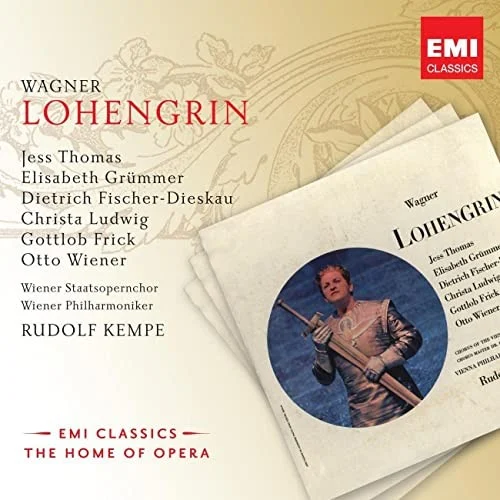
Rudolf Kempe / Wiener Philharmoniker (EMI/Warner)
In this 1963 recording, Rudolf Kempe conducts Lohengrin with a sense of mysticism that never overwhelms, allowing lyricism and nuance to emerge. The Wiener Philharmoniker beautifully supports him. Jess Thomas is a vigorous Lohengrin who, fortunately, avoids exaggerating the heroism the role demands. Elisabeth Grümmer, as in the von Matačić live recording, is a deeply convincing Elsa who is not only vocally beautiful, but also compelling in her interpretation. Christa Ludwig and Dietrich Fischer-Dieskau are nearly unmatched as Ortrud and Telramund; every word is delivered with convincing deviousness and calculated deceit. Gottlob Frick’s performance as King Heinrich completes a sensational cast in a recording that has rightfully earned its place as the studio reference for this opera.
Bonus
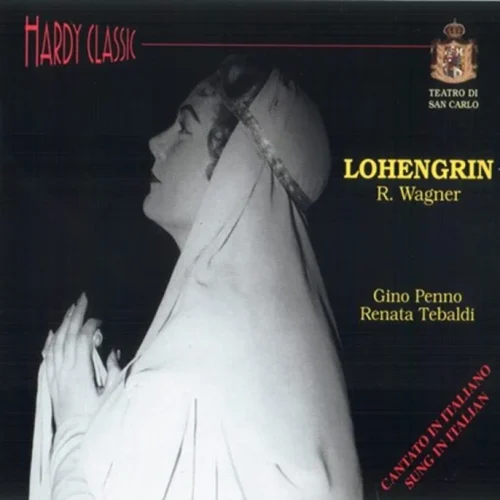
Gabriele Santini / Orchestra del Teatro San Carlo di Napoli (Hardy Classics)
This 1954 live recording from the Teatro San Carlo di Napoli, full of cuts, sung in Italian and conducted appropriately by Gabriele Santini, gives us a taste of how the exceptional voices we usually associate with the Italian repertoire approach Wagner. Renata Tebaldi’s Elsa is delightful, her Act I narration delivered expressively and beautifully. Gino Penno’s Lohengrin is distinguished by his immaculate phrasing and elegance, while Giangiacomo Guelfi’s multi-faceted Telramund is superbly sung. Elena Nicolai (Ortrud) and Giulio Neri (King Heinrich) complete a fine set of performances, unfortunately marred by the aforementioned cuts and less-than-ideal sound quality.