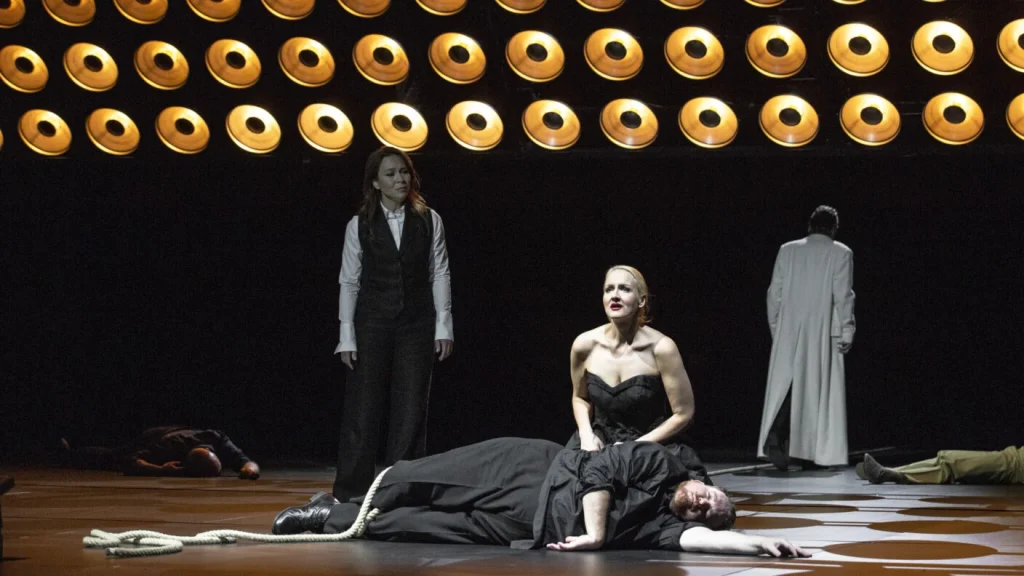
Deutsche Oper, Berlin, 1 November 2025
Richard Wagner: Tristan und Isolde
On a long rope, Isolde drags herself onstage for the prelude, led from right to left by Brangäne. The burden weighs heavily on the Irish princess, who fell in love with Tristan while she was healing him— instead of avenging the death of her fiancé Morold, whom Tristan killed in combat— and who must now be brought to King Marke as his bride. Exhausted, she collapses in the center of the stage. The dramatic backstory of Wagner’s love tragedy Tristan und Isolde is movingly reflected in this simple choreography. The hopes tied to it for a stirring premiere evening at the Deutsche Oper Berlin, however, are not fulfilled. What unfolds instead is an extremely static production that feels artificial, picking up its initial directorial idea only once more in a meaningful way— in the prelude to Act III, when Tristan, on his path from life to death, pulls a rope behind him.
It has been a long time since one has seen a convincing Tristan at the Deutsche Oper Berlin— not since Götz Friedrich’s staging from the 1980s, which older viewers may still remember with nostalgia. For context: in Graham Vick’s grim, gray predecessor production, Tristan and Isolde ended up in a retirement home. Director Thalheimer and his set designer Henrik Ahr, who work with reduction and abstraction, do offer a more appealing visual style, but rely largely on a lighting installation of more than 260 spotlights arranged symmetrically in a square— glowing in different colors and intensities in response to the action. Otherwise, the stage is empty and black. When the last light goes out for the long-awaited love night and the stage falls into total darkness, or when all the lights flare up like harsh floodlights as King Marke discovers the lovers, these are indeed effective moments— but they cannot replace the missing dramatic tension between the characters. A concert performance would have been the more consistent choice; one could have done without this staging entirely.
Musically, the performance is clearly more ambitious. To begin with, the Deutsche Oper Berlin chose not to rely on the usual well-travelled star singers who are passed around in the title roles— so, this time no Camilla Nylund, Anja Kampe, Andreas Schager, or Klaus Florian Vogt. Instead, the company presents the role debut of Bayreuth-experienced Elisabeth Teige, known on the Green Hill above all as Senta and Elisabeth, and who, as a tall, slim, blonde beauty, seems almost the ideal Isolde in appearance. Vocally, however, there is still room to grow. The Norwegian soprano does make it through the role with the required power, but particularly in Act I the tone is rather raw, and the top notes— often only briefly touched— lack radiance. Her consistently dominant chest voice is surely a factor. When chest and head voice blend more evenly for a moment, the sound instantly becomes more attractive and more supple.
Perhaps opening-night nerves also played a role early on, as Teige improved with each act. Her youthful-dramatic soprano moved more fluidly through the registers, though clarity of diction was lacking almost to the very end. Her desire for Tristan, however, remained merely asserted— the absent directing made it impossible to feel. Clay Hilley, as Tristan, can certainly be heard with respect. His tone is not the most beautiful either, but he has many of the qualities expected of an above-average heldentenor: brightness, secure intonation, agility, and a lean vocal line. Yet his Tristan does not truly move the audience. The moment when he— and shortly after, Isolde— slits his wrists during the love duet, letting stage blood run down his arms, feels artificial and unmotivated. It overwhelms the music rather than deepening it. Even the outstanding Georg Zeppenfeld— surely the finest King Marke of our time— is underused: he sings his part with his usual vocal authority and immaculate diction, but stands like a wax figure.
There is good reason, then, that the orchestra of the Deutsche Oper Berlin and its Music Director Donald Runnicles stand at the musical center of the evening. The 70-year-old, who was at times criticized— not entirely unfairly— for lack of motivation and for less than careful work with the orchestra, has clearly put real effort into this performance as his 16-year tenure draws to a close. Once known for long stretches of comfortable mezzo-forte, he now creates moments of mysterious quiet, such as at the end of the prelude leading into the first scene. The woodwinds repeatedly emerge with touching tenderness. Runnicles gives them space— for example allowing the bass clarinet, in dialogue with Zeppenfeld, to shape its lines without hurry. Chloé Payot plays the unaccompanied English horn solo with empathetic melancholy, and Martin Wagemann later performs the brighter melody in Act III on his wooden trumpet; both are rightly called forward for special applause.
One may also marvel that coordination between stage and pit never falters, even with the chorus singing from offstage (chorus preparation: Jeremy Bines). And at how precisely the horns behind the stage blend with the rest of the orchestra in Act II, with clean attacks— something not always heard here in the past. The singer-friendly conducting benefits the unexpectedly superb Kurwenal of Thomas Lehman, whose warm, full baritone commands attention from his very first phrases. And Brangäne, sung by Irene Roberts with her large mezzo-soprano, made a strong impression with the audience, though her heavily used vibrato may not please everyone. The often excellent individual performances show how much potential this orchestra still has. Runnicles may not be among those rare conductors who leave an ensemble in better condition than they found it after Thielemann’s departure in 2009— but he has kept the level reasonably steady. Under the new artistic director Aviel Cahn, there will initially be no Music Director; instead, three internationally less prominent conductors will alternate at the podium. One can only worry. Perhaps one day, people will look back on Runnicles with longing.