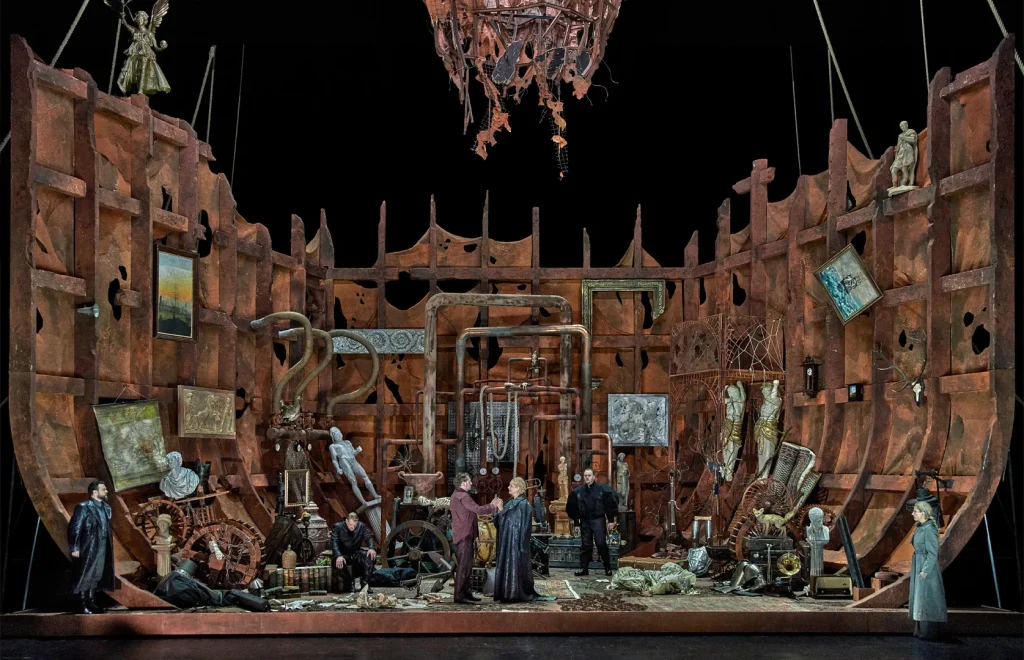
Festspielhaus, Bayreuth, 10 August 2025
Richard Wagner: Tristan und Isolde
In a letter to Franz Liszt from December 1854, Wagner wrote about his fascination with Schopenhauer’s philosophy and the conception of Tristan und Isolde:
“Never in my life having enjoyed the true happiness of love I shall erect a memorial to this loveliest of all dreams in which, from the first to the last, love shall, for once, find utter repletion. I have devised in my mind a Tristan und Isolde, the simplest, yet most full-blooded musical conception imaginable, and with the ‘black flag’ that waves at the end I shall cover myself over – to die.”
However you look at it, Tristan und Isolde is an intensely passionate love drama, in which the longing for death is really a longing for eternal union. It is striking, then, that in the past decade so many directors have all but sterilized the opera emotionally. Is it now out of fashion to show passionate love? Or is it simply a fear of seeming hopelessly clichéd and showing too little intellect? Thorleifur Örn Arnarsson’s 2024 staging in Bayreuth follows that trend, with a vague, unfocused reading of the love story, no clear direction in the protagonists’ movements – Isolde remains in almost one spot on stage throughout the entire first act – and no sense of character development. Instead, it is the set design (by Vytautas Narbutas) that provides what narrative there is: beginning on the deck of a ship, moving into its rusty interior – filled with antiques – and ending there as a wreck. Frankly, I found Roland Schwab’s production of Tristan und Isolde, performed in Bayreuth for only two seasons and which I saw two years ago, more convincing, even if it had its own questionable aspects.
The Finnish soprano Camilla Nylund has had a long and fairly successful Wagner career, and I heard her debut as Isolde in Zurich in 2022. Now, in addition to possessing solid technique and a well-balanced vibrato, she offers a fine interpretation of the role with her elegant soprano. I must admit, however, that for Isolde her voice is better suited to smaller auditoriums, such as the Opernhaus Zürich.
I have been listening to Andreas Schager for a decade, and every time I hear him, I ask myself, “How many more years will he be able to sing like this?” Yet his bright, metallic Heldentenor voice still shines with infinite power. Having said that, I personally prefer a darker tone for Tristan, as this gives the role a completely different psychological depth. Schager’s voice, however, is ideal for the roles of Siegfried and Tannhäuser.
Günther Groissböck sang King Marke’s monologue with great expression and temperament, sounding more furious than sorrowful over Tristan’s betrayal. Ekaterina Gubanova gave an excellent performance as Brangäne, with a steady and expansive mezzo voice.
I honestly don’t think you could assemble a much better cast for Tristan und Isolde in 2025. Yet despite that, the performance never truly took off, largely due to Semyon Bychkov’s overly careful – even disheartened – reading of the score. The intoxicating power of this marvellous work was completely lost in his four-hour marathon in mezzoforte, without passion or risk-taking.